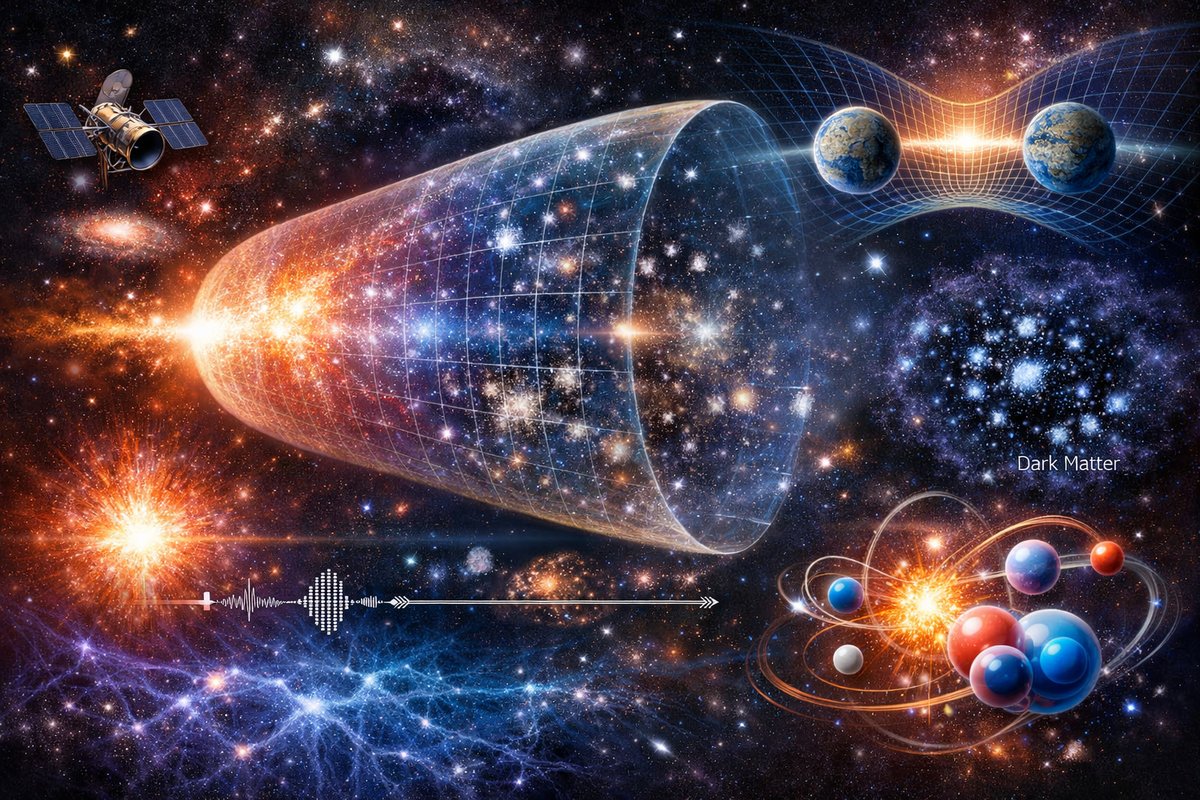

The quest to understand the universe’s origin has entered a new era, fueled by cutting-edge observations and refined theoretical models. In recent months, space telescopes have peered deeper into the cosmos than ever before, detecting faint glimmers of galaxies forming mere hundreds of millions of years after the Big Bang. Meanwhile, ground-based experiments are probing the cosmic microwave background with unprecedented precision, seeking the telltale ripples of primordial gravitational waves.
At the heart of this renewed drive lies the goal of stitching together a coherent narrative of the universe’s birth. The prevailing Big Bang framework describes a hot, dense state around 13.8 billion years ago, followed by rapid inflation-a fleeting burst of superluminal expansion. This scenario elegantly addresses puzzles like the horizon problem (why regions far apart share the same temperature) and the flatness problem (why the universe appears spatially flat). Yet, the details of inflation remain elusive, with a zoo of competing models vying for experimental validation.
Recent deep-field surveys conducted by advanced infrared observatories have revealed galaxies glowing in starlight barely 800 million years after the Big Bang. These fledgling systems challenge previous expectations about how quickly stars and heavy elements assembled. Spectroscopic analysis indicates unexpectedly mature chemical signatures, suggesting that star formation may have ignited even earlier or proceeded more vigorously than models predicted. Such findings force theorists to revisit assumptions about the behavior of dark matter halos and the rate at which gas cooled and condensed into the first stellar nurseries.
Meanwhile, observations of the cosmic microwave background (CMB)-the ancient afterglow of the Big Bang-are providing a complementary window into the early universe. High-resolution maps of CMB temperature and polarization fluctuations, produced by balloon-borne detectors and ground-based arrays, have refined key cosmological parameters. The density of ordinary matter, dark matter, and dark energy are now constrained to tenths of a percent. But perhaps most tantalizing is the hunt for a faint B-mode polarization pattern, a signature of primordial gravitational waves generated during inflation.
The detection of B-modes would constitute a landmark discovery, confirming that quantum fluctuations in the fabric of space were magnified to macroscopic scales. A few years ago, one research team reported a possible B-mode signal, only to trace it later to interstellar dust contamination. That setback underscored the challenge of separating cosmic signals from local foregrounds. Today, next-generation observatories with multi-frequency detectors aim to disentangle these effects, bringing us closer to a definitive measurement of inflation’s energy scale.
Beyond these core questions, other paradoxes continue to confound cosmologists. The nature of dark matter remains one of the most profound mysteries. While its gravitational influence is clear-from galaxy rotation curves to large-scale structure-its particle identity remains hidden. Weakly Interacting Massive Particles (WIMPs) and axions are among the leading candidates, but decades of direct-detection experiments have yet to yield conclusive evidence. In response, researchers are exploring novel detection strategies, from ultra-cold resonant cavities to ultra-sensitive underground detectors shielded from cosmic rays.
Another pressing puzzle is the matter-antimatter asymmetry. In principle, the Big Bang should have produced matter and antimatter in equal measure, which would annihilate and leave only radiation. Yet the observable universe is overwhelmingly dominated by matter. Experiments at high-energy accelerators and neutrino observatories are testing whether subtle violations of fundamental symmetries in particle interactions could tip the balance toward matter, offering a microscopic explanation for this cosmic imbalance.
The interplay between observational breakthroughs and theoretical advances has led to a rich tapestry of insights-but also to new questions. If inflation theory holds, what field or mechanism drove that explosive expansion? Some proposals invoke a scalar field similar to the Higgs boson, while others appeal to exotic high-energy physics beyond the Standard Model. Proposed space missions aim to measure the CMB’s spectral distortions at ultra-fine levels, which could reveal energy injections from decaying particles or cosmic strings formed in a primordial phase transition.
On another front, numerical simulations are reaching previously unattainable scales, modeling the growth of structure from the subatomic realm to cosmic filaments hundreds of millions of light-years long. These large-scale computations require supercomputers capable of performing trillions of operations per second. They incorporate both classical gravity and quantum field effects, exploring how tiny quantum ripples in the earliest instants seeded the vast cosmic web of galaxies and voids.
Public engagement with these findings is growing, as immersive planetarium shows and interactive simulations bring the early universe to life. Virtual-reality experiences allow users to fly through simulated expanses of primordial gas, dodging shock waves from explosive starbursts. Educational outreach programs are leveraging these tools to spark curiosity in the next generation of scientists, emphasizing that the story of cosmic origins is still unfolding.
Yet for all this progress, the big picture remains incomplete. No single theory has achieved universal acceptance, and key experiments are still in the planning or construction phases. The photograph of the very first light echoes-gravitational waves from inflation-remains elusive. The identity of dark matter continues to evade capture. And the quantum mechanisms that may have governed the universe at the Planck scale lie beyond our current experimental reach.
Still, the scientific community is optimistic that the coming decade will be a golden age for early-universe research. Proposed missions to place telescopes far beyond Earth’s atmosphere, free of thermal noise and atmospheric distortions, could extend our vision to the cosmic dawn. New ground arrays will push the limits of sensitivity for CMB polarization measurements. Particle physics experiments underground and at the highest accelerators will probe symmetry violations and rare decay processes with refined precision.
These endeavors underscore a broader truth: the origin story of the universe is not a closed chapter but an open invitation. Every new clue prompts fresh questions, and every paradox drives innovation in both technology and theory. As we refine our models of the Big Bang, inflation, and the emergence of structure, we also gain deeper insights into the fundamental nature of reality-how space, time, and matter interweave to create the tapestry of existence.
In the end, humanity’s journey to the beginning is as much about probing external reality as it is about exploring our own capacity for wonder and discovery. The forces and particles that shaped the cosmos billions of years ago continue to shape our curiosity today, inspiring us to look upward and ask: how did everything begin, and what might lie beyond the horizon of our imagination?
-
MMAXZ Astronomical Telescope Equatorial Mount,Profession 90mm ...
Buy MMAXZ Astronomical Telescope Equatorial Mount,Profession 90mm Refractor Telescope for Beginners,1000mm Focal Length Telescope,with Adjustable Tripod: ... -
Through the Telescope: A Guide for the Amateur Astronomer ...
And thanks to this revised and thoroughly updated new edition by astronomer and science writer, Patricia Barnes-Svarney, anyone with an interest can delve into ... -
Home Planetarium - Amazon.com
13 in 1 Star Projector Galaxy Light, Ceiling Night Light Milky Way Mood Lighting with Timer, LED Space Galaxy Lamp Bedroom Room Decor for Adults Kids - White -
SVBONY SV112 Telescope Camera Adapter Kit for Canon EOS ...
SVBONY SV112 Telescope Camera Adapter Kit for Canon EOS Rebel SLR DSLR Prime Focus and 1.25 inches Variable Projection Eyepiece Astrophotography. -
82" Tall Camera Tripod Heavy Duty with Phone Holder, Victiv ...
【Adjustable Height Range】 Extend from 23.5 inches to 80 inches (short column heighten), the legs are designed with flip locks for quickly height adjusted. -
Cosmos: A Spacetime Odyssey - Amazon.com
Hosted by renowned astrophysicist Dr. Neil deGrasse Tyson, this thrilling, 13-part adventure will transport you across the universe of space and time, bringing ...