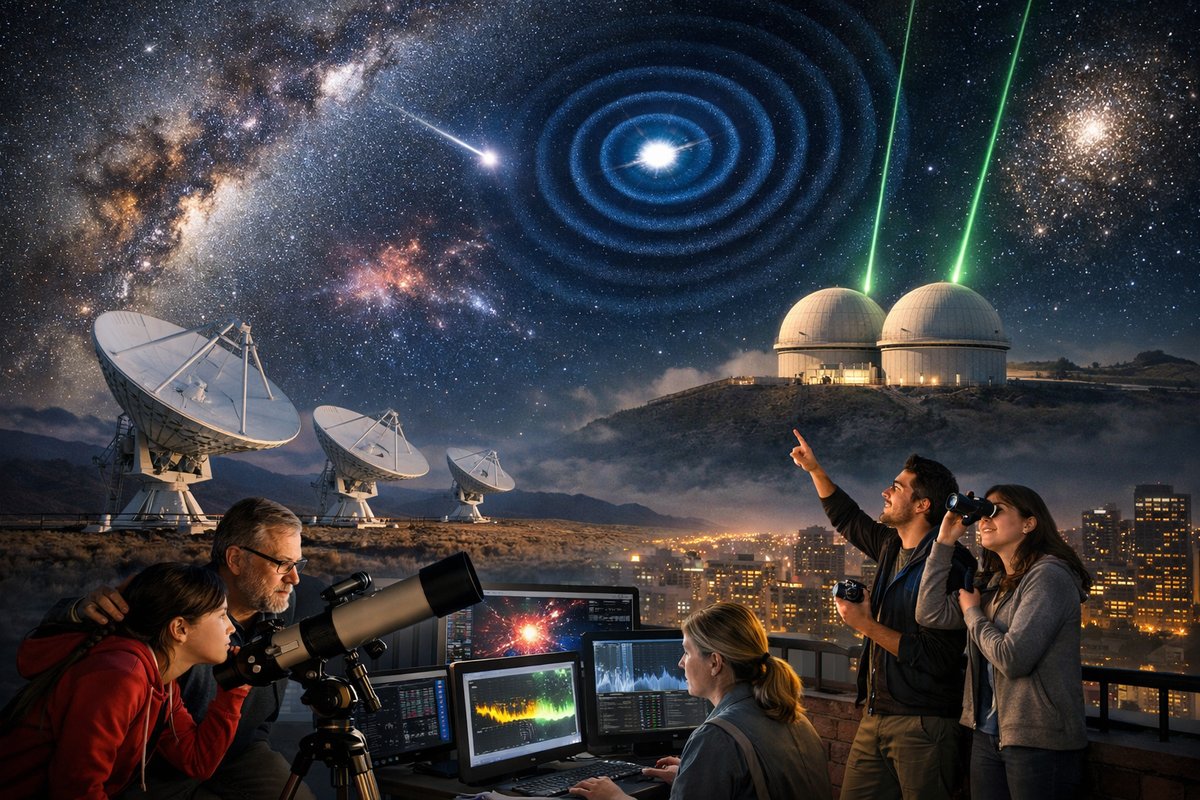

In recent months, a cascade of cosmic revelations has captured the public imagination: ultra-sensitive radio arrays mapping interstellar gas, gravitational wave detectors tuning in to distant black hole mergers, and next-generation sky surveys unveiling billions of stars in unprecedented detail. Together, these breakthroughs have kindled a resurgence of cosmic curiosity that feels as boundless as the universe itself. From bustling urban observatories to quiet rural backyards, stargazers of all stripes are collecting data, sharing findings and helping to unlock the secrets of space and time.
At the heart of this renaissance lies a constellation of cutting-edge instruments now coming online around the globe. A network of ground-based radio telescopes stretching across continents has begun to piece together the faint whispers of hydrogen atoms in intergalactic space. Meanwhile, gravitational wave stations-once confined to dry technical reports-now make headlines as they detect ripples from neutron star collisions. And a new optical sky survey, powered by artificial intelligence, has already flagged surprising patterns among nearly ten billion individual light sources.
What makes this wave of discovery especially compelling is the growing involvement of citizen scientists. Amateur astronomers are no longer limited to casual sky-watching; many now contribute real data to global research projects. A suite of web platforms lets volunteers classify galaxy shapes, flag transient events like supernovae, and even help triangulate the position of a newly detected black hole merger. In some cases, a backyard telescope has provided the crucial first sighting that prompted follow-up observations with major observatories.
In a suburban neighborhood outside a major city, a group of high school students meets every week on a rooftop terrace equipped with a pair of Dobsonian reflectors and a smartphone-to-eyepiece adapter. They recently spotted an unexpected flare from a distant variable star and reported their findings to an online forum. Within days, a professional observatory scheduled time to investigate, turning a student discovery into a deeper scientific study. ”It’s thrilling to know that our small telescope can play a part in real astronomy,” says one student, eyes bright with excitement.
Beyond direct contributions to research, the newfound enthusiasm is reshaping public spaces and educational programs. Science centers are hosting monthly ”astronomy hackathons,” where participants collaborate on data-analysis challenges using publicly released datasets. Cities have begun installing communal telescopes in parks, with guided viewings led by astronomers and storytellers who weave cosmic history into their presentations. Even planetarium shows have taken a DIY turn, sharing open-source software that lets viewers conduct virtual space missions in real time.
These shifts come at a time when humanity faces profound questions about its place in the universe. Fresh inquiries into dark energy, the nature of dark matter and the earliest moments after the Big Bang demand ever more precise measurements. Next-generation space observatories-designed to scan the sky in infrared, ultraviolet and X-ray wavelengths-are on the way. They promise to reveal the structure of distant galaxies, trace the evolution of cosmic dust and probe the atmospheres of worlds beyond our solar system. Yet for all their sophistication, these instruments rely on a broad community of observers, data scientists and curious minds to interpret the flood of information.
The economic and cultural impact of this cosmic awakening is spreading beyond academic circles. Telescope sales have surged, with astronomy retailers reporting double-digit growth in consumer and educational models. Virtual reality experiences that let users ”ride” along gravitational waves or ”fly” through a simulated interstellar nebula have found niche followings. Even in the world of art, cosmic motifs are enjoying a revival-from abstract sculptures inspired by galaxy clusters to interactive installations that respond to live telescope feeds.
At the same time, the drive to explore carries growing ethical considerations. Light pollution from expanding cities threatens to drown out faint celestial signals. The construction of giant observatories in ecologically sensitive regions has sparked debates about land use, cultural heritage and environmental stewardship. Observers are urging local governments to adopt ”dark-sky friendly” lighting policies and work with indigenous communities to respect sacred sites. In response, some astronomy organizations now tie public outreach efforts to conservation initiatives, teaching stargazers how to minimize their impact while maximizing their view of the night sky.
Meanwhile, educators are seizing the moment to rethink science curricula. Instead of mere classroom lectures, students are invited to participate directly in data collection and analysis. Coding workshops teach budding astronomers how to sift through raw telescope data using machine-learning tools. Collaborative online portals allow learners from different continents to compare night-sky images and crowdsource the discovery of new cosmic phenomena. ”It’s not about memorizing facts, it’s about engaging with real science,” notes a physics teacher who recently launched a pilot program partnering her class with an urban observatory.
This broader engagement is reshaping the public’s relationship with science. No longer confined to specialized journals or lecture halls, astrophysical research is becoming a shared cultural experience. Social media channels dedicated to astronomy have seen subscriber counts skyrocket as users post time-lapse videos of meteor showers, detailed sketches of lunar craters and livestream events from remote observatories. These platforms foster lively discussions, from amateur comparisons of telescope setups to deep dives into theoretical questions about cosmic inflation.
In the coming year, several milestones loom on the horizon. A new all-sky survey telescope will begin scanning vast swaths of the sky each night, searching for transient phenomena like supernovae and near-Earth asteroids. The next generation of gravitational wave detectors promises tenfold gains in sensitivity, making it possible to ”hear” events from earlier in cosmic history. And plans are advancing for Earth-based cosmic microwave background experiments that could map temperature fluctuations with sub-microkelvin precision.
Yet perhaps the most profound implication of this moment lies not in any single discovery, but in the collective spirit it embodies. From seasoned researchers to weekend skywatchers, people are rediscovering the joy of looking upward and questioning the grand tapestry of existence. The universe, once perceived as an abstract backdrop, has become a playground for collaboration, creativity and wonder.
As citizen scientists log their first observations, and as professional teams decode signals from the furthest reaches of space, a new chapter in human exploration is unfolding. It’s a chapter written in the language of light, gravity and electromagnetic echoes-yet composed by countless hands, each guided by curiosity. In this stargazing renaissance, every viewpoint counts, every question matters, and the next cosmic breakthrough may come from the most unexpected corner of our shared sky.