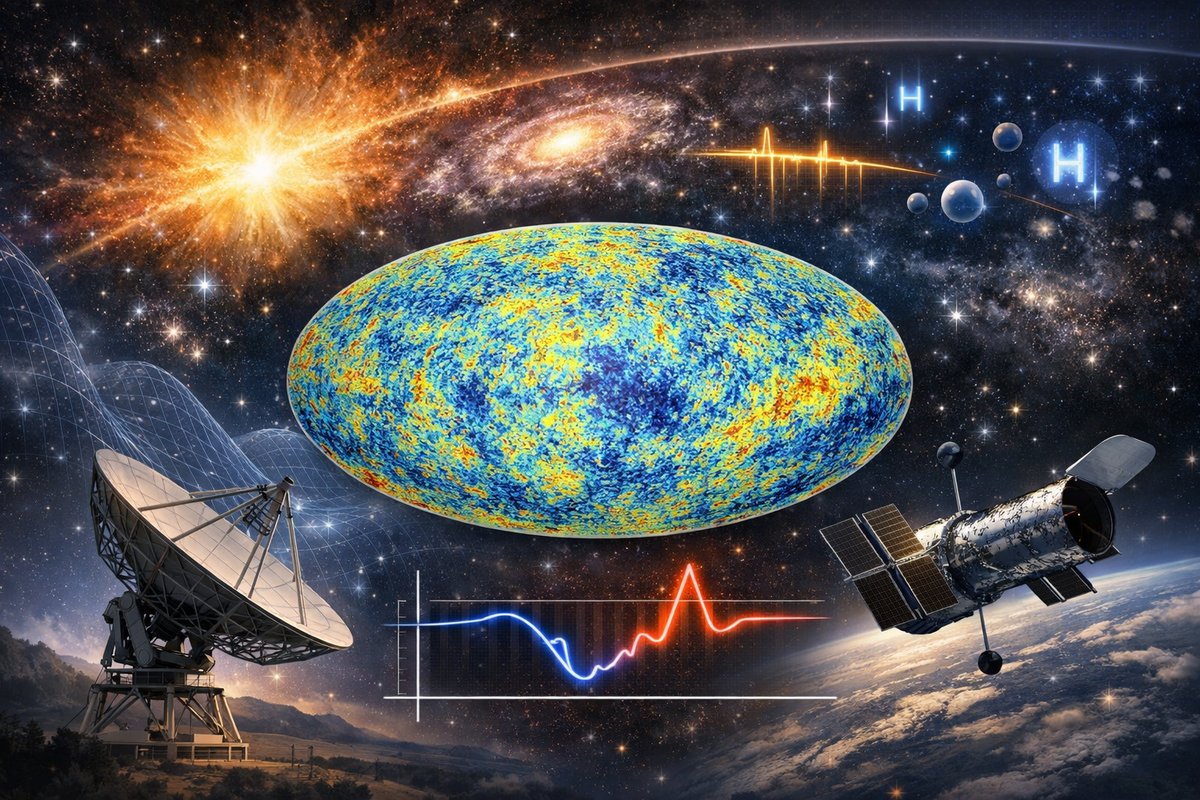

Late last month, a global collaboration of cosmologists unveiled the first results from an ambitious joint analysis of cosmic microwave background (CMB) measurements and radio observations of the hydrogen 21-centimeter absorption feature. By combining high-precision data from ground-based telescopes with spaceborne observations, researchers have identified subtle anomalies that appear to depart from the predictions of the simplest inflationary models. These findings are generating excitement and healthy skepticism within the scientific community, as they open new avenues to probe the universe’s infancy just fractions of a second after the Big Bang.
Researchers focused on two key datasets. The first is a reprocessed map of the CMB’s temperature and polarization patterns, refined by the latest corrections for galactic foregrounds and instrumental systematics. The second comes from deep radio surveys that target the global absorption trough created by neutral hydrogen during cosmic dawn, a period when the first atoms began to coalesce into protogalaxies. By overlapping these lines of evidence, the team explored whether any coherent deviations emerge at angular scales corresponding to the universe’s horizon at inflationary energies.
Lead author Dr. Anjali Rao explained that the collaboration’s strength lies in cross-validating signals across entirely different observational regimes. “CMB surveys reveal the universe at about 380,000 years old, but 21-centimeter observations probe even earlier phases, down to a few hundred million years after the Big Bang,” she said. “By weaving these threads together, we can test whether primordial fluctuations evolved as expected or if there are hints of exotic physics at play.”
Their analysis revealed two intriguing features. First, a hemispherical power asymmetry in the CMB temperature field appears more pronounced when mapped against the latest polarization data. While previous studies had flagged a mild north-south imbalance, the new results accentuate the discrepancy and suggest a possible departure from perfect statistical isotropy. Second, the depth and timing of the hydrogen absorption trough deviate from theoretical curves by nearly 5 percent-an offset too large to be explained by uncertainties in intergalactic heating or standard astrophysical processes alone.
Both anomalies were first reported independently, but this marks the first time they have appeared in a unified, joint dataset designed specifically to test inflationary consistency. “Individually, each effect might be dismissed as a calibration artifact or a quirk of foreground removal,” noted team member Dr. Luis Ferrer. “But when they line up across independent measurements, we have to take notice.”
These results arrive amid a surge of high-resolution studies into the universe’s structure. The James Webb Space Telescope has already pushed the frontier by capturing some of the earliest galaxies at redshifts beyond 15-objects that began forming less than 300 million years after the Big Bang. Those observations have raised their own puzzles, such as unexpectedly bright star-forming regions that defy conventional models of galaxy assembly. Now, with fresh tension in the inflationary picture, theorists are racing to reconcile all these data points under a common framework.
One proposed path forward is to refine the shape of the inflationary potential, the mathematical function that describes how a hypothetical scalar field drove exponential expansion. By introducing subtle features or additional fields, some models can accommodate hemispherical asymmetries and modified power spectra. Others venture beyond the inflationary paradigm altogether, exploring alternatives like bouncing cosmologies, in which the universe contracts then re-expands, or string theory constructs that replace the initial singularity with a pre-Big Bang phase.
Yet not everyone is convinced that new physics is required. Critics point out that the hydrogen absorption line measurement remains extremely delicate, prone to interference from terrestrial radio sources and uncertainties in the early interstellar medium’s temperature. Similarly, even modest biases in map-making algorithms can amplify perceived CMB asymmetries. Upcoming observations-including the next data release from the CMB Stage-4 experiment and expanded 21-centimeter surveys with the Square Kilometre Array-will be critical to confirm or refute these tantalizing hints.
Meanwhile, laboratories around the world are pushing efforts on the particle-physics front. Experiments aimed at detecting primordial gravitational waves-ripples in spacetime produced during inflation-have steadily lowered their sensitivity thresholds. Until now, no convincing signal has emerged, tightening constraints on the energy scale of inflation. If gravitational waves remain elusive by the end of the decade, theorists may need to revisit the underlying assumptions of single-field inflation models or explore mechanisms that suppress tensor modes.
Beyond theoretical debates and data hunts, these developments carry profound philosophical weight. They confront us with the question of how the cosmos came to be-whether it arose from a simple, smooth expansion or emerged from more intricate, perhaps cyclical, processes. “Understanding the first moments shapes our entire narrative of existence,” reflected Dr. Rao. “Every time we peel back a layer, we’re reminded that the universe still has secrets to tell.”
The collaboration’s findings will be formally presented at the upcoming International Conference on Cosmology and Particle Physics, where peers will have the opportunity to scrutinize the methods and propose refinements. In parallel, open-access code and archived data products have been released to ensure full transparency and enable independent teams to conduct their own analyses.
Looking ahead, the community is gearing up for a new generation of observatories. Planned missions like the LiteBIRD satellite will target CMB polarization with unprecedented precision, while the Hydrogen Epoch of Reionization Array will extend 21-centimeter studies deeper into cosmic dawn. On the ground, the Vera C. Rubin Observatory’s Legacy Survey of Space and Time will chart billions of galaxies, providing a complementary census of large-scale structure that links early fluctuations to present-day clustering.
As this wave of data arrives, theorists anticipate an era of rapid iteration-models will be sharpened, anomalies either resolved or confirmed, and our picture of the primordial universe refined to astonishing detail. Even if the current anomalies fade under closer scrutiny, the exercise itself will raise the bar for precision cosmology and expand the toolkit for probing the cosmos’s ultimate origin.
For curious minds eager to follow these discoveries, publicly available databases and citizen-science platforms offer hands-on entry points. Open-source software suites allow enthusiasts to simulate inflationary scenarios and visualize how tiny quantum fluctuations can balloon into the vast structures we observe today. Museums and planetariums are likewise integrating the latest findings into immersive exhibits that bring the universe’s birth to life in domed theaters.
Whether the anomalies ultimately herald new physics or fall under the umbrella of known processes, the quest to understand the universe’s birth continues to inspire. From the chirps of hydrogen atoms in distant intergalactic gas to the faint polarization patterns imprinted on ancient photons, every clue adds to a tapestry woven across time and space. As we press deeper into that tapestry, one thing is certain: the story of our cosmic beginnings is far from complete, and the next chapter promises to challenge our imaginations all over again.