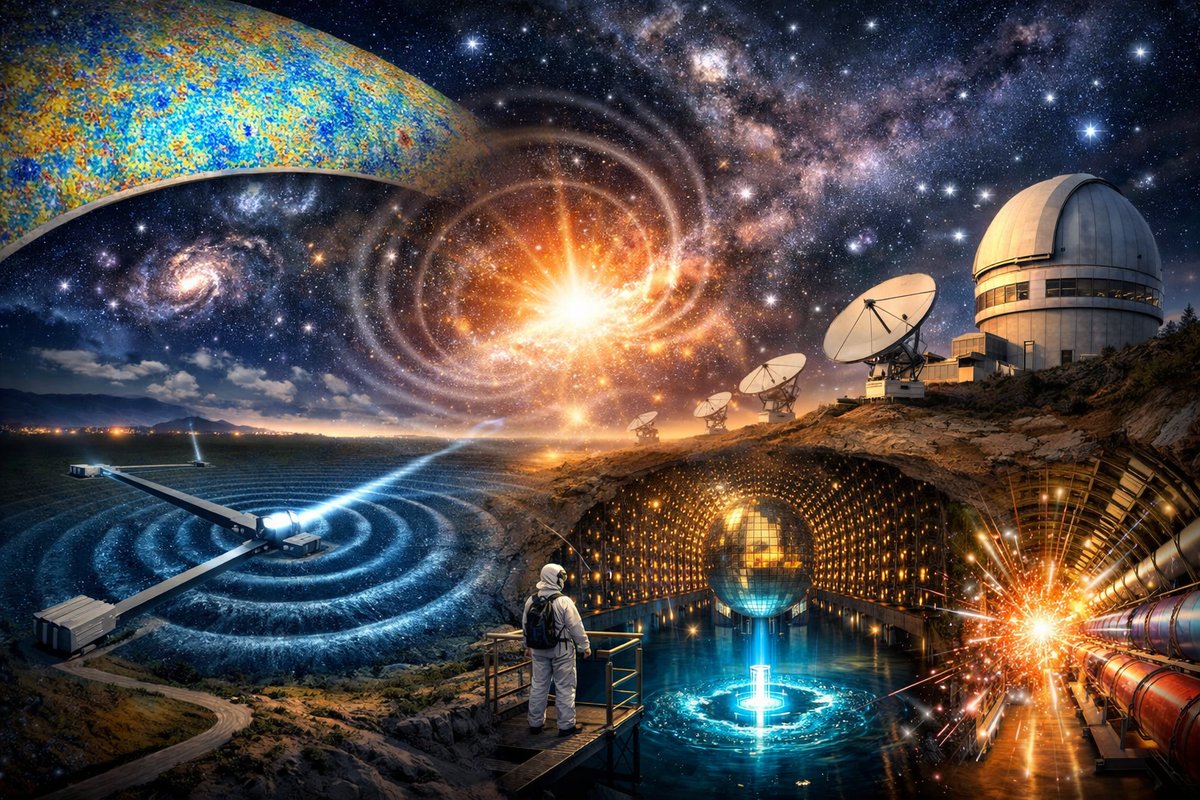

Imagine pointing a sensitive detector not at the stars, but at a whisper-an echo of spacetime’s earliest tremor. That faint resonance, buried in the cosmic microwave background and the subtlest of gravitational waves, may hold the blueprint of the universe’s birth. In recent months, teams operating ground-based sky surveys and underground particle observatories have reported tantalizing hints that our familiar cosmos emerged from a quantum froth far more intricate than classical theory predicted.
At a high-altitude telescope in the Andes, a new analysis of polarization patterns in the cosmic microwave background (CMB) has revealed irregularities at scales smaller than ever mapped. These “B-mode” distortions could be the imprint of primordial gravitational waves-ripples generated during an inflationary epoch when space itself expanded faster than light. While earlier balloon experiments suggested such patterns decades ago, the latest data combines observations from multiple sites to reject most known sources of noise. The result is a sky map so detailed that it suggests inflation may have been driven by a more complex field than the simplest models allow.
Meanwhile, half a world away, underground neutrino detectors originally designed to track ghostly particles from the sun have turned their attention to antineutrinos emitted in the first second after the Big Bang. By sifting through a deluge of background events, scientists are zeroing in on a slight imbalance between matter and antimatter that could explain why our universe coalesced into galaxies and stars instead of evaporating into pure radiation. Early reports indicate this asymmetry is larger than long-standing models predicted-pushing theorists to explore new interactions beyond the familiar forces of electromagnetism and gravity.
Adding another layer to the puzzle, the latest results from collaborative runs at gravitational wave observatories have hinted at a stochastic background-a diffuse hum created by the overlap of primordial gravitational waves. If confirmed, this low-frequency murmur would represent the cosmic equivalent of white noise: the superposition of countless microscopic events from the universe’s first heartbeat. Researchers are using advanced machine learning techniques to separate this ancient hiss from the cacophony of black hole mergers and pulsar signals recorded in recent years.
On the theoretical front, these experimental advances are fueling fresh attempts to unify general relativity and quantum mechanics. Paradoxes that once seemed confined to black hole event horizons-like the information loss problem-are now being revisited in the context of inflationary cosmology. Some physicists propose that quantum entanglement between horizon-sized patches during inflation could entangle the entire cosmos, embedding information correlations that survive even today. Others suggest the early universe behaved like a quantum computer, processing and compressing information in ways that left subtle traces in both the CMB and high-energy particle collisions.
To test these bold ideas, next-generation experiments are taking shape. A consortium of universities has proposed a deep-space mission to map primordial gravitational waves at ultra-low frequencies, far below the reach of Earth-bound observatories. Simultaneously, plans for a new underground neutrino observatory promise to push detection thresholds to record lows. These facilities aim to capture neutrinos from cosmic sources so ancient they predate the formation of the first stars, offering a complementary window into pre-inflation conditions.
Closer to home, high-energy physics labs are gearing up for ambitious collider upgrades that could recreate conditions a trillion times hotter than the sun’s core. By smashing heavy ions at unprecedented energies, researchers hope to glimpse the so-called quark-gluon plasma-a state of matter believed to have filled the universe in its first microsecond. Although this exotic soup has been produced in miniature for years, the planned energy boost could reveal how fundamental forces separated as the cosmos cooled.
Yet with all this cutting-edge technology, fundamental questions linger. What mechanism ended inflation and set the stage for the cosmic tapestry we observe? Did exotic particles flicker into existence only to vanish again, leaving no trace beyond quantum fluctuations? And could alternate universes have branched off at the very instant our own bubble of space-time crystallized? While speculative, these concepts are being translated into concrete mathematical frameworks that can, in principle, be tested against observational data.
Beyond the lab and the observatory dome, these scientific advances are shaping a broader cultural conversation about our place in the cosmos. Public outreach programs have started streaming real-time feeds of sky survey data, inviting amateur stargazers to search for anomalies alongside professional astronomers. Virtual reality experiences allow anyone with a headset to “float” through a reconstructed primordial universe, witnessing the rippling fabric of space in immersive detail. Even educators are weaving the latest discoveries into interactive lesson plans that illustrate how quantum uncertainty gave birth to galaxies.
Such efforts underscore an important reality: exploring the universe’s origins is not just a quest for academic understanding, but a shared human adventure. As we push deeper into the unknown-harnessing telescopes, detectors, and supercomputers-we are compelled to rethink concepts of time, causality, and the nature of reality itself. The echoes from the cosmic dawn may be faint, but they carry the profound message that every star, planet, and particle traces its lineage to a fleeting instant of creation.
The next decade promises even more dramatic revelations. With each new instrument coming online, we inch closer to a cohesive narrative of how the universe emerged from chaos into structure. Whether by decoding the faint polarization of ancient light or by capturing neutrinos older than Earth itself, scientists are assembling a cosmic origin story of unprecedented clarity. In doing so, we reaffirm a timeless truth: to understand where we came from is to illuminate where we might one day go.