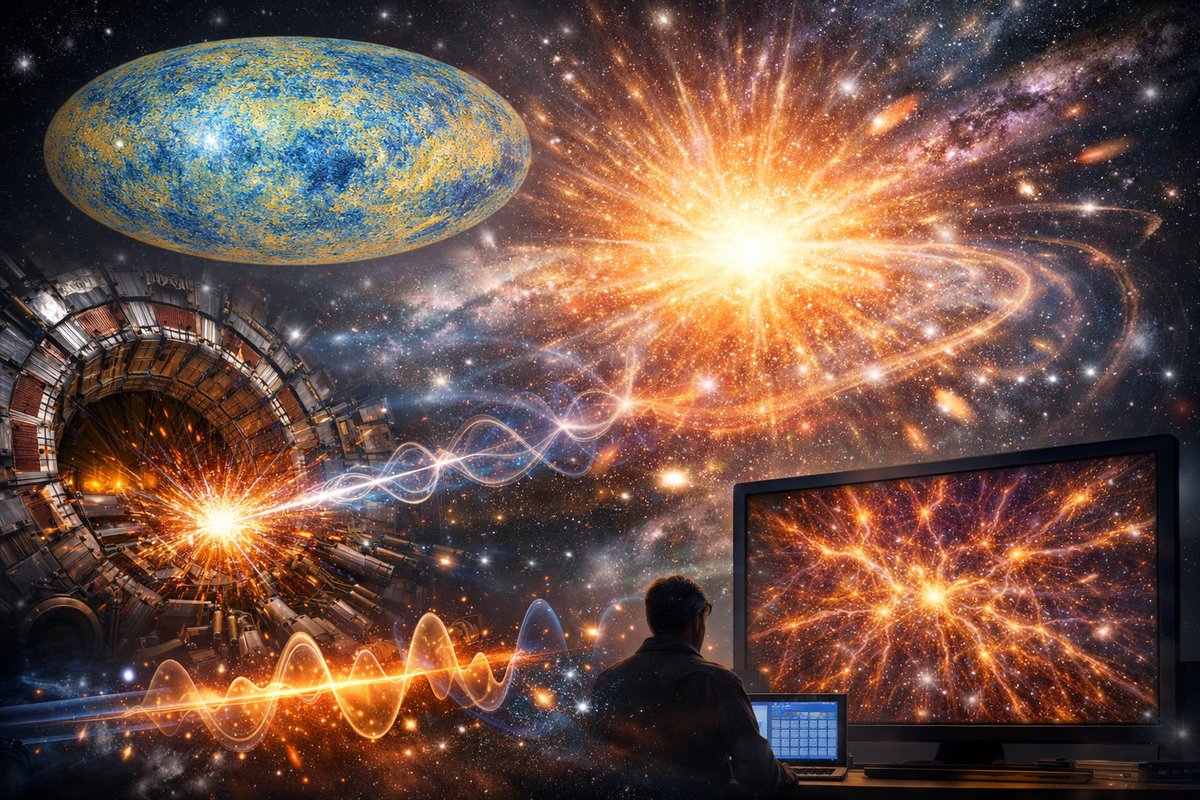

A wave of discoveries is rippling through astrophysics as humans edge closer to decoding the universe’s birth. In observatories perched under pristine skies and labs humming with particle colliders, scientists are triangulating evidence to reconstruct the sequence of events that led from a hot, dense state to the tapestry of galaxies we see today. This emerging picture balances precise measurements of ancient radiation with sophisticated theoretical models-and sometimes, it overturns long-held assumptions.
Recent data from a network of cryogenic sensors aboard high-altitude balloons has revealed previously undetected anomalies in the cosmic microwave background-the faint afterglow of the universe’s infancy. Tiny temperature variations at angular scales smaller than a tenth of a degree hint at exotic processes that could have occurred within fractions of a second after the Big Bang. While standard inflationary models predict a smooth, nearly scale-invariant pattern, these new wrinkles suggest that quantum fluctuations might have left more intricate fingerprints than expected.
Simultaneously, ground-based facilities tuned to pick up gravitational waves are honing their sensitivity to frequencies produced by primordial oscillations in space-time itself. The next generation of detectors, featuring cryogenically cooled mirrors and ultra-low-noise lasers, may be capable of registering the faint tremors generated when quantum fields first underwent rapid expansion. Detecting such a primordial wave background would revolutionize cosmology by directly probing conditions at energy scales far beyond those accessible in particle accelerators.
Speaking of accelerators, researchers have begun leveraging high-intensity beams of protons and heavy ions to recreate fleeting glimpses of the universe’s earliest microseconds. By smashing particles together at near-light speeds, laboratories are generating fireballs with temperatures over a trillion degrees-hotter than the cores of stars-and watching how quarks and gluons interact in that extreme state. These experiments refine our understanding of the quark-gluon plasma, an ephemeral soup thought to dominate the universe shortly after its birth, and feed crucial data back into cosmological simulations.
On the theoretical front, pioneering teams are deploying quantum computers and supercomputing clusters to simulate early-universe phenomena with unprecedented fidelity. Algorithms originally designed for condensed-matter physics now tackle the evolution of scalar fields that drove inflation, exploring scenarios where field interactions produce subtle deviations from standard predictions. Though current quantum hardware remains noisy and limited in scale, proof-of-concept runs are demonstrating that quantum simulation may ultimately reveal hidden dynamics in the universe’s founding moments.
Cross-disciplinary collaborations are accelerating progress. Astrophysicists working alongside computational scientists have developed open-source codes capable of evolving millions of particles across cosmic time, tracing how initial perturbations seed the formation of dark matter halos and galaxies. Meanwhile, teams of experimentalists and theorists are jointly designing new detector materials with lower thermal noise, pushing the boundaries of measurable phenomena.
Large-scale surveys mapping the distribution of galaxies across vast cosmic volumes have uncovered a surprising abundance of mature galaxies at high redshifts-meaning they formed when the universe was less than a billion years old. These ancient structures challenge conventional models of galaxy assembly and suggest that star formation may have ignited earlier and more vigorously than previously thought. Adding to the intrigue, observations of distant quasars show that their supermassive black holes grew to tremendous masses in unexpectedly short times, leaving scientists to ponder whether unknown mechanisms accelerated their growth.
Such findings have profound implications for the nature of dark matter and dark energy. Some theorists propose that interactions among exotic dark-matter particles could heat or cool early gas clouds, influencing the timeline of star birth. Others suggest that a dynamic form of dark energy-one that evolves over cosmic epochs-might subtly alter the rate of cosmic expansion, leading to anomalies in large-scale structure formation. Testing these ideas requires more precise measurements of galaxy clustering and cosmic expansion at multiple epochs, which in turn depends on advanced instrumentation and sustained observational campaigns.
Yet the path forward is not without challenges. Building and maintaining ultra-sensitive telescopes and detectors demands cutting-edge engineering, rigorous calibration, and secure funding across multiple agencies. Data volumes from next-generation observatories will soar into the exabyte range, placing immense pressure on data storage, retrieval systems, and analysis pipelines. Teams are racing to apply machine learning techniques to sift through petabytes of images and sensor readings, tagging patterns that could point to rare cosmic events or new physics.
Infrastructure improvements extend beyond hardware. Global consortia are standardizing data formats and sharing protocols to ensure that measurements from different facilities can be combined seamlessly. Open-data initiatives are inviting citizen scientists to examine sky surveys for transient phenomena-such as supernovae or gravitational-wave counterparts-while educational platforms use interactive simulations to bring cosmic evolution to students around the world.
Public engagement has surged as a result of these collaborative efforts. Planetariums and science centers are updating their programs to include the latest hypotheses about the universe’s first milliseconds. Virtual reality experiences let visitors wander through virtual universes and watch galaxies take shape from primordial density ripples. Meanwhile, documentary filmmakers and podcasts have captured popular interest by dramatizing the scientific detective work that underpins cosmic origin research.
Looking ahead, an array of ambitious missions promises to extend these breakthroughs. Space-based telescopes operating at millimeter and submillimeter wavelengths will map the microwave background with finer resolution and broader sky coverage. A new fleet of gravitational-wave observatories-both terrestrial and orbital-will scour the low-frequency band for echoes of inflation. Neutrino observatories buried deep under ice or water may detect high-energy particles born in primordial phase transitions.
These endeavors collectively represent humanity’s quest to answer a question as old as wonder itself: How did the universe begin? As each experiment pushes deeper into uncharted territory, and each simulation grows more detailed, researchers edge closer to stitching together a cohesive narrative that spans the quantum, the cosmic, and everything in between. Though uncertainties remain-and debates will undoubtedly continue-the momentum of discovery suggests that the cosmic dawn is no longer beyond our reach but is instead a frontier illuminated by ingenuity, collaboration, and relentless curiosity.
Exploring the origin story of existence demands instruments built for extremes, minds open to the unknown, and sustained dialogue between experiment and theory. In the years to come, the fusion of high-precision observations, laboratory breakthroughs, and advanced simulations may finally unveil the forces and particles that orchestrated the universe’s grand overture.