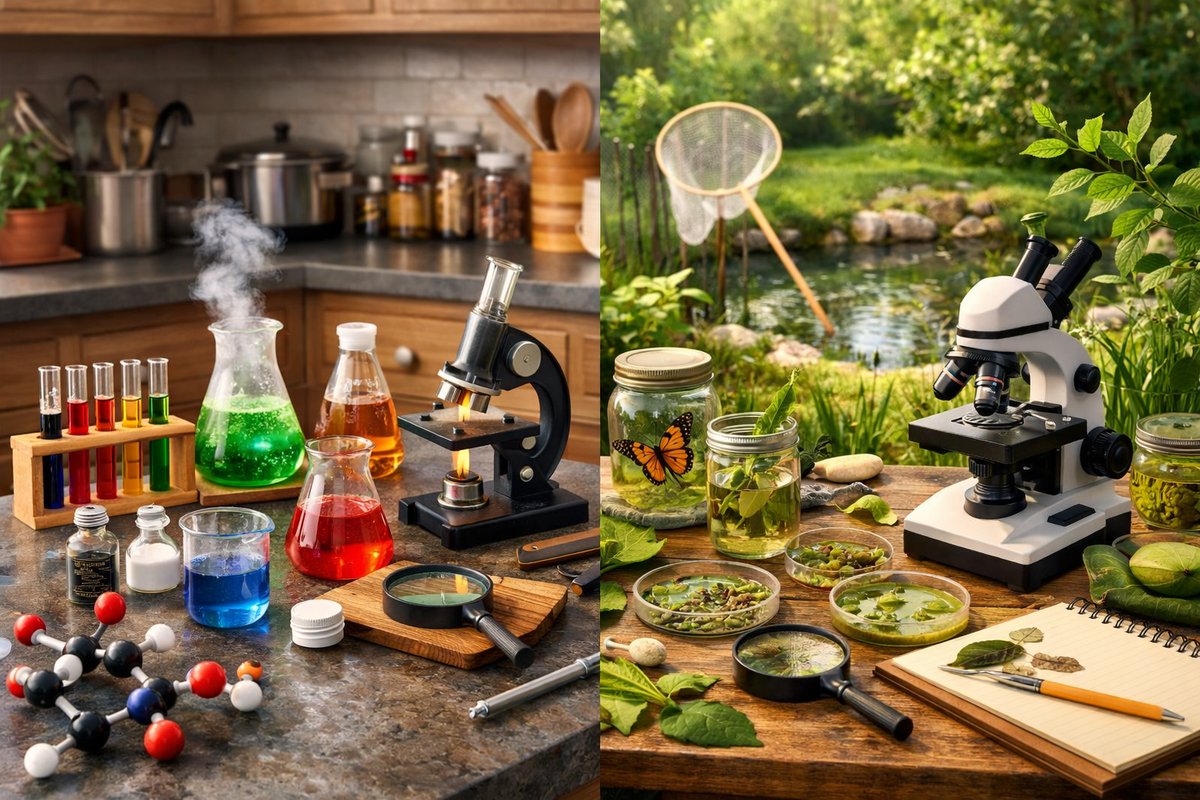

Science isn’t confined to sterile laboratories or towering research institutions. It lives in the drip of a leaky faucet, the color change of a tea bag in hot water, and the patterns of sunlight dancing through a prism. By reshaping familiar spaces into mini-laboratories, everyday explorers can uncover principles that have shaped our understanding of matter, energy, and life itself. This article lays out a roadmap to create a flexible science workspace, suggests approachable experiments, and shares strategies for documenting discoveries with clarity and enthusiasm.
First, consider your workspace. A sturdy table, good lighting, and an organized layout are your foundation. Keep a small caddy of essential tools-measuring spoons, test tubes or small glass jars, pipettes or droppers, and a basic digital timer or stopwatch. Store dry reagents like baking soda, citric acid, salt, sugar, and pH strips in clearly labeled containers. A magnifying glass or inexpensive handheld microscope helps bring tiny textures and patterns into focus. Don’t overlook safety: protective goggles and gloves are a nonnegotiable part of a well-run science playground.
Next, cultivate a mindset of open-ended inquiry. Rather than following rigid instructions, pose questions about everyday phenomena. Why does dough rise? How quickly does salt dissolve in water at different temperatures? What happens to the structure of an egg shell when exposed to vinegar? Formulate a hypothesis-an informed guess-then design a simple run of trials. Keep variables controlled: change only one factor at a time, record observations precisely, and repeat experiments to ensure reliability.
One of the most rewarding arenas for home inquiry is chemistry. A classic demonstration involves acid-base reactions. Mix a teaspoon of baking soda into a small cup of water, then slowly add vinegar. Notice the vigorous fizz as carbon dioxide bubbles form. Record the duration and volume of gas released by collecting it under an inverted container in a bowl of water. Try the same with lemon juice or carbonated water-how do different acids compare? Track your results in a lab notebook complete with tables, sketches, and notes on temperature or concentration.
In parallel, physics experiments can be as simple as an inclined plane. Use a board or sturdy book stack to create a ramp, then roll a toy car or small ball down the incline. Measure time, distance, and angle to explore concepts of acceleration, friction, and gravitational force. Plot your data on graph paper or digital spreadsheet to uncover linear or nonlinear relationships. This exercise not only reinforces kinematic formulas but also hones measurement precision and data‐analysis skills.
For budding biologists, the backyard is teeming with specimens. Capture insects under a clear container, then examine their anatomy with a magnifier. Collect water samples from a nearby pond to observe microorganisms under a portable microscope. Press leaves and flowers between sheets of paper to create herbarium specimens that reveal venation patterns and structural diversity. Even a single soil sample can spark multistep investigations-test pH, screen for organic content, and monitor moisture retention over time. Comparing soil from different locations sheds light on environmental variability and ecosystem health.
Citizen science projects offer another avenue to connect local observations with global research efforts. Bird watchers can submit counts to regional monitoring networks. Star gazers can log meteor sightings or track lunar phases. Apps and websites collect these contributions, turning crowd-sourced data into large-scale studies on migration patterns, climate change impacts, and biodiversity trends. By bridging personal experiments with collaborative databases, everyday scientists find deeper purpose and contribute to knowledge that transcends individual laboratories.
Documentation is the bridge from fleeting observations to lasting insight. A well-kept lab notebook includes date, time, list of materials, step-by-step procedures, and clear tables of results. Sketch diagrams with labels and colors to capture structural details. Write reflective notes on unexpected outcomes-sometimes anomalies reveal new questions more exciting than expected results. If you have access to a smartphone or digital camera, photograph setups and key stages of reactions. These visual records become invaluable when sharing findings or revisiting experiments months later.
As confidence grows, so can the complexity of investigations. Try building a simple spectroscope from cardboard and a diffraction grating to separate light into its component colors. Construct a rudimentary seismograph using a weight, string, and pen to trace ground vibrations on a rotating drum. Experiment with hydroponic plant growth by suspending seedlings in nutrient solutions under LED lights. Each new apparatus stretches creativity and engineering skills, turning theory into tangible setups that inspire deeper questions.
Learning in community amplifies motivation. Host a science exchange with friends or family-each participant brings a mini-project to demonstrate. Swap materials, test each other’s hypotheses, and offer constructive feedback. Invite neighbors to an outdoor event showcasing homemade rockets, chemical gardens, or optical illusions. Sharing the thrill of discovery builds enthusiasm and sparks ideas that might otherwise remain tucked away in solo pursuits.
Over time, this habit of playful inquiry fosters more than just knowledge of equations and protocols; it cultivates resilience, adaptability, and the joy of lifelong learning. When a failed reaction leads to a new hypothesis or an unexpected data pattern reveals a hidden variable, the process of troubleshooting becomes as valuable as the final results. These transferable skills-critical thinking, problem-solving, and clear communication-prepare explorers for challenges far beyond petri dishes and test tubes.
The beauty of an everyday science playground is its scalability. A single cardboard prism can spark hours of questioning about color perception and optical physics. A dropper of colored water can lead to investigations on diffusion and membrane permeability. A discarded plastic bottle becomes a terrarium or an anemometer. By keeping the bar for entry low and the scope of exploration high, this approach invites anyone-regardless of background or age-to become an investigator in their own home or neighborhood.
No special license or degree is required to ask questions and seek answers. All you need is curiosity, a pinch of resourcefulness, and a willingness to record and reflect. The world brims with mysteries waiting to be unraveled: Why do soap bubbles form spheres? How does crystallization produce intricate snowflake-like patterns? What hidden organisms flourish in the soil beneath your feet? Every observation is a step toward understanding the complex tapestry of interactions that govern life and matter.
Science in everyday life is more than a set of facts-it’s a mindset that cherishes evidence, embraces uncertainty, and delights in discovery. By transforming familiar spaces into experimental stages, maintaining careful records, and sharing findings with a community of fellow explorers, you cultivate skills that extend far beyond the laboratory bench. Whether your next breakthrough is a colorful chemical garden or a precise plot of acceleration data, the experience itself enriches understanding and feeds the boundless curiosity at the heart of all scientific endeavor.