
The late afternoon sun filters through the kitchen window, turning a glass of water into a prism that scatters rainbows across the table. In that moment, a simple act of pouring a drink becomes a physics lesson, an invitation to wonder how light bends and refracts. This is the essence of DIY science: the thrill of exploring universal principles with tools you already own or can easily acquire.
You don’t need a million-dollar particle accelerator or a top-of-the-line sequencing machine to uncover the hidden workings of the world. A few everyday items-mason jars, light bulbs, smartphones, or even your backyard-can become portals to discovery. With the right mindset and a basic set of instruments, curious minds of all ages can experiment, observe, record, and share findings that deepen our understanding of the natural world.
At its core, DIY science embraces four guiding values: privacy, sustainability, curiosity, and emotional intelligence. Privacy allows enthusiasts to explore ideas in a safe, judgement-free zone. Sustainable practices encourage the repurposing of household materials instead of buying single-use plastic kits. Curiosity fuels the questions that propel experiments forward, and emotional intelligence helps us respect living organisms and treat data-and fellow explorers-with care.
In this article, we’ll embark on a journey through kitchen chemistry, backyard astronomy, urban biology, and tinkering with electronics. Each section highlights simple experiments and essential tools that readers can adopt and adapt, whether they’re parents looking for weekend activities, educators seeking hands-on lessons, or lifelong learners chasing new challenges.
A stroll through any home will reveal potential laboratory equipment tucked away in plain sight. Glass jars, measuring spoons, and basic kitchen timers lay the groundwork for experiments in reaction rates, density, and thermodynamics. An old light bulb can demonstrate electrical resistance when paired with alligator-clip wires and a power supply. A smartphone’s camera and flashlight become a microscope and spectrometer when combined with a drop of water and a diffraction grating film.
The kitchen is a science playground for food chemists. Vinegar and baking soda fizz in a mini-volcano demonstration that illustrates acid-base reactions and gas production. Sugar and cream heated in a double boiler teach Maillard browning-why seared meat develops savory flavors. Homemade pectin from apple cores shows how citrus pH influences gel formation in jam. Recording temperature, mass, and pH with a smartphone-connected probe turns a cooking session into a data-driven investigation.
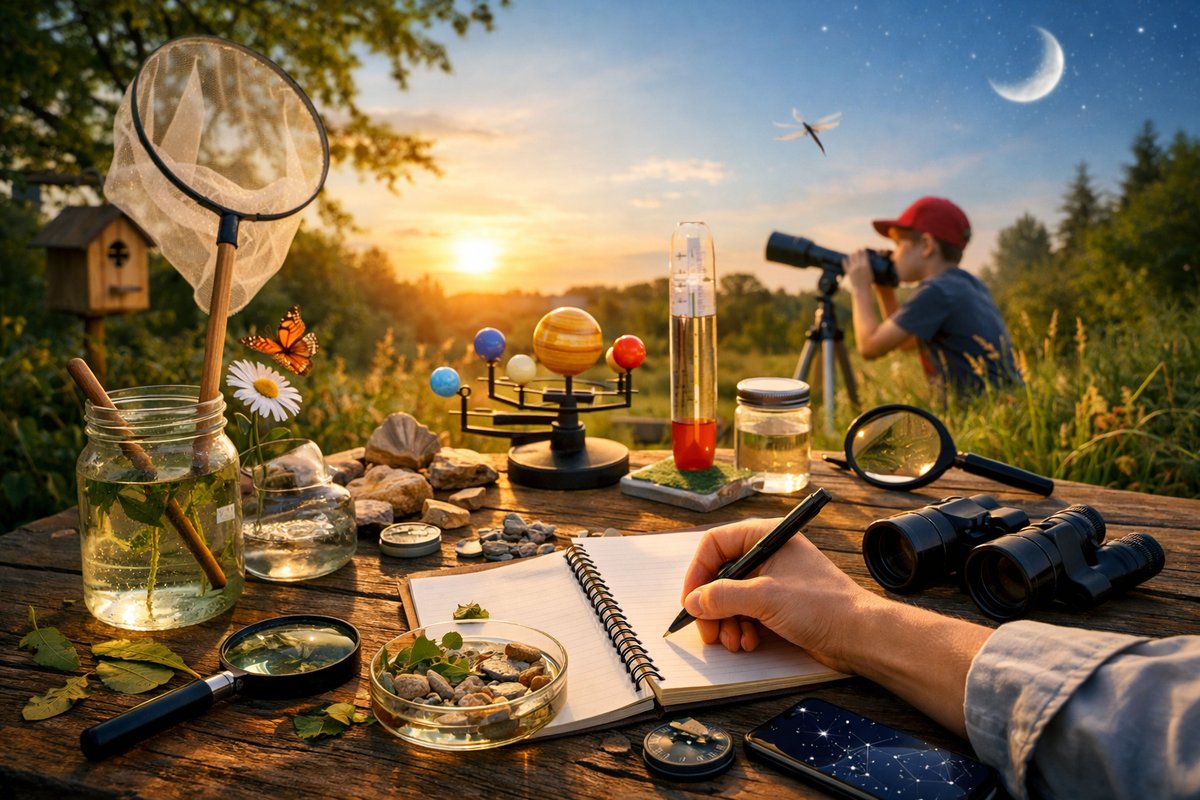
Moving outdoors, the backyard reveals a universe waiting to be charted. A pair of binoculars offers glimpses of bird species, while a simple camera attached to an online platform contributes to citizen-scientist databases tracking migration patterns. As dusk falls, a beginner telescope brings the craters of the Moon, Jupiter’s bands, and the rings of Saturn into crisp view. Even without high magnification, star-charting apps help you identify constellations and log light-pollution measurements for environmental studies.
Urban ecology experiments show that city streets teem with life. With a petri dish and agar gel, you can swab sidewalk surfaces to cultivate microbial colonies, revealing the invisible ecosystems underfoot. Using test strips, you can measure nitrogen and phosphates in standing puddles or garden beds, learning how runoff and fertilizers affect local waterways. These projects underscore the connection between human activity and environmental health, empowering participants to design sustainable solutions.
Tinkering with electronics bridges the gap between abstract theory and functional design. A breadboard, jumper wires, LEDs, resistors, and a microcontroller open endless possibilities. You could build a soil-moisture sensor that sends data to your phone or a light-tracking robot that follows a lamp’s beam. Applying Ohm’s law to calculate current flow, writing simple code in a block-based environment, and debugging hardware failures all sharpen problem-solving skills and demystify the gadgets we rely on daily.
These individual pursuits are part of a broader movement: community-powered science. Online forums, local makerspaces, and school clubs bring together collaborators who swap protocols, share results, and coauthor blog posts or conference presentations. Privacy settings ensure individuals can protect sensitive data or intellectual property, while open-source platforms foster sustainable knowledge growth. Emotional intelligence is vital here-respectful communication, proper attribution, and ethical treatment of living subjects maintain trust and safety.
If you’re ready to design your first project, start by defining a clear question: How does sunlight intensity change under different colored lenses? How quickly does fruit juice ferment at room temperature? What microbes colonize the surface of your favorite park bench? Next, list the materials you’ll need-many can be scavenged from discount stores or repurposed from household items. Sketch a protocol with steps for setup, observation, measurement, and cleanup. Finally, document your process in a lab notebook: dates, variables, raw data, sketches, and reflections. A well-kept record transforms casual play into reproducible science.
Creative leaps often emerge when disciplines collide. A musician noticing patterns in wave interference might collaborate with a programmer to model sound propagation in a virtual environment. A gardener experimenting with compost could team up with a chemist to analyze nutrient breakdown rates and design custom fertilizer blends. These crossovers embody the highest aspirations of DIY science: genuine discovery fueled by diverse perspectives and shared resources.
In an era when cutting-edge laboratories tackle genome editing and quantum computing, it’s easy to feel that meaningful science happens only in expensive settings. Yet history is full of breakthroughs sparked by amateurs: the citizen astronomers who charted variable stars, the home biologists who mapped enzyme activity, the tinkerers who improved radio transmitters. Today’s home chemist or backyard observer stands on the shoulders of those pioneers, equipped with affordable tools and global connectivity.
Whether you’re guided by a smartphone app, a paper lab manual, or sheer imagination, the scientific method remains your compass: observe, hypothesize, experiment, analyze, and share. Each cycle refines your understanding and builds confidence to tackle more ambitious questions. Embrace mistakes as data points-failed trials often reveal hidden variables or design flaws, guiding you toward better experiments.
At the heart of DIY science is a sense of wonder. When a 3D-printed probe measures soil moisture in real time, you glimpse the intersection of coding, materials science, and environmental stewardship. When your homemade spectrometer splits sunlight into a spectrum of colors, you appreciate the quantum effects at play. And when community members applaud your pest-monitoring project in an urban garden, you feel the power of collective curiosity.
So gather your jars, lenses, wires, and notebooks. Step into the kitchen, the backyard, or the garage. Record your measurements, sketch your designs, and share your findings with open-source communities. The universe may be vast, but it also fits inside a petri dish, a telescope eyepiece, or the screen of your smartphone. With curiosity as your guide and a few well-chosen tools, the hidden wonders of science become tangible-and every experiment is a step toward deeper understanding and sustainable innovation.