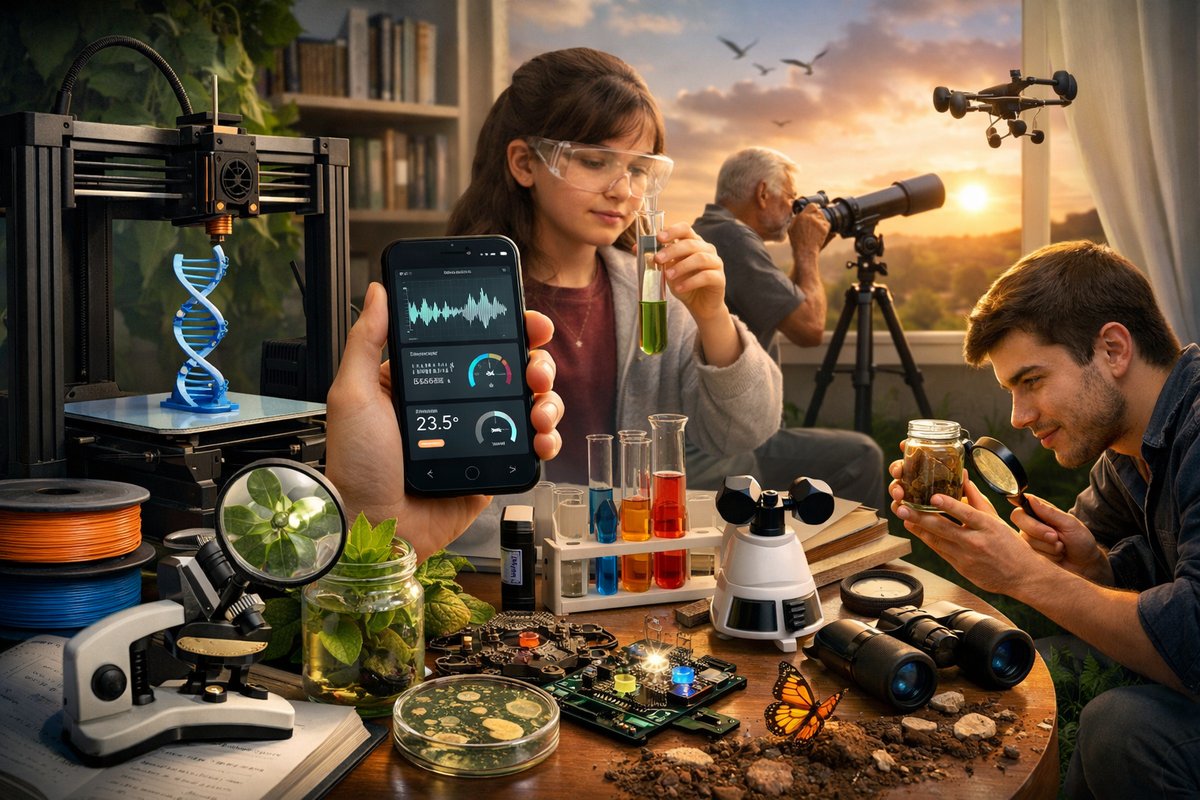

Every time you pick up your smartphone, prepare a meal, or walk through a park, you’re surrounded by instruments and phenomena begging to be explored. Whether you’re measuring the vibrations of a subway tunnel, culturing microorganisms from a backyard pond, or capturing the light fingerprint of household objects, the essence of science is nothing more-and nothing less-than the art of asking questions and using tools to find answers. Today, a growing army of curious minds is turning everyday devices into gateways for hands-on discovery.
Smartphone sensors have become the pocket laboratories of modern exploration. Already fitted with accelerometers, magnetometers, gyroscopes, and light detectors, these devices let anyone conduct physics experiments on the fly. With a simple data-logging app, you can record acceleration as you ride a bicycle down a hill, then plot velocity curves to estimate gravitational acceleration. A DIY compass project might map local magnetic anomalies near power lines, offering insights into urban infrastructure. Even a light sensor can help you measure the sun’s path through the sky, track shadows, and calculate your latitude-all without leaving your front yard.
If magnification sparks your curiosity, a low-cost digital microscope transforms your desktop into a microcosm. Slide a leaf under the lens and witness stomata-tiny pores through which plants breathe. Examine pond water to see protozoa darting like microscopic dancers. Schools, hobbyists, and small labs are embracing plug-and-play USB microscopes that pair with open-source imaging software, enabling photo capture and time-lapse videos. This marriage of affordability and power has put microbiology and material science at the fingertips of anyone with a computer.
Meanwhile, makerspaces and home workshops are democratizing fabrication. Desktop 3D printers spit out plastic gears, custom mounts, and even entire lab jigs in a matter of hours. Enthusiasts download free designs for spectrometer housings, pipette stands, or microfluidic chips. With a spool of filament and basic calibration, these printers bring prototyping costs down by orders of magnitude, blurring the line between science hobby and laboratory research. Collaborative platforms host design files, encouraging iterative improvements and peer-to-peer sharing of experimental hardware.
Light analysis is undergoing its own revolution thanks to pocket spectrometers and DIY environmental monitors. These handheld devices break incoming light into its component wavelengths, revealing the chemical fingerprints of materials. Citizens can test the authenticity of spices by scanning their spectral signatures or assess water quality by measuring absorbance peaks caused by pollutants. Combined with pH strips or conductivity probes, these monitors form the backbone of grassroots environmental science, empowering communities to crowdsource air and water data in near-real time.
Gazing upward, amateur astronomers are capturing the cosmos with entry-level telescopes and smartphone adapters. A simple refractor telescope equipped with a phone mount can record lunar craters in crisp detail or track the phases of Venus. Enthusiasts join online networks to share observations of meteor showers, supernova candidates, or exoplanet transit dips. Through collective effort, they contribute to databases that professional astronomers use to verify transient events and refine orbital models.
Behind every data point lies code. Open-source electronics platforms and single-board computers enable custom sensors to log temperature, humidity, or motion indefinitely. Python libraries turn raw numbers into interactive graphs, while cloud-based notebooks let teams collaborate on data analysis from different continents. Platforms that crowdsource citizen contributions-classifying galaxies, identifying animal calls, mapping invasive species-bring together thousands of volunteers, demonstrating that large-scale research need not be the sole province of massive institutions.
All these tools share a common thread: they invite active participation. You don’t need a Ph.D. to sequence DNA with a benchtop sequencer in a community lab, 3D-print a prosthetic limb for a friend, or track local noise pollution with a sound meter app. The barriers to entry have fallen as curiosity and maker ethos have risen. By turning everyday gear into scientific instruments, we not only demystify the methods of discovery but also foster a deeper connection to the world around us. So pick up a sensor, plug in a microscope, or launch a code snippet-your next discovery could be just around the corner.