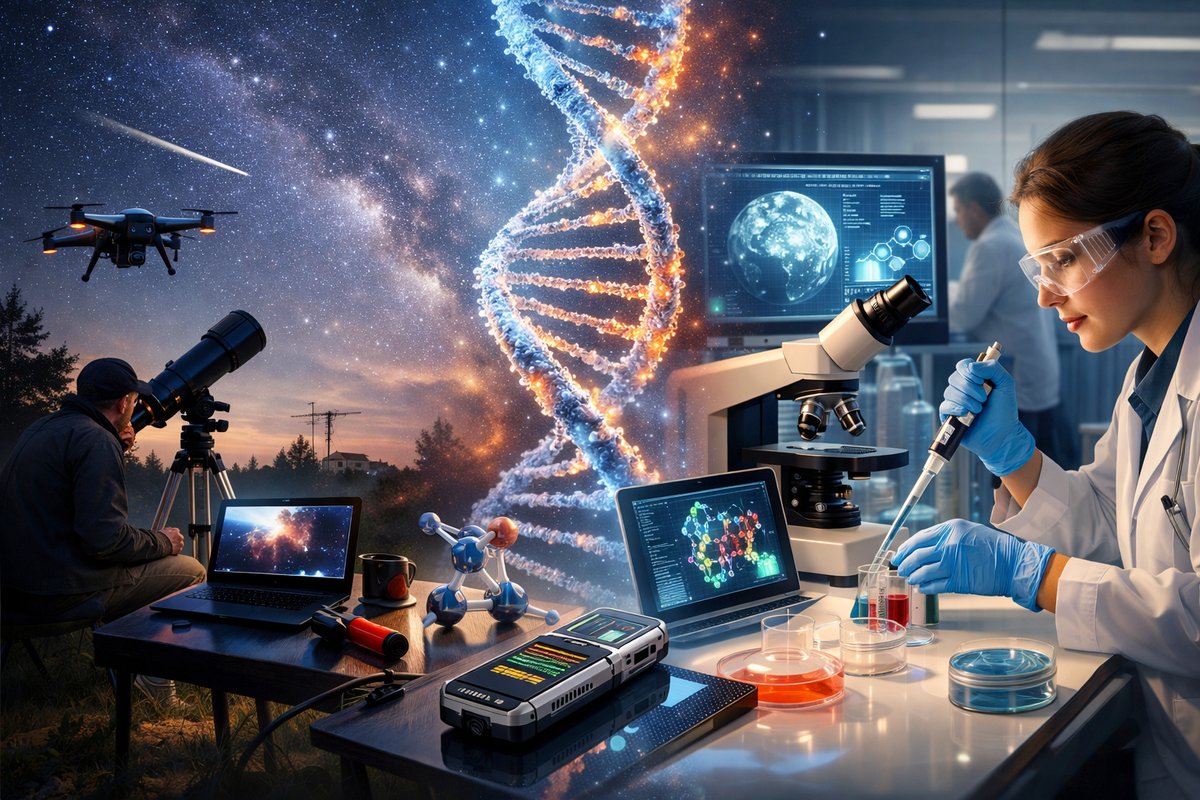

Science has always been a tapestry woven from curiosity and tools-simple lenses that transformed dusty deserts into telescopic vistas, rudimentary compounds that unlocked chemical mysteries, and crude voltmeters that set the stage for electrification. Yet the past decade has witnessed an unprecedented acceleration in the accessibility and diversity of instruments that democratize discovery. A teenager in her garage can now sequence microbial DNA, a community in the countryside can monitor local air quality in real time, and a remote classroom halfway across the globe can manipulate virtual molecules in three-dimensional space. These developments are not accidental; they arise from a confluence of open hardware, open data, and a cultural shift toward collaborative science.
At the heart of this revolution are digital sensors and imaging devices that once cost hundreds of thousands of dollars but now sell for a few hundred or less. Consider the latest USB microscope cameras: they can magnify insect wings, pond microorganisms, or circuit boards with equal ease, streaming crisp video to a laptop or smartphone. These tools invite exploration at a scale that blends the tactile thrill of hands-on work with the digital advantages of easy sharing, annotation, and archiving. Efforts like citizen-science microscopy projects harness that immediacy: volunteers around the world upload snapshots of soil samples, algal blooms, or insect specimens to global databases, helping professionals track biodiversity, map outbreaks, or assess pollution hotspots.
Meanwhile, backyard astronomers have gained unprecedented access to telescope mounts with computerized guides, motorized focusers, and portable star trackers that automatically follow celestial objects. These devices have turned what was once reserved for major observatories into an amateur’s evening ritual. All that is needed is a modest refractor telescope, a reliable equatorial mount, and an app on a handheld device to calibrate alignments. On any clear night, one can peer at Saturn’s rings, resolve craters on the lunar surface, or chase down distant galaxies-all from a suburban driveway. Online communities then stitch these images into collaborative sky surveys, filling in gaps that professional telescopes may overlook due to scheduling constraints or geographic limitations.
Beyond optics and imaging, the rise of affordable microcontrollers and single-board computers has added “smart” to virtually every instrument. Temperature probes, pH sensors, spectrometers, and electrochemical detectors can now be networked through open-source firmware, logged to the cloud, and shared via interactive dashboards. Farmers track soil moisture with DIY sensor arrays to optimize irrigation. Water quality advocates deploy floating buoys that measure turbidity and dissolved oxygen to safeguard freshwater ecosystems. Even DIY biologists set up compact bio-reactors controlled by simple feedback loops, exploring fermentation pathways for sustainable biofuels. This proliferation of sensor networks, sometimes dubbed the Internet of Scientific Things, multiplies data sources and amplifies local insights into global patterns.
Computer modeling and simulation have embraced a similar open ethos. Freely available molecular-dynamics packages let chemical students probe drug-protein interactions, while climate model frameworks allow communities to downscale regional weather projections. The open data movement ensures that raw satellite images, genomic reads, and environmental monitoring logs are shared as soon as they’re validated. Scientists embroidered across continents contribute code, tweak parameters, or validate results in parallel, reducing duplication and accelerating breakthroughs. Notably, open-access journals and preprint servers democratize findings, so a researcher in a resource-limited region can tap into the latest methods without paywalls or subscription barriers.
Artificial intelligence and machine learning have become indispensable collaborators rather than cryptic black boxes. Image-analysis algorithms quickly scan thousands of microscope fields for anomalies, freeing researchers from monotonous counting or classification. Natural language processing digests terabytes of literature to suggest novel connections between proteins, chemical compounds, or ecological factors. By sharing trained models on public repositories, teams avoid reinventing codebases and can instead focus on refining edge cases or integrating domain-specific constraints. The transparency of these shared tools nurtures trust and reproducibility-critical currencies when translating insights into policy recommendations or clinical trials.
Crucially, this toolbox extends beyond the professional researcher’s bench. Educators harness online labs to teach physics experiments in virtual reality, letting students manipulate pendulums, circuits, or wave phenomena without needing expensive hardware. Community science festivals repurpose cardboard and recycled plastic into spectroscopes or rudimentary particle detectors, inspiring hands-on engagement. Makerspace membership gives novices access to 3D printers that materialize prototypes of microfluidic channels or structural models of proteins. The joyful act of discovery-seeing a diffraction pattern on your phone screen, measuring local air pollution levels, or printing a model of a viral capsid-builds scientific literacy and a sense of stewardship for shared resources.
Yet powerful tools bring responsibilities. Data privacy and responsible use must guide every project, from neighborhood air sensors to portable sequencing rigs. Ethical considerations-such as informed consent for biological sampling or environmental impact for field equipment-require ongoing dialogue. Communities working with sensitive ecosystems or indigenous knowledge systems benefit hugely from transparent protocols and benefit-sharing models. Sustainability also plays a role: open-source hardware designs can embrace modular repair, recycled plastics, or off-grid power solutions, reducing e-waste and enabling resilient operations in remote areas.
Looking ahead, the future toolbox promises even richer interfaces between human and instrument. Haptic feedback gloves may let chemists “feel” molecular forces, augmented-reality overlays might project data streams onto field samples, and networked robots could automate dangerous tasks in extreme environments. Quantum sensors could reveal subtle gravitational or magnetic variations for geophysical mapping. Yet these dazzling prospects will still rely on core principles: openness, collaboration, and curiosity.
Whether you’re a seasoned researcher mapping climate change, an amateur astronomer unveiling distant nebulae, a high-school classroom decoding DNA barcodes, or an activist group documenting plastic pollution, today’s scientific toolkit empowers you to ask questions and pursue answers. It invites you to share not only data, but also stories, challenges, and triumphs. Embracing this evolving arsenal of instruments is a testament to science’s most enduring promise: that together, we can illuminate the unknown, nurture wonder in every mind, and steward a more informed, compassionate world.