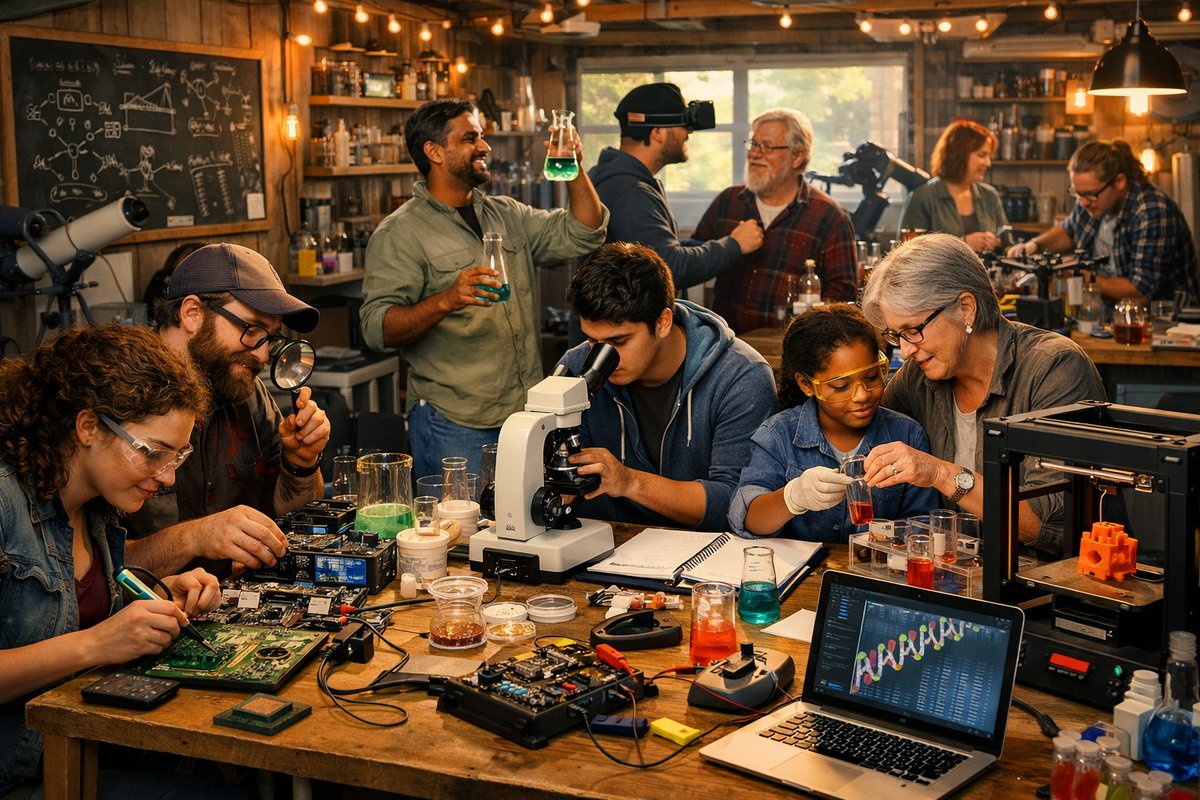

Science has long lived behind the walls of ivory towers and specialized laboratories, but a new paradigm is breaking down those barriers. Across neighborhoods and online forums, amateur researchers, hobbyists, and professional scientists are joining forces to explore questions once deemed too niche or too complex for traditional institutions. This shift is powered by a blend of accessible technology, shared data platforms, and a collective desire to tackle challenges from climate monitoring to genetic mapping. As these grassroots initiatives gain traction, they underscore the idea that scientific discovery can emerge wherever curiosity finds a home.
At the heart of this movement is open-source hardware. Designs for everything from microscopes to fluidic devices are now available under free licenses, enabling anyone to build, modify, and improve laboratory instruments with off-the-shelf components. Single-board computers and microcontrollers, once the domain of hobbyist coders, have found a place on lab benches. Coupled with affordable sensors and 3D-printed parts, these tools demystify measurement and analysis. No longer must aspiring researchers rely solely on expensive, proprietary machines. Instead, they can tinker, iterate, and share improvements with a global community.
Online repositories hosting instrument designs and assembly instructions serve as the backbone of this ecosystem. Contributors post detailed build logs, troubleshooting advice, and alternative component lists. When someone in a remote region lacks a specific circuit board, a collaborator suggests substitutes they can source locally. That level of adaptability embodies a values-driven approach to science, prioritizing accessibility and sustainability. Rather than sending unused equipment to landfills, community scientists salvage, repurpose, and upcycle materials-transforming e-waste into experimental potential.
Software plays an equally vital role. Platforms for crowdsourced data collection allow volunteers to contribute observations ranging from bird migrations to aerosol concentrations. Smartphone apps guide participants through standardized sampling protocols, ensuring data quality while accommodating varying skill levels. Machine learning models in the cloud process incoming streams of information, highlighting anomalies and flagging potential hotspots for follow-up. The result is a real-time portrait of environmental changes unfolding in cities and wilderness alike.
Community labs and makerspaces are physical manifestations of these online networks. Converted storefronts, co-working facilities, and pop-up labs provide shared benches, chemical hoods, and safety gear alongside soldering stations and laser cutters. Members pay modest fees or volunteer time in exchange for access and training. Workshops on basic microbiology, electronics repair, or plant phenotyping bring beginners up to speed, while guest speakers bridge the gap between amateur enthusiasts and seasoned researchers. This face-to-face interaction fosters emotional intelligence as well as technical skills: participants learn to give constructive feedback, to question assumptions, and to celebrate small wins.
Consider the case of a coastal community monitoring water quality. Residents concerned about algal blooms and pollutant levels pooled funds to build a network of low-cost monitoring buoys. Each buoy houses a set of sensor modules tracking temperature, pH, and nutrient concentrations. Data wires back to an online dashboard that anyone can view. When trends suggest a sudden spike in runoff after a heavy rain, local schools use that information as a basis for classroom discussions and community outreach. The project not only generates valuable environmental data but also nurtures scientific literacy and civic engagement.
In urban neighborhoods, rooftop gardens and street-corner plantings are becoming living laboratories. By comparing growth rates under different soil mixes, irrigation methods, or companion-plant pairings, citizen botanists contribute to studies in urban agriculture and pollinator health. Simple genetic assays-based on colorimetric tests rather than specialized equipment-reveal microbial communities in compost piles. The insights guide more sustainable gardening practices and feed into larger research networks mapping soil biodiversity across climates and socioeconomic contexts.
Of course, community science faces hurdles. Ensuring data reliability requires clear protocols, redundant measurements, and validation steps. Projects must navigate ethical considerations around privacy, especially when engaging volunteers or collecting data in sensitive areas. Liability and safety protocols can pose challenges for spaces handling chemicals or biological specimens. In response, many initiatives partner with local universities or nonprofit organizations, tapping into institutional expertise while preserving community autonomy.
Ethical stewardship also extends to data ownership. Open data champions argue that research findings, once generated collaboratively, should remain publicly accessible. Others caution that unfettered sharing might compromise privacy or leave contributors vulnerable to misuse. Balancing transparency with responsible data governance has led to creative licensing schemes and community drafting of data use agreements. These frameworks reflect a shared commitment to emotional intelligence, ensuring that voices from diverse backgrounds guide the trajectory of projects.
The educational impact of community-powered science cannot be overstated. Traditional classrooms often struggle to make abstract concepts come alive for students. When young people participate in real-world data collection or instrument building, they witness science in action. They learn that experimentation can be messy, that failure breeds insight, and that collaboration multiplies impact. Such experiences demystify scientific careers and inspire a generation of learners who see themselves as potential contributors, not passive observers.
On a broader scale, the community science renaissance aligns with a push toward sustainability. Faced with global challenges like climate change, biodiversity loss, and water scarcity, decentralized monitoring networks offer resilience. If one node goes offline-due to damage or resource constraints-others can fill the gap. Local stakeholders inject contextual knowledge into data interpretation, ensuring that solutions respect cultural practices and environmental nuances. In this way, participatory research meshes scientific rigor with on-the-ground stewardship.
Technological advances promise to accelerate these efforts. Low-cost drone platforms equipped with multispectral cameras are expanding community-scale mapping projects. Handheld DNA sequencers-once reserved for high-end labs-are entering makerspaces, enabling fast field tests for pathogens or invasive species. Augmented reality glasses guide novices through complex protocols, overlaying step-by-step instructions in their field of vision. While these tools spark excitement, they also demand thoughtful integration. Training, safety checks, and community-defined goals remain paramount.
Looking ahead, the fabric of scientific discovery may become increasingly textured by grassroots contributions. Funding agencies are beginning to recognize the value of citizen-generated data, launching grant programs tailored to community-led initiatives. Academic journals are publishing special issues dedicated to crowdsourced findings. Even private industry is taking note, collaborating with amateur astronomers to classify star patterns or enlisting hobby engineers to refine sensor designs for urban air quality monitoring.
In this evolving landscape, the most powerful driver is curiosity itself. When people see that their observations, questions, and experiments matter, they step into the role of co-creators. They move from passive consumption of knowledge to active construction. Whether it’s mapping plastic pollution on a local beach or probing the microbial life in a backyard pond, every effort underscores a universal truth: science thrives wherever wonder finds an outlet.
This community-powered revolution does more than generate data or build instruments; it weaves science into the fabric of daily life. Kitchens become fermentation labs. School hallways become poster sessions. Neighborhood meetings become forums for hypothesis testing. And amid all this, a new generation learns that the line between amateur and professional can blur, as long as rigorous methods, collaborative spirit, and ethical care guide the journey. From curiosity to discovery, community-powered science is opening doors for everyone with a question-and that is perhaps the greatest breakthrough of all.