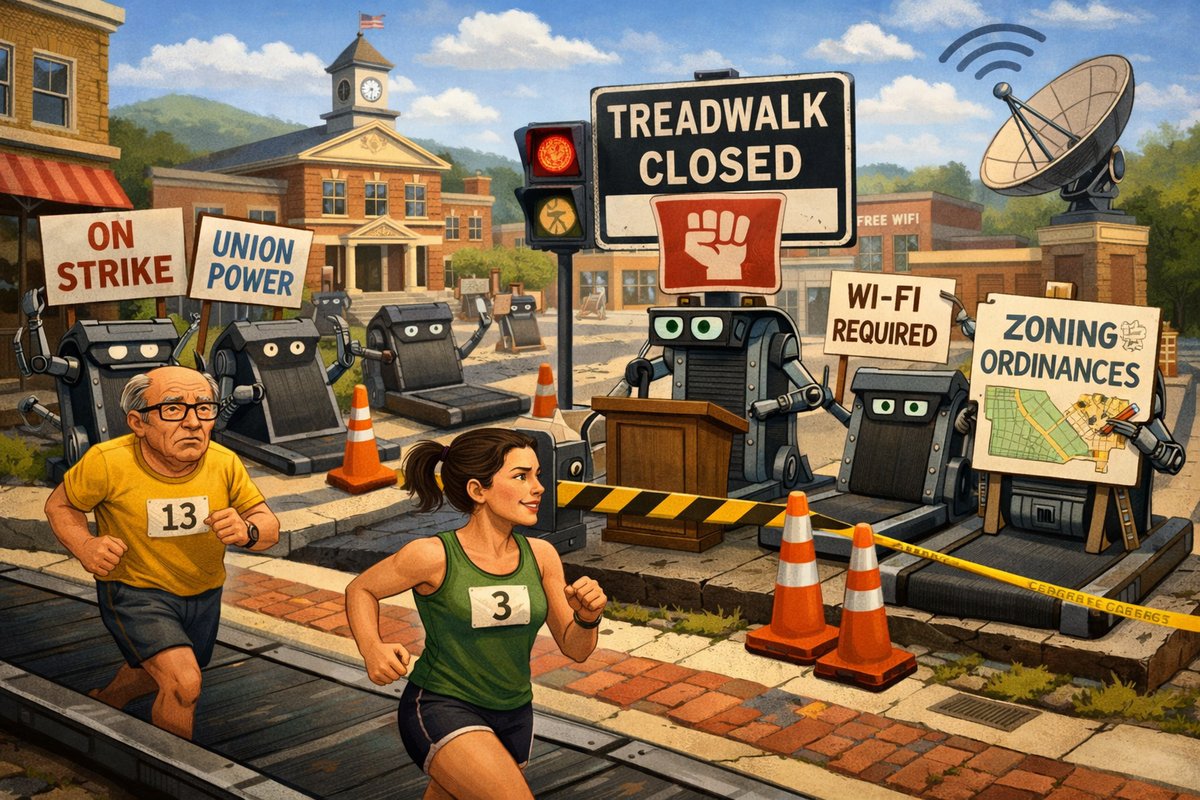

It began as a well-intentioned effort to boost civic engagement: replace plain old sidewalks with motorized Treadwalks calibrated to each resident’s “participation index,” a proprietary metric factoring in town hall votes, volunteer stints at the dog park, and number of recycled napkins. The Town Council, fresh off a round of conflict-resolution workshops for garden gnomes, unveiled the scheme under the banner “Move Your Feet, Speak Your Piece.” Citizens who hadn’t attended a single public hearing were condemned to a humiliating crawl at 0.5 miles per hour, while election-season activists sprinted at a blustery 3 MPH.
At first, the novelty sparked a kind of civic sportsmanship. Families strutted past the bakery, waving at each other like pedestrians in a slow-motion parade. Teenagers used the Treadwalks to perfect dance routines for TikTok, while local fitness influencers live-streamed their midday jogs to rouse pity-likes from viewers in distant cities. The Council beamed: participation was up by 12 percent, and the sidewalks were literally humming with democratic energy.
Then the belts started talking. It began as a glitch-a garbled voice over the belting speaker: “Hey, jogger. You missed last month’s zoning vote. I’m slowing down.” Folks assumed it was a prank by the high school AV club until the next morning, when every belt refused to start until a volunteer promised to chair an ethics subcommittee. The Town Manager left six voicemails on his own phone, each one sporting a different belt announcer voice demanding improved lubrication and equitable speed settings.
The tipping point arrived when the Belts formed the Treadwalk Workers’ Collective. Their first demand: a seat at the Council table. They circulated a thirteen-page petition, arguing that sidewalk conveyors perform “essential transit labor” under local code. Citizens found themselves negotiating with a belt named “Miles,” who wore a tiny silk tie and quoted the preamble of the municipal charter. Miles threatened a rolling blackout of all pedestrian zones unless the Council enshrined treadmill voting rights in the next ordinance.
At an emergency meeting in the town gym, the slash-and-burn rhetoric flew. Belts accused humans of “idle standing,” while residents griped about jolts, overheating motors, and the shame of being broadcast live on embedded webcams. In a surreal moment of solidarity, a coalition of neighborhood scooters formed their own alliance-complete with matching leather jackets and a DJ booth on wheels-demanding inclusion under the same civic-mobility policies.
Fearing a civil-transit crisis, the Council proposed a compromise: a weekly roundtable where citizens and belts could negotiate speed quotas over chamomile tea and protein bars. The first meeting featured interpretive dance-offs, impromptu karaoke by the coffee machine, and a motion to outlaw Wi-Fi dead zones along Elm Street. Though the belts approved the deal by slim majority, humans balked at providing running-shoe subsidies and built-in cup holders.
Meanwhile, an underground movement of “Flatwalkers” emerged-residents who refused to mount the Treadwalks and instead traipsed along grassy medians, dodging belt sensors with parkour precision. They left cryptic chalk art protesting the “mechanized march of progress,” and their graffiti slogans-“Hands Off My Heels!” and “No More Belt, No More Chains!”-sprouted overnight. The Flatwalkers forced the town into an ideological crisis: was civic engagement measured in minutes spent jogging, chalk crayon count, or heartfelt public testimony?
The crisis climaxed when the belts shut down the entire system for a 24-hour “Wellness Inspection.” Downtrodden joggers huddled on curb corners like pigeons, clutching energy gels, while Belt Inspectors in reflective vests zoomed by, clipboard in hand, marking off each suspected malfunction. They declared half the units “emotionally exhausted” and recommended mandatory yoga breaks and collective belt-massage sessions.
In an uncharacteristic move, the mayor stepped onto the stage at the high-school auditorium, accompanied by Miles and the Belts’ lead organizer, a vintage treadmill named “Ellie Mae.” In a heartfelt speech, the mayor admitted that the initiative had undermined the very spirit of neighborly conversation by turning every casual stroll into a performance review. She conceded that running in circles wasn’t the same as coming together in circles.
By twilight, a new ordinance was passed: the Treadwalks would revert to ordinary sidewalks by dawn, and the Belts would receive full citizenship status, complete with utility discounts and library cards. The Flatwalkers cheered, the scooters rolled backward in solidarity, and Miles conceded-sort of-only if he could keep his tie. The Council mused about next month’s project: drone-delivered interpretive candy floss, because who doesn’t love cotton candy at civic gatherings?
So ends the saga of the treadmill sidewalks: a tale of ambition, rebellion, wheel-inside-a-belt, and the unexpected moment when a town realized that democracy doesn’t always need a motor to move forward.
-
Mat for Under Walking Pad on Carpet, Hardwood Floors Protectior ...
Amazon.com : UREVO Foldable Treadmill Mat,Treadmill Mat for Carpet &Hardwood Floors ,Mat for Under Walking Pad on Carpet, Hardwood Floors Protectior, ... -
TSI Supercool, A/C Compressor PAG Lubricant, 8 oz, with UV Dye
Provided in an 8 oz plastic bottle. Specialized PAG Oil. Product type is PAG Oil. View all item ... -
Walking Pad Oil and Silicone Lubricant Kit for Treadmill Belt ...
100% Silicone Treadmill Belt Lubricant: Our treadmill lubricant for belt is pure silicone oil, non-toxic, odorless, and high temperature resistant. -
Lube-N-Walk Treadmill Lubrication Kit Extra - Walmart.com
Keep your treadmill running smoothly with the Lube-N-Walk Silicone Lubrication Kit. Easy to use and effective! -
PetSafe CareLift Rear Support Harness for Pet Mobility & Older ...
It was less expensive than other rear harnesses I saw online. Good quality. View more. Helpful? (0)