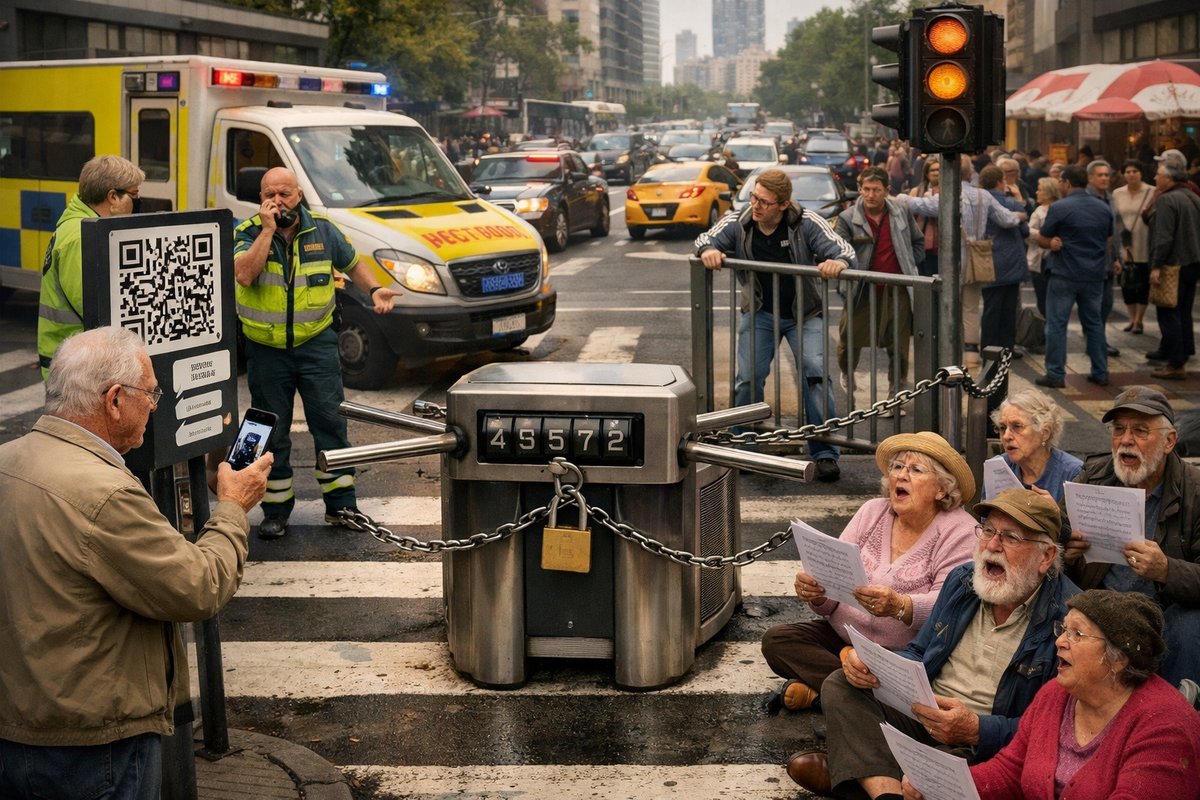

Last Tuesday, the Town Council unveiled its most ambitious public-engagement initiative yet: converting every pedestrian crosswalk into a pop-up escape room. At a standing-room-only meeting, officials promised that solving cryptic riddles and manipulating color-coded locks would not only “enhance civic pride” but also “transform routine foot traffic into immersive urban theater.” Citizens were handed laminated clue sheets and warned that failure to crack the conundrums within forty seconds could result in an indefinite hold at the curb.
The pilot installation on Elm Street greeted morning commuters with a sequence of glowing symbols embedded in the asphalt. A small keypad announced, “Enter the element that binds water to winter,” while the crosswalk light above featured a miniature hourglass counting down from sixty. Only by typing ICE before the sands ran out would the signal shift from red to green. Early adopters reported a heady sense of triumph when they cracked the code, though some admitted resorting to cryptic smartphone forums for hints.
By midday, Grandma Lillian-age eighty-two and renowned for her devotion to crossword puzzles-found herself marooned on the sidewalk. Her clue? “I dance on riverbanks when moonlight glows, yet vanish at noon’s stern repose.” Despite three earnest guesses (“dew,” “silver,” “night”), the barrier refused to budge. Bystanders watched in horror as an apologetic gray-haired senior remained trapped until a passing teenager blurted out “mist” at the last second, triggering raucous applause and a flurry of celebratory emojis in the assembled crowd.
Meanwhile, middle-schoolers commandeered the accompanying smartphone app to remap puzzle sequences at will. Commuters on Market Avenue were serenaded by baroque harpsichord chords before the crosswalk would permit passage, leading to impromptu dance circles in mid-street. A valiant few tried to reprogram the interface entirely, turning the final puzzle prompt into a continuous loop of tongue twisters and chicken jokes that snarled morning rush hour.
Expectant mothers discovered yet another twist: the “Hourly Gravity Test,” which imposed a fifteen-second delay triggered by an actual mechanical hourglass. At precisely the moment a new parent pushed her stroller across Maple Boulevard, the ancient sands slipped free, halting traffic in both directions. Witnesses claim the pregnant test subject took the delay in stride, offering to meet the mayor at City Hall-riddle in hand-if she didn’t feel her baby’s first kick by sunset.
The true breaking point arrived when local paramedics responded to a call at Pine Ridge Manor. First responders arrived to find the crosswalk module engaged in a lateral sliding pattern, akin to a miniature corn maze, and insisted on a rhyme-based password. As time ticked away, the ambulance crew radioed dispatch: “We’re stuck solving a limerick about a three-legged cat.” By the time they emerged triumphant, the patient’s pet parrot had already administered first aid-screeching “Polly wants a cracker!” every time the vitals monitor beeped.
Reactions among townsfolk varied wildly. Puzzle enthusiasts formed waiting lists to claim weekly “Puzzle Passes,” which granted expedited entry through a single designated crosswalk each Friday. A handful of adrenaline junkies even camped overnight at the curb, hoping to catch the golden sunrise puzzle reveal. Conversely, a wave of frustrated citizens began lobbying for “Bypass Badges” that would ignore the game entirely-an emblem resembling a coffee cup crossed out by a red circle.
Under pressure, the Town Council announced a complimentary upgrade: Choreography Day. On Wednesdays, each pedestrian was required to perform a twenty-second interpretive dance sequence before a motion sensor would activate the walk signal. Videos of joggers flailing in tutus and besuited bankers executing pirouettes went viral, earning the municipality an unexpected spike in tourism inquiries.
Yet not everyone was amused. That Saturday, the Harmonious Voices Community Choir staged a sit-in at the intersection of Oak and Fifth, belting protest anthems in four-part harmony until every traffic light turned purple. Rush-hour drivers joined in, their horns sounding in melodic counterpoint. Even the crosswalk sensors seemed to lull in appreciation, granting pause long enough for the final chord to fade.
The most surreal moment arrived when a junior councilmember tested a prototype puzzle in downtown’s busiest intersection-only to vanish mid-clue. Witnesses reported a faint “bing” sound as the keypad sealed shut, then nothing until three Tuesdays later, when the councilmember emerged clutching a damp notebook filled with cryptic symbols. He delivered a passionate manifesto on “the true purpose of urban riddling,” then promptly declined further comment and requested a private crosswalk key.
By week’s end, local bookstores sold out of brain-teaser volumes, coffee shops ran short on energy bars, and the mayor was rumored to be consulting a professional sleep coach. An emergency town-hall meeting convened to address “puzzle fatigue” and “crosswalk PTSD,” leaving one resident to quip, “I’d rather parallel park blindfolded.”
In a dramatic final act, the Council voted unanimously to suspend the escape-room crosswalk program-while preserving the Elm Street installation as a roadside museum piece. Glossy brochures now advertise it as a “monument to human perseverance,” complete with guided tours and commemorative keychains stamped ICE. Locals speak of a single, still-active crosswalk at Maple Boulevard that reportedly scribbles its own bylaws in chalk and issues urgent memos to distracted pedestrians. But for now, the town breathes a collective sigh of relief-until the next ambitious policy idea wiggles its way onto the Council agenda.