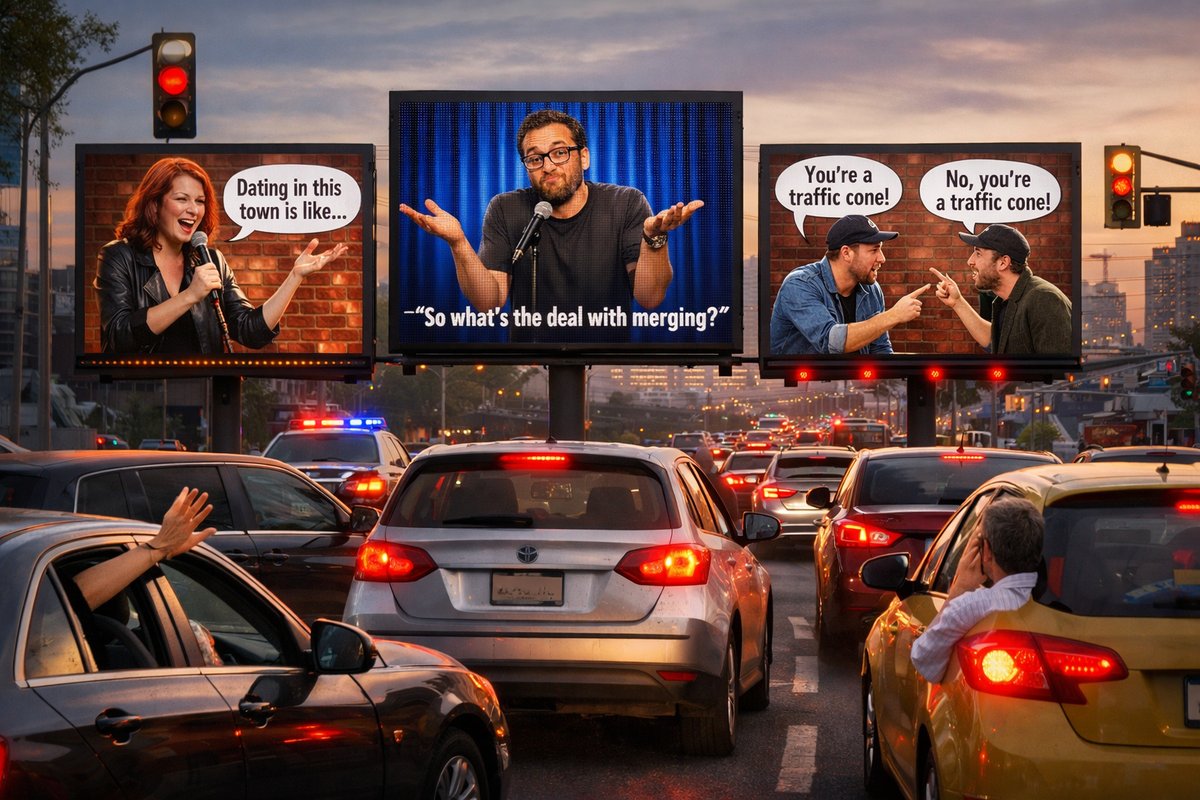

When the town council unveiled its latest public safety initiative, motorists expected updated signals or smarter sensors, not the debut of “Stand-Up Signals.” On the first Monday morning, every red light was replaced by a thirty-second comedy loop performed by local amateur comedians. Instead of a solid crimson square, drivers encountered a squeaky-voiced joke about expired parking meters. Yellow meant a rapid-fire one-liner, while green signaled a punchline so sharp you were supposed to roll through the intersection while laughing.
The rollout took place beneath the glare of half a dozen LED panels installed at major junctions. Council President Marjorie Llewellyn announced that statistics prove laughter reduces stress and, therefore, fender-benders. The first commuter to test the system was Harold Jensen, who nearly rear-ended a sedan while searching for a mute button. “I didn’t mind the joke,” Harold reported between heart palpitations. “I just didn’t know whether to stop or chortle.”
Within hours, footage of a minivan rolling through a red light to avoid missing the comedian’s closing callback went viral. The local improv troupe, The Ragged Yuks, saw an opening and petitioned to take over the screen time slots. When their representative delivered a roast at 5:15 p.m., traffic ground to a halt as drivers debated whether the MC’s taunt about fluorescent windbreakers constituted safe driving material.
Pedestrians fared no better. At the Main Street crosswalk, a makeshift stage sprouted behind the LED rig. Doris the Crossing Guard, known for her no-nonsense whistle, adapted by hosting open-mic minutes between routines. Her best-loved zinger-“If you can’t time your stride to a joke, you’ll be late for life”-left both jaywalkers and punctual office workers equally unmoored.
Local seniors, who once enjoyed predictable green signals for leisurely street chess sessions, staged a protest known as “Operation Silent Signal.” They arrived in recliners on wheels, plugging ears with cotton balls and carrying petition signs reading, “Give us back our boring lights!” Their campaign gained traction when a retiree accidentally applauded during a monologue about tax brackets and whacked a cyclist with a foam finger.
Social media swelling added to the chaos. The hashtag #LaughOrYield trended regionally when commuters-relying on laugh-to-advance gauges-debated whether a groaner, gasp or full belly laugh met the minimum decibel for green-light clearance. Meanwhile, transportation planners convened a virtual summit titled “Comedy or Commuting: A Viable Hybrid?” which, ironically, produced no consensus beyond recommending a decibel meter app on every dashboard.
By Wednesday, the council’s emergency caucus convened in a room lit by the glow of a dozen smartphone screens playing the live feeds. Debate raged over whether to install a “Laugh-O-Meter” or revert entirely to stoplights. Councilmember Raj Patel argued for an adjustable system: families could dial down the jokes during summer vacations. Others worried that any manual override would be misused by pranksters.
The community theater group that had provided the Monday morning schedule decided to host an improv duel at the Central Intersection. One side pelted cars with pun-laden signs, the other countered with riddles about roundabouts. Drivers stranded for an hour reported improved moods but lost productivity. The regional Chamber of Commerce demanded answers; the mayor replied with a haiku about fiscal responsibility.
The turning point came when delivery drivers began using joke sequences as secret codes for high-priority packages. A punchline about missing socks meant express delivery, while a quip on municipal audits signaled overnight shipping. Postal workers threw in their own routines, turning every red envelope drop-off into a surprise stand-up cameo.
At the community potluck that night, conversations revolved around whether the program was a creative triumph or a municipal misfire. The local mechanic complained that customers rolled into his garage asking for laugh-tuned carburetors. Teenagers formed flash mobs at intersections, performing synchronized pratfalls whenever the LED panels triggered a silent-film gag.
Faced with runaway improv mania, the council proposed a compromise: reverse the program for four hours daily to allow “sound-sensitive zones” near schools and hospitals. Even that brief respite backfired when nursing home residents found themselves deprived of their midday joke break, prompting protests with humorous efficiency.
Council President Llewellyn finally conceded that perhaps laughter belongs in theaters, not traffic lanes. She introduced a resolution to replace all digital joke screens with traditional lights but repurpose the panels for once-weekly “Comedy Commute Night,” where drivers could tune their car radios to a designated frequency broadcasting live stand-up from downtown stages.
The final vote passed by a single vote margin-Councilmember Patel cast the swing vote while choking on his soda during a particularly dry heckle about municipal budgets. In celebration, the council invited the senior recliner brigade to host a gentle knitting circle on the asphalt under a dim green glow, symbolizing hope and a return to normal signaling protocols.
On the first Monday after the reversal, traffic lights blinked in orderly red, yellow and green once more. Horns were used exclusively for emergencies. The Ragged Yuks relocated their battle to a converted warehouse, billing it as “Intersection of Laughs: Edgy Commuters Only.” Doris returned to whistle duty, occasionally slipping in a playful wink but no full-blown roast.
Commuters reported improved focus but admitted to a touch of nostalgia for the chaos. One driver told a local reporter, “I did miss trying to out-laugh a Chevy Impala. Now I just out-brake it.” Meanwhile, the town’s new app let citizens vote on future public-safety experiments-though most users settled on restoring blinking crosswalk bars rather than auditioning for another municipal performance art stunt.
In the end, the council’s grand experiment taught the town that when you mix infrastructure with improv, the only certain punchline is chaos. Yet for a brief interlude, gridlock became a communal comedy club, reminding everyone that even in the slowest crawl of morning traffic, a well-timed laugh can feel like a green light to hope.
Life on the street returned to its usual cadence, but on rainy afternoons, drivers sometimes glimpse empty LED frames and catch themselves humming opening lines to jokes that once ruled the roads. The town may have traded laughs for lane discipline, but it gained a legend-one as colorful as any comedy troupe’s punchline and as enduring as their unexpected spotlight on Main Street.
As dusk settles and crosswalk bars blink on, the world hums with mundane signals once more. Yet in the town’s collective memory, rush hour still echoes with laughter, applause and the faint voice of Doris, urging drivers to pause, find humor in red lights and remember that every intersection is a chance for connection-even if not every driver is ready for a punchline.