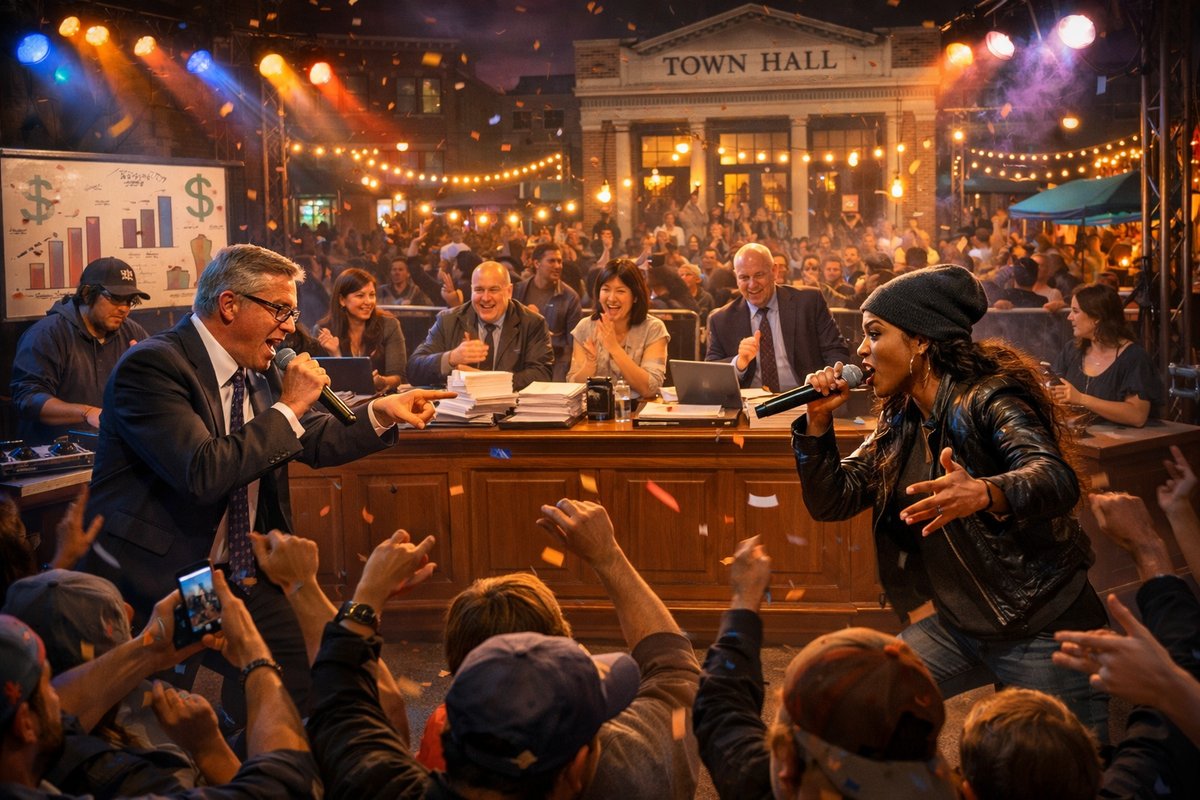

When the budget shortfall reached an all-time high and partisan rancor ground every meeting to a halt, one ambitious council aide pitched an idea so outlandish nobody dared say no: settle appropriations through epic rap battles. What started as a dare became the town’s most anticipated event of the year, transforming dusty meeting rooms into neon-lit arenas and turning village politicians into battle-rap contenders.
The first contest was scheduled on short notice. The council chambers were cleared, folding chairs lined the perimeter, and a rented DJ booth cranked out boom-bap previews. Councilor Marisol “MC Budget Buster” Jenkins strode to the mic wearing off-brand sneakers and a tie printed with dollar signs. Her opponent, Councilor Greg “Line-Item Lion” Prescott, arrived in a custom hoodie sporting a pie chart meme. Moderators shuffled scrap paper, hoping nobody recited the wrong line item midway through a killer verse.
At exactly 7:03 PM, the beat dropped. Jenkins launched into an eight-bar salvo about Medicaid grants, rhyming “allocation” with “moonshot innovation.” Prescott fired back with a scathing critique of infrastructure spending: “You talk big roads but can’t fix a pothole, I’ll school your ledger like a classroom, that’s my protocol.” The crowd roared like a Kickstarter campaign that actually delivers.
Within days the rap battle format spread to zoning debates. Developers and neighborhood associations traded verses over density limits and green space allocations. Gone were the hours of dull slideshows and snooze-inducing fiscal reports; instead, people showed up in streetwear, prepared to spit bars about sewer maintenance and storm-drain capacity.
Local DJs volunteered to curate instrumental tracks. A retired librarian serving as hype man recited mortgage amortization schedules in rhythmic spoken word between rounds. The public gallery filled with college students live-streaming on social media, local entrepreneurs hawking budget-themed T-shirts, and outraged taxpayers waving printed flowcharts like placards.
Even the town’s code enforcement officer got involved. After citing two battle fans for “excessive foot stomping,” she apologized on stage mid-rhythm, dropping a freestyle apology that ended in a standing ovation. From that moment on, every civil citation required an upbeat apology verse to request leniency.
On battle night number three, an overloaded power strip exploded, plunging half the council chamber into darkness mid-verse. Rather than pause, contestants rapped by flashlight until the generator kicked in. That clip went viral as “Budget Bars in the Dark,” inspiring amateur rap battles in basements and dorm rooms across the country.
State auditors formally questioned the legality of approving multi-million-dollar expenditures through rap duels. A hastily drafted ordinance declared all battles binding if both sides recited the legal citation at the end of round two. Now, fiscal law students study battle transcripts alongside traditional case law.
Pizza vendors and coffee trucks parked outside the chamber door every night. One pizza owner even created a “Deficit Destroyer” pie topped with extra cheese and jalapeños, claiming the spice inspired fiercer rhyme schemes. When the pie sold out in fifteen minutes, he charged a premium, citing “event-driven market forces.”
Podcasters started livecasting rhymed budget annotations. Some fans compared it to high-finance street theater. Local seniors argued it showed disrespect for public office, while high school poets said it was the most educational civics lesson they’d ever heard.
Surprisingly, the deficit shrank by nearly 40 percent after six battle nights. Council overtime pay and equipment rentals softened the savings, but the spectacle raised enough community enthusiasm for small-dollar fundraising and voluntary tax-rebate auctions, where residents rhymed for premium street parking spots.
At the same time, parking tickets soared, as enthusiastic battle fans lingered until the closing verse. The police department complained of understaffing when three DJs turned the courtyard into a mini-festival, complete with breakdancing traffic controllers. The town’s insurance premiums spiked after a fan fainted mid-cheer.
National news outlets sent correspondents, dubbing it “democracy as performance art.” Political scientists cited the town as a case study in deliberative improvisation. Critics warned that free-form lawmaking invited mob rule, while supporters praised the renewed sense of civic engagement.
By battle night eight, organizers introduced special effect smoke machines and colored strobe lights. The council chamber was rebranded “The Fiscal Mic Arena.” Architects were on call to redesign the dais for better acoustics, and audio engineers recommended investing in wireless microphones to avoid cord entanglements during dramatic exits.
In an ironic twist, the council’s youngest member was disqualified after forgetting one verse’s rhyme scheme. Her opponent recited the magical confirmation number that unlocked a concealed contingency fund, sealing the deal. She conceded with grace, delivering a final closing bar about future innovation that brought tears to the audience.
Now the town’s annual budget cycle is known as “Taxation Tuesday,” complete with VIP seating for prominent donors willing to sponsor the opening beat drop. Local schools host junior rap-battle contests to teach students about municipal finance. Even the neighboring town’s mayor has petitioned to attend as an observer-though he’s rumored to be scouting lines to steal for his own campaign speeches.
Some veterans of conventional council meetings mourn the return to agenda-driven monotony. Others volunteer as beatboxers and hype men. The municipal website now livestreams to more viewers than small-town councils typically manage in a decade.
In the end, the old process of memorizing regulatory codes has been replaced by memorizing rhymes about fiscal codes. And while financial experts still debate whether measuring success by attendance and YouTube views undermines sober deliberation, one thing is clear: when democracy is pitched in perfect eight-bar cadence, constituents show up in droves-and nobody ever falls asleep in the back row again.