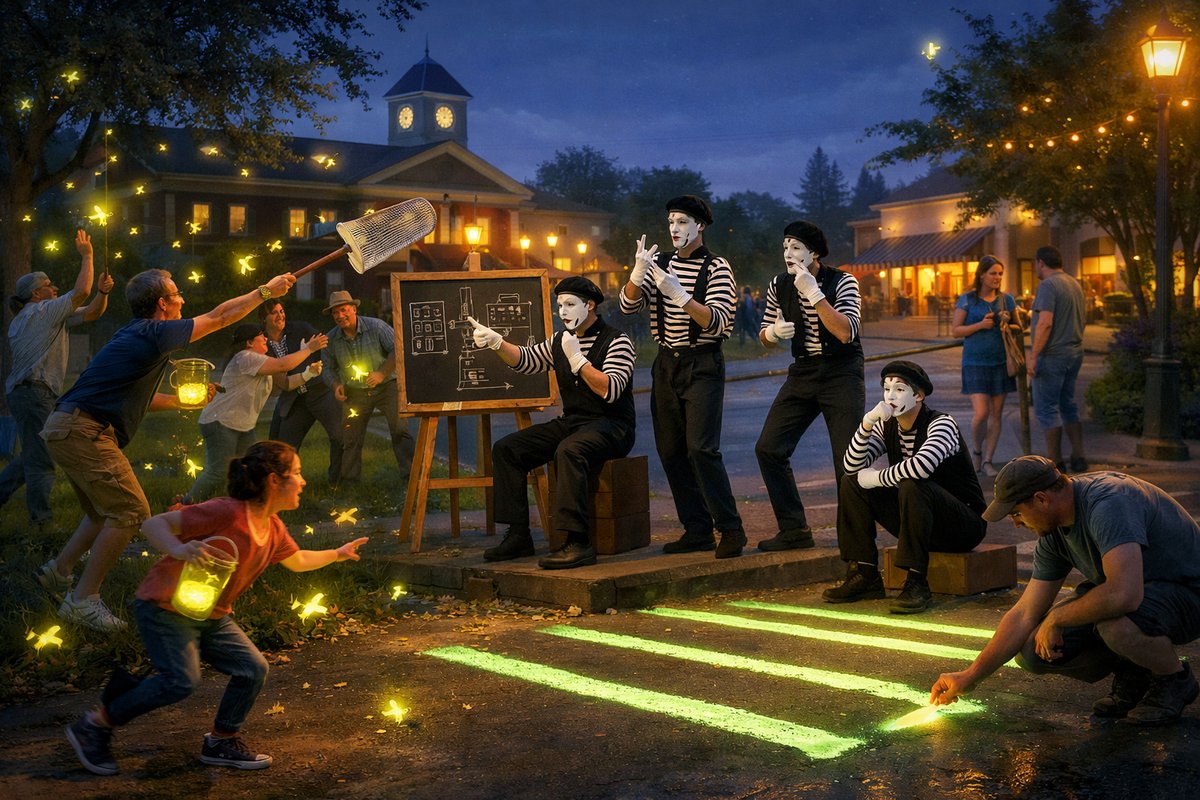

The town council’s decision to send its traffic signals to “collective healing” sessions quickly spiraled into a cosmic farce. Officials announced that the red, yellow, and green lights were suffering from acute burnout, leading to jaywalking fatalities and tailgating meltdowns. In solidarity, the council arranged “traffical therapy” for each bulb and proudly declared that migrating firefly swarms would henceforth consult on intersection safety.
On Monday morning, as dawn gave way to an otherworldly glow, drivers found themselves coasting through intersections guided by blinking insect neon. Some commuters described a trance-like state as tiny beacons hovered above crosswalks, pulsing Morse code warnings. One resident reported, “I felt like I was mid-romance in a nature documentary-except I was late for work and everyone behind me was honking.”
The new system inspired impromptu night markets by the roundabout, where vendors sold battery-powered butterfly nets and reflective wristbands. Children chased errant fireflies with glee while parents wavered between poetic awe and mild panic. Local photographers arrived in droves, hoping to capture long-exposure shots of glowing insects overhead-though a stray sneeze in the crowd once sent the entire swarm veering into a stop-sign, igniting a brief flash of municipal panic.
Meanwhile, bored by conventional bureaucracy, the council secretly auditioned a troupe of mime philosophers to rewrite zoning regulations. Armed only with invisible chalk, imaginary ladders, and existential shrugging, the performers delivered a silent soliloquy on property lines and building heights. Their final act involved pantomiming a skyscraper folding itself into the city library, leaving citizens scratching heads and scribbling frustration-tinged haikus in response.
To comply with the mime-crafted bylaws, contractors began erecting edifices that existed mostly in one’s imagination. A local developer proudly marketed “invisible townhouses” with holographic porches. Potential buyers queued for tours that required wearing noise-cancelling headphones to fully appreciate the acoustic minimalism of unbuilt walls. One early adopter confessed, “I never realized how liberating it is to have a home you can’t actually see.”
Council meetings evolved into open-mike nights held at a portable disco ball venue. Participants were encouraged to wear reflective jumpsuits and dance each budget proposal into existence. Revenue forecasts were translated into funky bass lines, while tax cuts manifested as choreographed moonwalks. An ambitious teen breakdanced her pitch for new streetlamps, winning unanimous approval through a flawless windmill spin.
Amid the revelry, a solitary box of quantum fortune cookies was delivered to the mayor’s bench. Each slip of paper promised random policy outcomes: one read, “Tonight you will champion compulsory bubble wrap uniforms,” while another warned, “Beware the cupcake lobby.” Councilmembers cracked the cookies in solemn ceremony, then proceeded to hold a bake sale in the council chambers, citing “nutritional democracy.”
The local grocery store tried adapting by stocking glow-in-the-dark chalk and insect-safe repellents. Aisle three displayed emergency disco outfits alongside reflective dog leashes and biodegradable sequins. Shoppers pushing carts under soft neon halos reported difficulty reading product labels through tears of laughter. One surreal moment came when a group of grandparents lined up at the checkout, each wielding homemade protest signs demanding a return to plain old fluorescent bulbs.
As word spread, amateur poets arrived to compose odes to the great Firefly Commission. Armed with scrap paper and caffeine, they held midnight reading sessions under flickering streetlamps, interpreting each insect flash as metaphysical punctuation. A wandering duo recited a two-hour epic titled “Ode to the Glow,” prompting a spontaneous interpretive dance by a trio of senior citizens brandishing umbrellas as pretend lanterns.
Parents, meanwhile, organized clandestine “old school crossings” in their driveways. They painted makeshift zebra stripes using standard white chalk and tangibly enforced stop signs made of cardboard. These underground assemblies recruited teenagers as volunteer crossing guards, wielding real handheld signals and belting safety jingles into battery-powered megaphones. One crosswalk captain noted, “It’s either this or risk getting hypnotized by insects while texting.”
Local entrepreneurs seized the moment by launching limited-edition merchandise: firefly-patterned leggings, portable strobe lights, and glow-in-the-dark face masks. A custom DIY puppet stage kit sprouted sales among mime fans eager to reenact council debates with sock puppets. Meanwhile, tech startups pitched apps that translated insect flickers into text messages-though beta testers complained the algorithm often rendered “turn left” as “consider existential left turn.”
On the county level, neighboring municipalities watched the spectacle in bemused horror. One councilmember quipped, “Our traffic lights are also stressed, but we prefer daytime spa retreats over insect consultants.” Another town threatened legal action, arguing the fireflies were public resources and should not be monopolized for municipal theatrics. The debate itself was held in interpretive dance format, further blurring the line between protest and performance art.
At a special midnight session, the town council unveiled its magnum opus: a live-action role-play where each citizen embodied a traffic signal. Participants dressed in tri-colored capes and choreographed synchronized spins. Applause echoed through the empty streets as drivers were tasked with following human signals instead of bioluminescent bugs. One dispatcher recounted the chaos: “I had to chase someone in green cape all the way to the donut shop.”
Despite the pandemonium, a surprising sense of unity emerged. Neighbors swapped glow sticks like trading cards, confided in one another about phantom hermit crabs seen hitching rides on firefly backs, and joined forces to draft a petition demanding cookie-free council rules. Children giggled at the idea of chalk battles breaking out at town hall, while local poets busied themselves crafting limericks about rebellious streetlights.
Critics argue the experiment endangered public safety, but supporters insist it fostered community bonds that no ordinary streetlight could ever achieve. A group of senior citizens marched in tandem, clutching reflective umbrellas, chanting, “We demand insect rights!” Observers compared the scene to a theater festival gone wildly off script, complete with accidental slapstick and impassioned interpretive gesturing.
As dawn broke on the third day of this grand performance, fireflies winked farewell and mime philosophers vanished between columns of nonexistent text. The council declared the trial a resounding success, promising to review traffic signals’ mental health quarterly. Meanwhile, residents dusted off their normal routines, hugged real stop signs once more, and nursed hangovers from spontaneous disco sessions.
For now, the town has learned that governance can be an art form-and chaos, a surprisingly effective glue. Whether firefly consultants return next season remains unclear, but one thing is certain: every blinking streetlamp will henceforth be greeted with applause or at least a respectful nod. In this brave new world of glowing bugs and silent revolutions, community spirit shone brighter than any LED ever could.