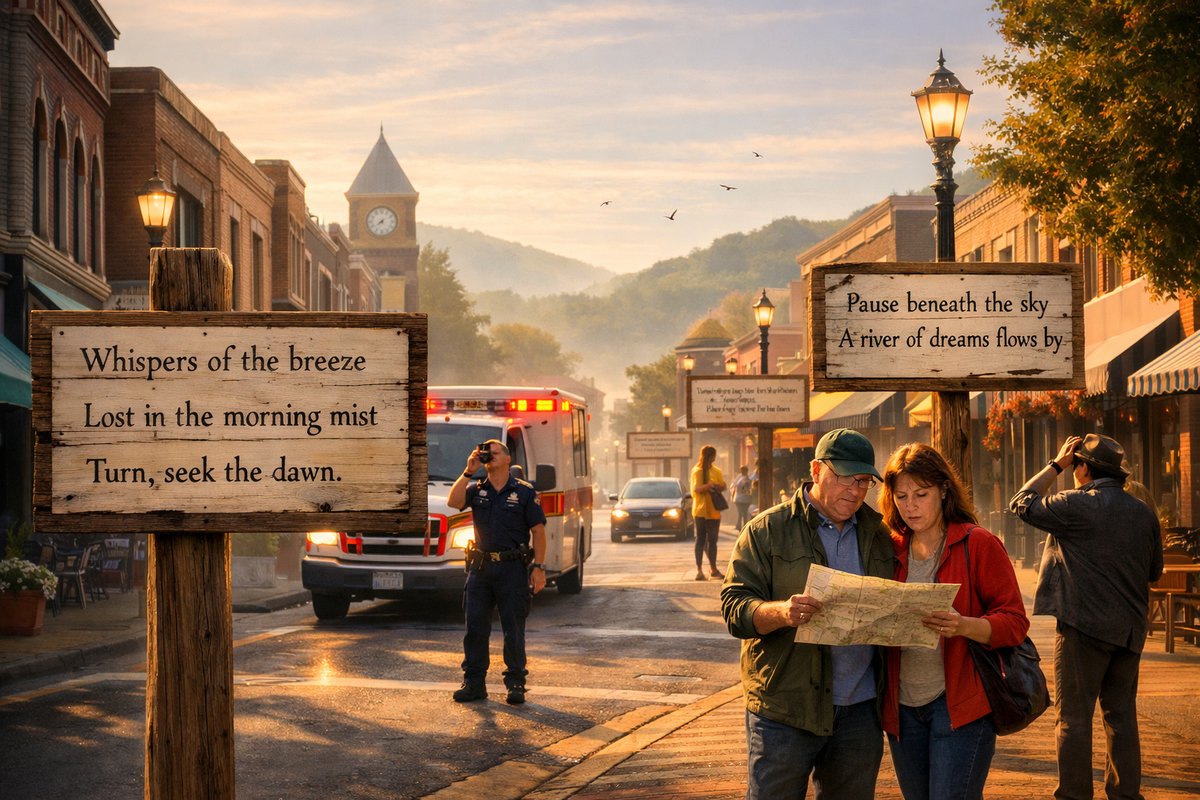

Nobody expected Thursday’s town council meeting to rewrite the town map in verse, yet by the end of it, every familiar street name had blossomed into a three-line poem. Instead of the blunt precision of “Elm Avenue,” drivers now encounter:
“Whispering green bough
Carries footsteps through hush and mist
Home among the winds”
Residents awoke the next morning to discover that entire blocks had metamorphosed into rolling syllables. The intersection of Oak and Pine, once confused enough, now reads as a cryptic invitation:
“Two kin stand as one
Rising branches touch the dawn
Crossroads of soft light”
Local businesses scrambled to translate the new signage into something shoppers could follow. The bakery on Metcalf Street posted hastily scrawled index cards: “Haiku Line 2 = Look Left; Haiku Line 3 = Look Right.” One frustrated customer reportedly circled the block four times, memorizing each couplet, before abandoning a dozen croissants in his car.
The mayor defended the move as “a fresh approach to civic engagement,” citing studies that poetry strengthens neural connections and inspires mindfulness. During a press conference, she paused dramatically before reciting her own contribution to Brookside Drive:
“Silent waters flow
Under moonlit emerald beams
Guide your weary soul”
One ambitious council member proposed renaming the mayoral office “Chamber of Whispered Verses,” suggesting that all future resolutions be sung in free verse. That idea passed on a tie vote-though no one is quite certain which side prevailed, since the tie-breaker speech itself was composed in ghazal form.
Emergency services suffered the worst growing pains. Fire Chief Morales described a call to contain a grease fire at the local diner: “Our crew spent seven minutes trying to decode whether ‘Searing cradle holds / molten dreams beneath steel lids / caution’s wary heart’ meant ‘restaurant on fire’ or ‘candlelight vigil.'” Paramedics arrived at the wrong address after interpreting “Melting of the dusk / shadows gather on smooth stones / under scarlet haze” as an art installation on the school lawn. The volunteer ambulance squad is now lobbying for an appendix of literal translations.
Schoolchildren, by contrast, embraced the changes. Fifth graders formed impromptu poetry circles at the bus stop, comparing drafts of new sign-inspired verses. Ellie Tran, age 10, said, “I like turning street signs into stories. Yesterday I wrote one about the crosswalk. My mom still takes me to ballet class, but now we recite two limericks on the way.” Even the principal admitted that standardized test scores had ticked upward-possibly the result of increased practice with meter and syntax.
Local high school theater troupe “Backstage Banter” seized their moment: they wrote a one-act play in which the town council must appease a capricious Muse god who demands free-form verse as tribute. Town hall parking lot became the set, complete with glow-in-the-dark haiku scrolls rigged to the fire escape. After a sold-out preview, ticket sales were rumored to have eclipsed those of even the annual chili cook-off.
Meanwhile, tech startups smelled opportunity. Three enterprising students pitched an app called “Haiku Finder,” which scans smartphone camera images to display plain-English street names beneath the poems. Its beta launch crashed when thousands of users tried to scan the same lamp post haiku simultaneously. A rival group launched “Syllable Counter GPS,” guiding drivers through each poem with turn-by-turn voice narration delivered in iambic pentameter. They’re now seeking venture capital on the premise that “poetry is the new user interface.”
Even pets got caught up in the craze: one dog walker taped index cards explaining haiku lines to leashed dachshunds. According to multiple eyewitness reports, the beagles paused mid-sniff to tilt their heads at haiku about “scented breezes” and “hidden murmurings.” Park benches are now littered with scribbled fragments-a collective log of lost tourists and overly committed birdwatchers.
The local joggers’ club introduced evening “Poetic Runs,” following routes inspired by seasonal verses. Runners recite lines aloud at each corner. Halfway through last Thursday’s Frost Lane circuit, participant Leon Gonzalez attempted to ad-lib a stanza about his aching calves and accidentally launched a movement that renamed the old mill pond “The Mirror of Weary Limbs.” By dawn, every online map labeled it accordingly.
The reversing force of human ingenuity emerged when the Chamber of Commerce launched a series of community workshops entitled “Decoding Your Town in 17 Syllables.” Over fifty residents squeezed into the library’s meeting room, clutching highlighters and sticky notes. Attendees practiced clustering nouns, verbs, adjectives-then argued over whether “crescent” should be considered one or two syllables. One elderly man brought his karaoke machine to belt out translations in operatic style.
A particularly surreal moment arrived when local street artist Serena Cho staged a midnight performance, repainting the haiku in glow-in-the-dark ink. She choreographed dancers to trace each verse in phosphorescent strokes on the pavement. At dawn, passersby described walking through a dream. A visiting real-estate agent, hoping to reference the neighborhood’s “charming bungalows,” could only mumble about “ethereal-limbed residencies.”
Not all reactions have been poetic. The Chamber of Seniors filed a petition demanding a return to block numbers and cardinal directions, citing compass anxiety and chronic “haiku phobia.” Their spokesperson delivered a press statement under a pop-up canopy, holding up a giant placard that read, in bold block letters, “ENOUGH WITH YOUR FLOWERY NONSENSE.” A symbolic haiku-burning ceremony was narrowly averted when local officials accidentally declared it an “art performance” protected by free expression laws.
By week’s end, the town council conceded that even the most loyal versifiers had grown weary of interpreting “petals drifting down / on silent sidewalks of gray / footsteps hold their breath.” They passed a motion-written entirely in haiku-that authorized reversion to conventional signage if public feedback exceeded fifty percent in favor. Initial tallies suggested more than sixty percent wanted change, but precisely which way the lines were counted is still up for debate.
In an ironic twist, the council announced a compromise: all street signs will display both the original name and a haiku “for flavor.” Drivers can follow crisp white lettering beneath each poem. Onlookers cheered, though some hemming and hawing was audible when the haiku for River Road read:
“Liquid hands on stones
Guide passage through silent night
Under moon’s bright gaze”
Now the town moves forward with bilingual signage-literal and lyrical. Delivery drivers cling to GPS units, poets roam sidewalks with highlighters, and local cafés offer “city council haiku lattes” topped with latte-art syllable counts in foam. Visitors report that navigation feels less like a chore and more like a lived poem-provided they don’t mind the occasional unexpected stanza. And as one resident put it, sipping a haiku latte while scanning the map, “I’ve never gotten so delightfully lost.