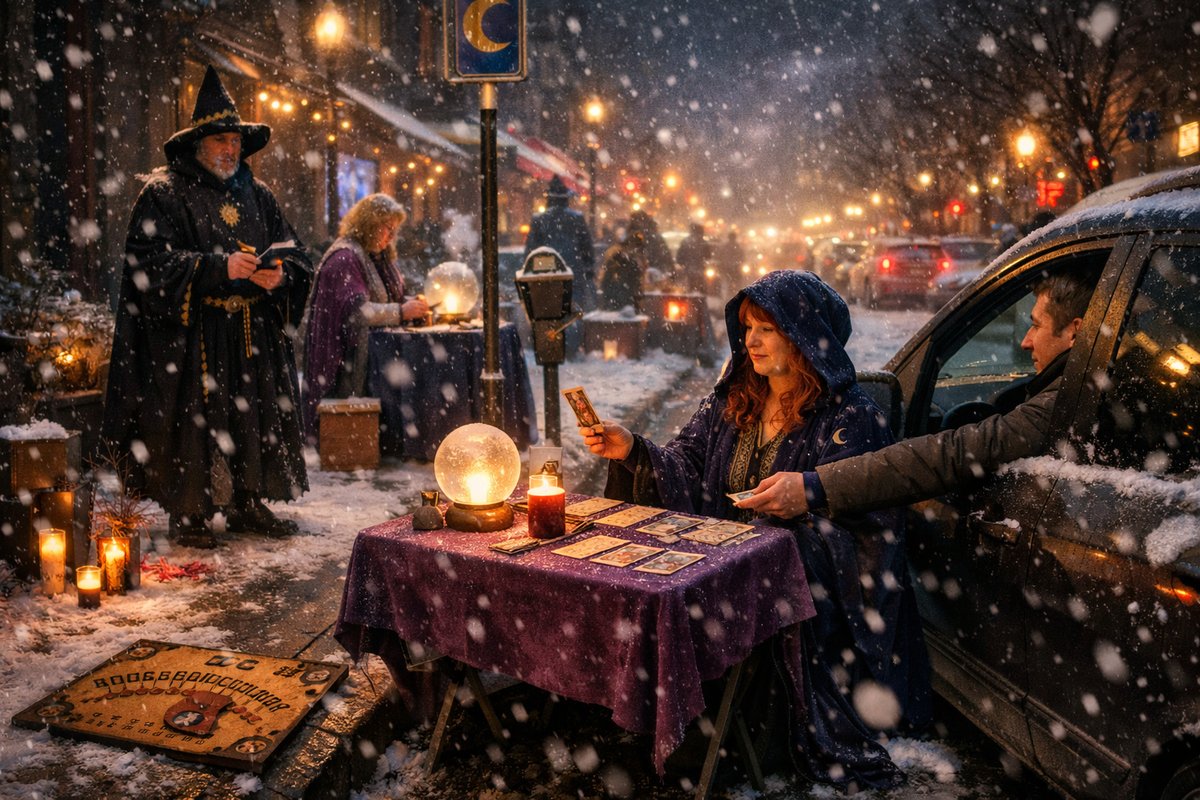

It began on an otherwise nondescript Tuesday morning, when commuters pulling into downtown spaces blinked twice at a row of folding tables draped in deep purple velvet. Seated behind them were local tarot card readers, faces powdered with dramatic eyeliner and hands submerged in ritual crystals. A new sign proclaimed “Payment by Prophecy Only,” and beneath it, a coiled incense burner expelled enough smoke to fill two city council chambers.
Councilwoman Everleigh Mossflower, leading the initiative, described it as a “harmonious fusion of infrastructure and intuition.” According to her keynote address, replacing metal parking meters with tarot readers would reduce municipal maintenance costs by 82 percent and raise “soulful awareness” by an undetermined but definitely significant amount. She insisted that every driver needed guidance from the Major Arcana before facing urban stress, traffic jams, or the existential dread of parallel parking.
Morning rush hour turned into a carnival. Drivers hopped out of sedans clutching spare change and fanned out in search of the rider-waite faithful. Some arrived in suits, others in sweatpants, but all left clutching a three-card spread predicting their parking fate: A knight of swords meant a two-hour stay, the tower reversed implied a ninety-minute limit, and the mysterious red jack of spades-no one quite agreed on its meaning-triggered an immediate summons of a parking enforcement officer.
Enforcement itself took on a theatrical flair. Officers swapped fluorescent vests for embroidered robes and official whistles for Tibetan singing bowls. When a prophecy expired, they would chant “Time has passed!” in unison, prompting drivers to scurry back for a fresh reading-or risk a cosmic fine. Merchants discovered that fortunes quickening foot traffic boosted sales, while commuters griped that their sedans felt less like vehicles and more like chariots of fate.
The financial impact was as unpredictable as the prophecies themselves. On Tuesday alone, the town tallied 2,347 payments in the form of hope, dread, and vanished socks. A handful of drivers attempted to bribe the tarot readers with coffee gift cards and coupons for deep-dish pizza. One enterprising reader accepted three parking slips and promised to “shuffle the deck of destiny” to extend a car’s stay until Friday, which remains under investigation as potential fraud.
Local businesses, ever opportunistic, adapted at warp speed. An artisanal coffee shack down the block introduced a “Prophecy Latte,” served in tarot-themed cups. A neighboring boutique launched “Parking Deck Couture,” selling velvet pouches to stash reading tokens. Meanwhile, a real estate agent claimed that properties near tarot dispatch points had a 12 percent bump in mystique value, although skeptics note that mystique doesn’t pay the mortgage.
A minor scandal erupted when a seance spilled onto Maple Avenue. Word spread that a reader summoned the spirit of the town’s founding coyote, hoping to renew the historic parking franchise. Residents watched from behind bus stops as Ouija boards clicked and cursors drifted toward ominous letters: S-O-R-R-Y. The session ended abruptly when commuters demanded change; the coyote apparition retreated to the Spirit World, fur covered in ash from the nearest incense burner.
Cries for public clarity gained volume the next day, when Mayor Lucian Maplewood-never one to miss an opportunity-announced a weekly press conference via interpretive dance under the municipal clock tower. His pirouettes spelled out budget amendments, while the climactic grand jeté symbolized a potential return to coin-operated meters. Interpretations vary, but it appears he favors a hybrid model of digital tokens and divination cards.
At the heart of the debate lies an unspoken question: Does mystical oversight improve civic responsibility or just scare people into compliance? Parking compliance soared by 37 percent-at least according to the second knight of pentacles, drawn by Councilwoman Mossflower-but complaints about “cryptic time limits” rose even faster. One outraged citizen claimed her sedan was slapped with a fine for overstaying the hermit reversed, despite having displayed a valid handicap permit.
Late-night talk shows seized the storyline, airing skits of drivers refusing to exit their cars until they consulted the ace of cups. A viral video showed a yoga instructor conducting a downward dog while requesting a three-card draw for an illegally parked Prius. Traffic apps scrambled to add “nearest freelance astrologer” as a feature. And rumor has it that next week’s meeting will debate employing local baristas to predict peak traffic times based on coffee bean origins.
Yet amid the absurdity, a surprising camaraderie blossomed. Neighbors huddled at curbside tables, comparing tarot spreads like anxious stock traders. Strangers bonded over shared frustration at the cup of dispirited water that accompanies every reading. Children giggled at the sight of hooded parking wardens tapping wands against expired meter stubs. The daily grind of urban living gained a surreal patriotism: in Walnut Falls, everyone was equally bewildered and invested.
As winter’s first flurries dusted the municipal lot, the future of the prophetic parking experiment hung in the balance. Will coins and credit cards reclaim their asphalt thrones, or will the council push forward with weekly “lunar alignment” checks? If nothing else, one thing is certain: in Walnut Falls, parking has transcended a mere transaction and become an existential journey-one that requires a seat at the cosmic reading table and a pocketful of hope.
And so, with engines idling and incense still burning, the town waits for its next revelation: whether the next major arcana will bring liberation, a fine, or perhaps a coupon for half-off prophecy readings on Tuesdays.
May your parking spot be true, and your shuffle ever in your favor.