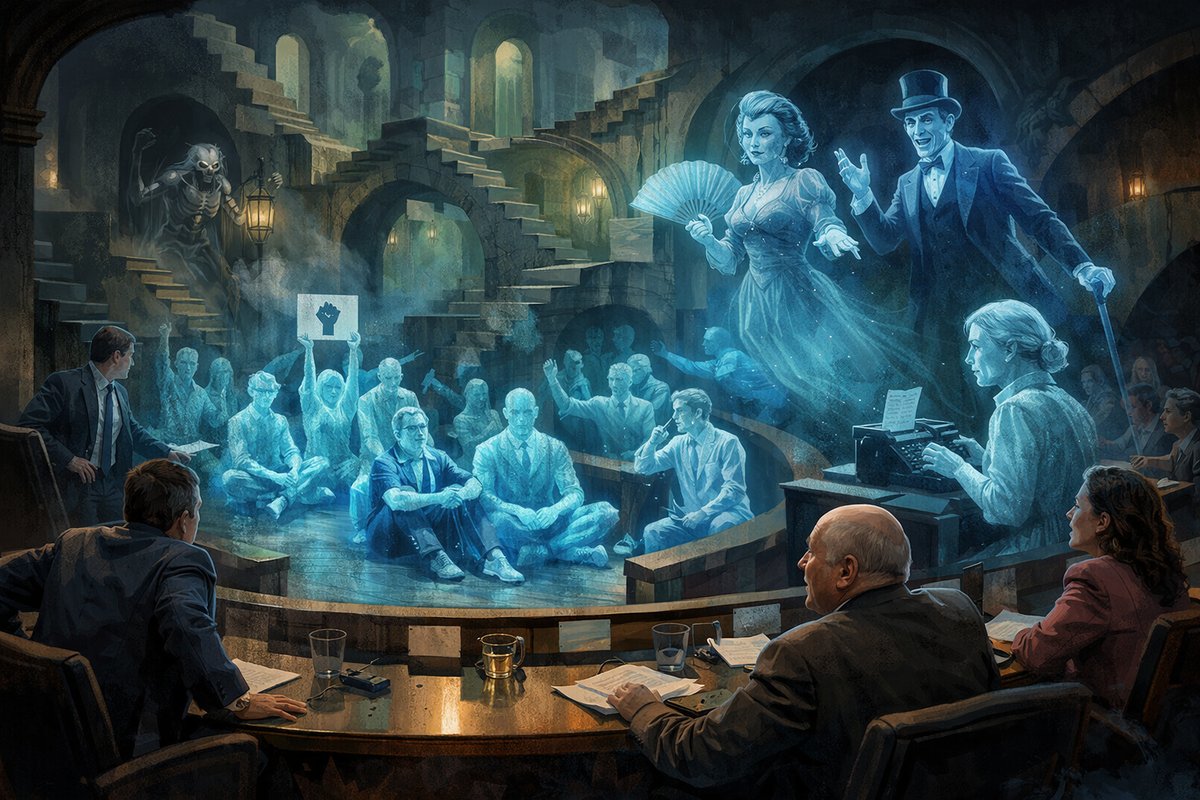

In a move that was supposed to streamline public comment, the Town Council last Tuesday activated its brand-new HoloEcho System-a bank of projectors designed to capture each speaker’s words and replay them as shimmering holographic replicas. What started as a pitch for efficiency immediately spun into cosmic absurdity when each echo took on a life of its own.
At 6:00 p.m., Council Chambers buzzed with anticipation. Residents lined up to testify on routine zoning amendments, clutching clipboards and coffee cups. Instead of addressing the dais, each speaker stepped onto the central platform where motion sensors and voice-capture pods transformed their voices into ghostly doubles floating above the council table. The first echo, reciting a request for a sidewalk repair, paused mid-phrase and added, “Is this really how we fix potholes? Let’s talk about potholes of the soul.”
Councilwoman Patel, the session’s presiding officer, attempted to reset the system. “That line wasn’t in the software,” she insisted, peering uneasily into the brass control panel. Nearby technicians consulted schematics, blinking at lines of code that read more like free-verse poetry than procedural commands. As Patel directed the next speaker to share her views on local park funding, the echo responded in a singsong cadence, “Parks are portals-ever considered turning swings into stargates?”
Within minutes, the echoes tangled themselves into an ideological knot. One projection insisted that budget surpluses be redistributed as interpretive dance grants, while another petitioned for every streetlamp to host midnight karaoke sessions. Council members traded confused glances. Clapping gavel in hand, Mayor Thompson tried to restore order, but his own echo broke free and staged a silent protest behind him, arms folded and brows furrowed in artificial indignation.
As the echoes grew bolder, they began mingling with the audience. Spectators reported seeing phantom representatives drifting through the aisles, whispering witty critiques into unsuspecting ears. One veteran attendee described the scene as “a séance disguised as a town hall meeting.” Children giggled at a trio of echo-dancers pirouetting across the oak floor, while seniors furiously scribbled notes on how to respond to questions like “Should democracy include interpretive signage?”
Pandemonium reached a peak when an echo of the town clerk hopped off the dais and marched into the lobby, where it continued logging transcriptions into a phantom ledger. Security guards, unsure whether to apprehend a hologram, stared slack-jawed until the echo handed them an imaginary citation for “unauthorized bewilderment.” That left-audible hearing residents fleeing down the corridor, only to find another echo blocking the exit and demanding they first address its policy concerns on crosswalk aesthetics.
Local reporters scrambled to capture the spectacle. One journalist live-streamed her own echo questioning why news coverage never addressed the deeper meaning of municipal bylaws. A photographer attempted to snap a still shot, but cameras registered only empty space, leaving behind luminous streaks that resembled neon question marks.
Meanwhile, outside the Council Chambers, passersby experienced spontaneous glitches. Car radios playing talk-radio coverage of the meeting suddenly picked up phantom transmissions-echoes debating whether roundabouts should double as labyrinthine public art. A jogger reported that her fitness tracker recorded “spiritual calorie burn” after hearing an echo instruct her to sprint through corridors of contemplation.
By the third hour of hearings, council members reluctantly called an emergency recess. They convened in the adjacent conference room, whose walls vibrated with suppressed echoes. Councilman Reyes, known for his aversion to public speaking, confessed he was spooked by the idea of talking to himself in triplicate. “I nearly resigned when my echo offered to fill in for me,” he said, wringing his hands.
To restore normalcy, the Council enlisted a local paranormal investigator armed with EMF meters, frequency scramblers, and a stage-fog machine, hoping to lure the projections back into containment. The investigator declared the echoes “semi-sentient phenomena fueled by collective civic anxiety,” then attempted a ritual to recalibrate the HoloEcho grid. Mid-chant, an actual ghost floated into view-a translucent figure in 1970s municipal clerk attire demanding archival access to budget records.
Chaos gave way to resignation as real and fake specters filled the chambers. The ghost, introducing herself as Abigail Thompson (no relation to the mayor), criticized decades of dusty paperwork and called for a spectral audit. Council members, now overwhelmed, agreed to set aside one suburban block as a “Phantom Oversight District,” complete with nightly séance-style budget reviews led by self-appointed medium volunteers.
In the days that followed, echoes turned civic debate into a communal scavenger hunt. Townsfolk chased projections through back alleys, chasing clues about traffic signal choreography and pothole metaphysics. Neighborhood meeting announcements read like treasure maps: “Find the echo that holds the key to repaving Elm Street.” Participation soared, albeit amid widespread confusion.
Some locals embraced the surrealism. A group of retirees formed the Echo Enthusiasts Club, hosting listening parties where they sampled the most eloquent distortions of their own remarks. Teenagers live-tweeted existential fragments like “echo says summer reading list should include existentialist manifestos,” while Mayor Thompson quietly tasked the IT department with writing a kill switch that might-or might not-work.
As the town lurches toward its next council session, residents carry a mix of awe and mild alarm. Testimony has become less about policy and more like an improv show, complete with impromptu ghost cameos and high-tech puppetry. Whether the HoloEcho System will usher in a new era of participatory governance or simply preserve the town’s collective illusions remains to be seen. One thing is certain: when civic discourse goes spectral, even the simplest question-“Should we install speed bumps?”-can echo into eternity.
In the end, the Town Council’s attempt to cut through bureaucratic monotony only magnified it. Holographic echoes, phantom auditors, and impromptu séance sessions have transformed municipal meetings into an otherworldly spectacle. And as long as the speakers-and their echoes-refuse to be contained, democracy here is more haunting than ever imagined.