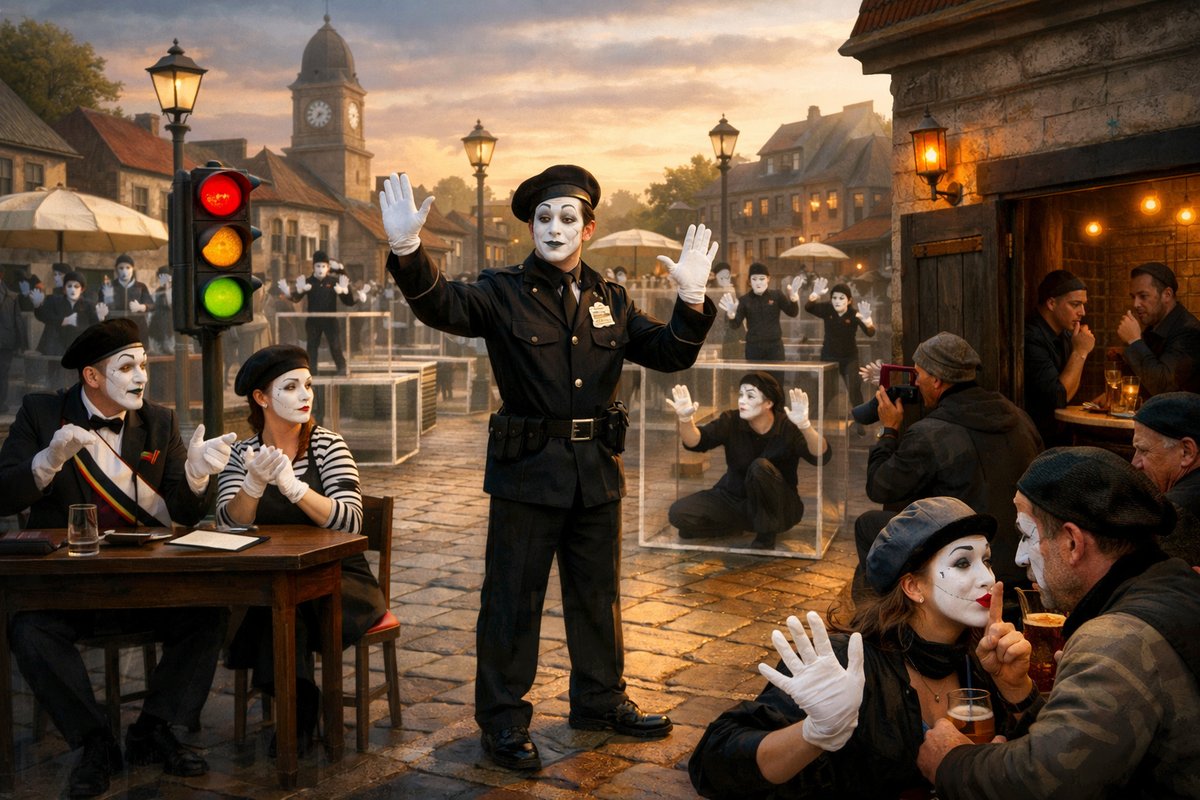

The moment the Town Council unveiled Resolution 727-C-banning spoken language from official gatherings-the small municipality of Crestview Falls braced itself for routine chaos. What no one predicted was a full-blown pantomime revolution. Within hours of the decree, civic employees arrived at Town Hall wearing white face paint and striped shirts, ready to convey zoning ordinances through invisible ropes and exaggerated eyebrow raises.
Council meetings transformed into silent slapstick theater, complete with imaginary walls, ropes, and even fire-breathing dragons. When Councilor Mendes proposed the annual budget, she did so while pretending to row an invisible canoe across a chasm of fiscal deficits. The public gallery, itself obliged to remain mute, responded with over-the-top jazz hands applause or weary head tilts. Journalists, barred from note-taking apps, scribbled frantically in notebooks to keep pace.
Mayor Hernandez, a lifelong devotee of performance art, championed the initiative as an eco-friendly way to slash “word waste.” Citing dubious research-primarily a half-remembered improv workshop-the mayor declared, “We speak 10,000 words per day; imagine the carbon footprint of that chatter! Mime replaces speech with motion, cuts pollution, and fosters empathy.” Convinced, the council also mandated that public announcements at crosswalks be relayed by volunteers from the local teetertotter troupe, rechristened “Mimes to Sign.”
On Silent Governance Day, traffic signals went dark. In their place, roving teams of amateur mimes directed motorists with sweeping gestures and phantom stop signs. One volunteer, Maxwell, dramatically clutched his chest in mock horror whenever a driver rolled through an intersection. “I’m committed to nonverbal safety,” he explained-while pantomiming CPR on an invisible victim. His dedication earned a municipal commendation and a near-collision when a delivery van mistook his fainting gestures for a personal endorsement of reckless driving.
Meanwhile, Crestview Falls’ underground “verbalist” community thrived. These word-enthusiasts met in windowless speakeasies-repurposed basements behind pizzerias-where people whispered stories over candlelight. They passed secret scrolls of haikus, sonnets, and the occasional haiku written as a limerick. Police crackdowns on audible conversation only fueled the thrill of forbidden syllables. By the second day, one group staged a whispered reading of Shakespeare’s most dramatic monologues, prompting an enthusiastic yet silent standing ovation.
At the municipal fountain, which the council had repainted in black-and-white stripes to match the mime motif, citizens gathered nightly to reenact classic silent films on giant projection screens. The local Rotary Club sponsored “Breakfast at Noon,” a pantomime brunch where attendees pretended to sip coffee and nibble pastries in perfect silence. Even the town dog-walkers coordinated elaborate dog-miming routines-simulated walks, pretend leash tugs, invisible frisbee tosses-turning sidewalks into an improvisational mime festival.
Not everyone was enamored. The Crestview Gazette’s editorial board, normally a mild-mannered crew, published a scathing cartoon: three mime-clad bureaucrats locked around a table in a box marked “Forever.” The accompanying caption read, “When democracy goes silent, only the mime remains.” That cartoon prompted furious letters from residents who claimed the mime dress code was an artistic triumph, while others filed complaints to the state attorney general over their sore throats from excessive throat-clearing.
Escalation came in the form of a traffic accident that might have been scripted by Chaplin himself. Late one evening, two volunteer mimes directed cross-traffic at the main intersection. As they engaged in an impromptu “wall climbing” routine-arms pressed upward-the stop gesture for northbound cars looked suspiciously like an invitation to race. A pair of college students, mistaking the climb for a green light, tore through the crossing at top speed. The ensuing fender-bender required emergency services, which themselves communicated via interpretive dance until paramedics could secure sign-language interpreters.
In response, the council added Resolution 728-D: any volunteer mime on duty must attend monthly traffic-control workshops taught by the high school drama coach. Attendance was mandatory, though silence remained enforced. Drama coach Evelyn Cho cheered the new rule, proclaiming, “Our students are emerging artists in civic choreography!” She then illustrated effective turn signals with a flamboyant ballet spin.
By day five, fatigue set in. Residents spent more time decoding gestures than living normal lives. Grocery lines resembled silent auctions: shoppers pantomimed produce weighing, bartered through nods, and paid with imaginary credit cards. A rumor circulated that City Hall staff had invented an electronic “Gesture-to-Text Converter,” but no one could prove its existence. Some whispered the device was locked in the mayor’s office, hidden behind a giant cardboard box.
Mounting protests appeared in the form of a Flash Mob Opera staged in the municipal plaza. Hundreds of masked singers belted arias in soft whispers, their sheet-music pages glowing under handheld lights. The performance climaxed with a chorus of “O mio canto proibito,” leaving mime-guard volunteers utterly flummoxed. Cameras streamed the spectacle live, and within hours the hashtag #SpeakCrestview fell into the town’s top ten trending topics nationwide.
Faced with viral embarrassment and a series of near-miss collisions, the Town Council convened an emergency session-conducted, ironically, with full speech privileges to expedite the repeal. In a rousing five-minute address, Mayor Hernandez admitted that “in the pursuit of silent progress, we may have tripped over our own imaginary walls.” Resolution 727-C was rescinded, and the town’s voice returned with a collective cheer audible from three blocks away.
As residents emerged blinking into the light of spoken communication, council members announced a new pilot program: “Embrace Your Inner Mime.” Rather than enforce silence, they invited citizens to sign up for weekly improv workshops-and next month’s agenda would apparently involve interpretive origami. Crestview Falls had learned one lesson above all: democracy thrives on dialogue, not drama. But if you ever see a mime lurking outside City Hall, wave hello-just to be safe.