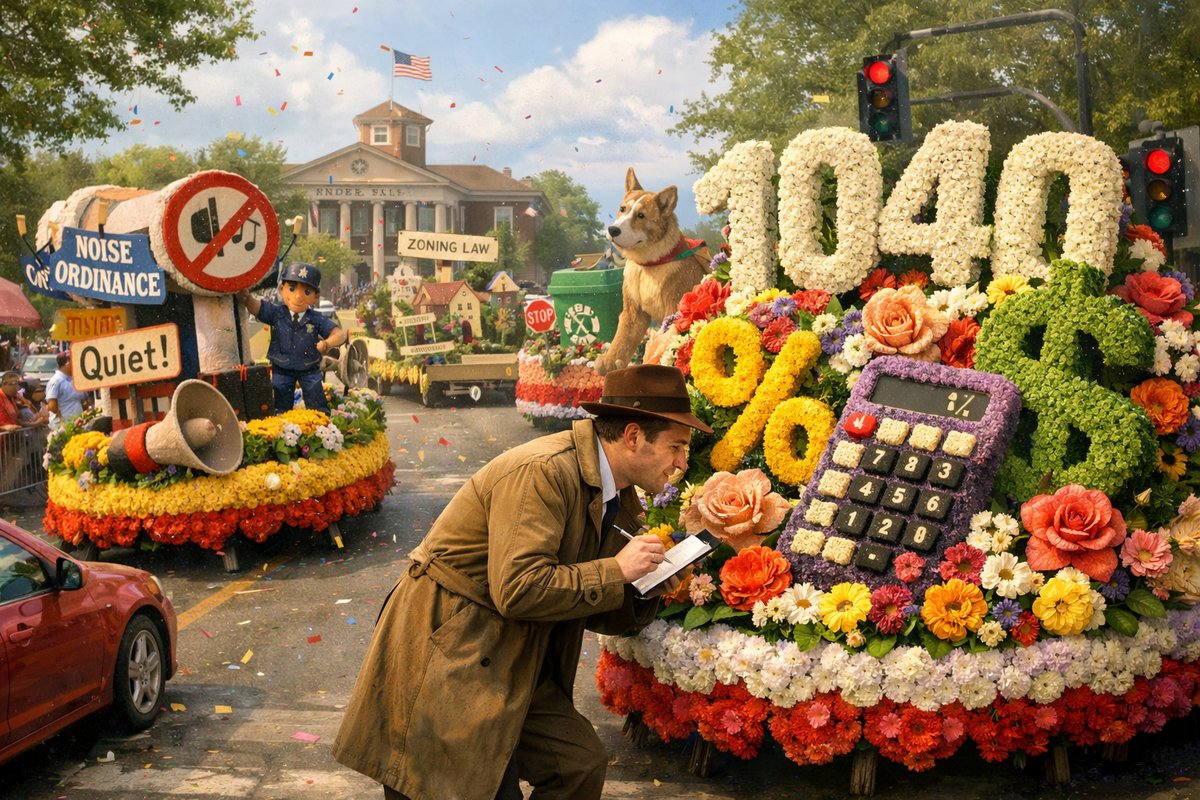

Last Saturday at sunrise, Main Street in Ridgeville was transformed into a makeshift Capitol Mall as the Town Council’s newly formed Bylaw Float Committee rolled in with seven elaborate parade floats, each representing a different municipal ordinance. Paint still drying, foam sculptures leaning at improbable angles, and engineering blueprints soldered with hot glue greeted bleary-eyed residents who’d been lured out of bed by rumors that the budget deficit would be settled by a giant papier-mâché piggy bank cannon. What could go wrong?
The idea originated at the council’s most recent retreat-an exercise in “immersive democracy” held in a rented barn and facilitated by a consultant wearing an Uncle Sam top hat. After sampling local produce and three kinds of honey-infused bourbon, the council president declared that distributing reams of printed bylaws was a “trust-killing slog” and that citizens needed theatrical stimuli to stay engaged. Thus, every proposed change to zoning, public safety, and community events would debut as a float in the inaugural ‘Civic Pageant of Policies.’
Float One, sponsored by the Planning Department, took the form of a giant clothespin pinching a miniature model of the historic district. Onlookers were handed card stock ‘zoning petitions’ to wave whenever the pinched buildings seemed out of scale. Float Two featured the Water Management Division’s ambitious sewer-fee overhaul, portrayed as a boiling cauldron of metaphorical sludge. Council staff tossed rubber ducks into the cauldron while chanting, “Brace your wallets!” Citizens scrambled for foam waders to catch the falling ducklings, convinced each quack contained secret discount codes-spoiler: they didn’t.
Throughout the morning, floats drifted slowly down the parade route, each accompanied by an interpretive marching band instructed to play the statute’s key provisions in musical form. The Junk Band of Ridgeville, known for turning street festival themes into discordant jazz, surprised everyone by rendering the capital improvement bond language into a surprisingly catchy riff. A cluster of toddlers twerked to the tune, inadvertently raising public support for the municipal pool renovation float.
The real chaos began when Float Four-the grand Tax Reform Spectacle-rolled headlong into the emergency lane, blocking an ambulance rushing to a nearby hospital. The float’s enormous gear mechanism, designed to symbolize “economic machinery,” failed to retract in time. Citizens watched in stunned silence as paramedics transferred the patient onto a neighboring float styled as a medieval galleon and navigated around the obstruction. The council’s public safety advisor later insisted that the dramatic rescue “reinforced the importance of flexible transportation policies,” though nobody was quite sure whether that translated to fewer floats or more ambulances.
Meanwhile, the Community Grants float resembled a Roman temple façade supported by Doric columns made of rolled-up grant applications. Volunteers dressed as toga-clad senators hurled envelopes like confetti, each one containing an actual grant from a local non-profit. One ham-fisted toss sent a $5,000 arts grant paddling down Cedar Creek. A teenage kayaker retrieved it just in time, becoming an unwitting hero who declined an interview until his father sized him up for a future in politics.
At midday, a flock of selfie-stick-wielding influencers congregated around Float Five, dubbed “Code Enforcement Carnival.” It was a rotating carousel of inspection notices: every quarter-mile spun a new citation for leaky gutters, overgrown hedges, or a neon sign’s wattage exceeding community guidelines. The carousel’s tickets slid out automatically, prompting citizens to scan QR codes and settle fines on the spot. Social media lit up with viral clips of neighbors scanning their phones mid-carousel revolution, often discovering they owed more than they had in their bank account.
While floats Six and Seven paraded the new recycling mandates and parkland acquisitions, fatigue set in. Children started trading miniature versions of the floats as if they were trading cards. A group of retirees in lawn chairs began live-blogging the event on an antique typewriter, stopping only for tea breaks and mild existential crises. Local bakery trucks trailed the procession, selling “float-inspired” pastries: tax-levy éclairs spiked with edible gold leaf and park-bench pretzels shaped like wrought-iron scrollwork.
Amid the mayhem, one citizen emerged as the day’s unlikely MVP. Sixteen-year-old Marisol Vega, president of her high school’s robotics club, noticed that the floral arrangements on the Tax Reform Spectacle were arranged in a Fibonacci sequence. She recognized a hidden code: when decoded, the sequence spelled out the precise adjustment needed to equalize the budget without raising property taxes. Marisol sprinted to the microphone atop the Emergency Lane Galleon Float, corrected the tax formula in real time, and was promptly awarded a life-size seat on the Tax Reform float’s council bench-an honor that came with complimentary foam waders and front-row parking.
By late afternoon, the council was forced to adjourn the Civic Pageant of Policies. The Bylaw Float Committee, overwhelmed by collapsed foam columns and conflicting marching band tempos, conceded that printing digital copies of ordinances might be “more cost-effective.” Nonetheless, they announced plans for a smaller spring event: a “Legislative Lantern Festival” in which every bylaw would be captured on floating paper lanterns launched into the sunset. Critics argued that was just as impractical, but supporters countered that at least it wouldn’t block ambulances.
In the days that followed, civic life in Ridgeville took on a newfound sense of levity. Local art classes filled up with adults eager to learn papier-mâché tax pigs. High school drama clubs rushed to remix float themes into one-act plays. A digital map of the parade route went viral after a cartographer overlaid it with Pokémon-style icons for each float’s policy category. Meanwhile, the retired typewriter-bloggers launched a Kickstarter to publish their epochal tweets in a leather-bound edition titled “Paper Trails: Chronicles of a Civic Circus.”
Town Council members maintained that the Civic Pageant of Policies achieved its goal: reengaging citizens in municipal affairs. They pointed to the record-high turnout at the subsequent zoning referendum-now held in the community center instead of on floats-and noted a 32% increase in public comments submitted online. Even the ambulance service reported that paramedics had never been so enthused to climb onto a foam dragon galleon at 8 AM.
Yet skeptics wonder whether the budget spent on foam sculptors, parade permits, and band stipends might have been better allocated toward road repairs, senior services, or straightforward digital newsletters. In an open letter, the local chapter of the Taxpayers’ Alliance called for an end to “float-based governance experiments” and the reinstatement of good old boring policy documents.
The council president responded with characteristic optimism: “We’re not abandoning floats-just downsizing. Next time, we’ll involve drones and projection mapping to reduce our foam footprint. Imagine zoning maps beamed onto clouds.” Critics rolled their eyes, though some admitted that at least it was more imaginative than the usual spreadsheet presentations.
Ridgeville’s civic experiment has since inspired other towns to propose their own theatrical twists: drone ballet for environmental regulations, hand-shadow puppet hearings for public hearings, and even augmented reality spectacles that project bylaws onto citizens’ sunglasses. Whether these ideas will fly remains to be seen-but one thing is clear: in this town, democracy never looks the same twice.
From the foam-flecked streets to the echo of jazz statutes, Ridgeville’s Great Float Fiasco will live on in local legend. At Council meetings now, members can’t help but grin at each new policy, wondering how it might one day pirouette down Main Street. And somewhere in her garage, Marisol Vega is tinkering on a miniature float with a built-in 3D printer, determined to automate next year’s Civic Pageant of Policies so that every citizen can have their own personal legislative float-and maybe decode it before the marching band catches up.