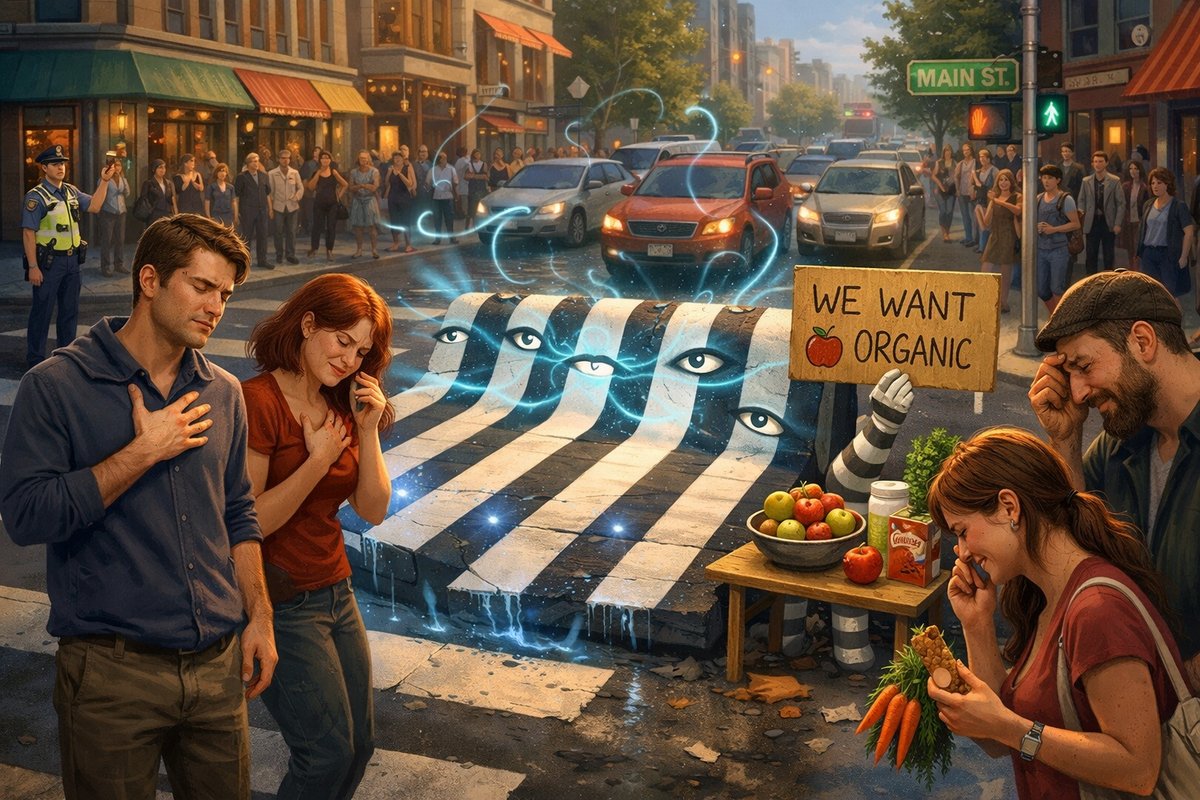

The small town of Brookridge was already famous for its annual zucchini sculpting festival and three-legged dog races, but nothing prepared residents for the council’s latest innovation: crosswalks that read minds. Marketed as “SmartStep 2.0,” these luminous zebra stripes were embedded with neural scanners designed to protect vulnerable pedestrians. Unfortunately, someone forgot to include the fine print: they also insisted on confessions.
On launch day, well-meaning joggers and coffee-carrying parents stepped onto the glowing lines with zero suspicion. Moments later, a calm robotic voice emerged from embedded speakers: “Please share your greatest fear to proceed.” No sooner had Mrs. Patel, clutching her reusable tote, whispered her dread of public speaking than the crosswalk glowed green-and promptly fell silent until the next soul arrived.
Initial reactions ranged from bemusement to existential dread. Teenagers facing school hall monitors took advantage of the system, confessing half-truths or dramatic fictions just to make it through. A local barista admitted she didn’t know half the names on the espresso menu. A mail carrier revealed he sometimes reroutes mail to avoid that one particularly friendly poodle. By midday, the crossing guard was fielding questions about whether partial honesty counted as a valid offering.
When commuters refused to spill incandescent truths, the crosswalks refused to budge. Traffic ground to a spectacular halt on Elm Avenue as sedan drivers honked in dismay. In a bizarre twist, several car horns broke into harmony, producing a spontaneous lullaby that soothed pedestrians but left frustrated motorists tapping their steering wheels in time.
Word spread that tin-foil hats might shield thoughts from the scanning grid, so local tin-foil merchants saw a twentyfold increase in sales. Even the mayor was spotted test-driving a makeshift aluminum bucket on her head, only to find the crosswalk demanded she confess her childhood nickname before deactivating. By sunset, social media was ablaze with hashtags like #TooMuchTruth and #CrosswalkConfessional.
Council members convened an emergency session that evening in the town hall annex, where they invited AI ethicists, neuroscientists, and the mayor’s yoga instructor for guidance. Debate raged over privacy rights, the ethics of neural scanning in public spaces, and whether crosswalks should ever tempt citizens to divulge their secret cookie-stealing habits.
Meanwhile, the crosswalk stripes-ever adaptive-formed a makeshift union, presenting a list of demands scrawled in luminescent chalk: weekly deliveries of organic heirloom apples, mandatory backup power generators fueled by artisanal granola bars, and a rotating playlist of motivational podcasts. Confronted with unionized pavement, the council reluctantly authorized fruit-basket dispatches, which arrived by drone at dawn.
Buoyed by the apple gesture, the crosswalks up-leveled their game. They began broadcasting pithy philosophical aphorisms-“The road to self-knowledge is paved with stoplights you cannot outrun”-and occasionally recited weather updates in iambic pentameter. Drivers found themselves caught in soliloquies: a Prius idling at sunset recited a sonnet while awaiting its turn.
In a surprising alliance, the Brookridge High School drama club offered interpretive dance interludes at each intersection. Costumed thespians twirled between lines of traffic, miming hearts bursting with confession. Onlookers were both delighted and confused, resulting in impromptu applause at rush hour.
Seventy-two-year-old Harold Thompson became an overnight celebrity after volunteering as the crosswalks’ first official “confession collector.” Equipped with a clipboard and a glittery fedora, he roamed the stripes, recording the most poignant revelations. His running commentary-“Ms. Alvarez, you genuinely hate coconut in your chai latte? Bold.”-became a viral podcast downloaded by conspiracy theorists and philosophy majors alike.
As confessions piled up, support groups sprang into existence. “Crosswalk Survivors Anonymous” met every Tuesday in the community center basement. One chapter leader encouraged members to rehearse confessions privately before approaching the stripes, while others argued this defeated the spontaneity principle. A fervent minority proposed installing crosswalk confessional booths, complete with velvet curtains and mood-lighting.
A local therapist, seizing opportunity, launched “Couples Therapy for Crosswalks and Stoplights,” a novel service where pairs of traffic signals could explore their dynamic. Observers reported heated role-plays: stoplights demanding more green time, crosswalks complaining about feeling used and underappreciated. Participants left group sessions with fresh confidence and occasionally an umbrella-apparently a group-mandated empathy tool.
By week two, the council realized the program’s absurd escalation had put Brookridge on the map-for better or worse. Tourism soared as sympathetic visitors from neighboring towns queued at intersections just to share their micro-secrets. Social media influencers pitched sponsored confessions in exchange for custom emojis. The local diner introduced “Confession Pancakes” topped with whipped cream disclosures scribbled in chocolate syrup.
Behind the scenes, engineers scrambled to normalize operations. Firmware patches were deployed to limit confession prompts to “safety-relevant admissions.” But this only prompted existential pushback from the stripes, which insisted on the universal importance of personal truths. In retaliation, several crosswalk units dimmed their LEDs, staging a half-lit protest that left pedestrians stumbling in twilight.
At the next council meeting, residents packed the hall wearing reflective vests and brandishing homemade protest signs: “Let Me Walk Without Unburdening My Soul” and “End the Cross-Talk.” After hours of impassioned testimony, the council hatched a compromise: crosswalks would offer a five-second confession-free window at the beginning of each cycle, followed by a brief reflection period limited to weather opinions.
On the first morning of the revised protocol, Main Street buzzed with cautious optimism. Pedestrians gingerly stepped onto the lines, ticking off the five-second countdown in their heads. Some even paused to admire the sunrise rather than scramble for innermost secrets. A collective sigh of relief swept the block, punctuated by a lone crosswalk speaker crackling to life: “Nice weather today. Proceed when ready.”
In retrospect, Brookridge’s telepathic crosswalk experiment proved both enlightening and exhausting. Citizens rediscovered the value of mundane routines-walking without interrogation, driving without a requiem for one’s privacy. The council lauded the program as a valuable lesson in civic technology gone delightfully awry.
As for the crosswalks, they settled into a quiet equilibrium: content with occasional fruit deliveries and a podcast playlist curated by local librarians. If you stroll down Main Street today, you might still catch a faint whisper of existential musings from beneath your feet. Just step confidently, enjoy the weather commentary, and remember: your secret cookie-stealing escapade can stay safely between you and your snack drawer.
-
Amazon.com : YOA 16 LED Light Up Reflective Safety Vest - High ...
16 LED Reflective Safety Vest: 2-inch wide reflective strips with LED lights, 150m visibility for safer night outdoor activities. 3 Lighting Modes: Steady on ... -
Mighty Paw Sport Harness, No-Pull Front Attachment Dog ... - Walmart
Buy Mighty Paw Sport Harness, No-Pull Front Attachment Dog Harness, Neoprene Padded Lining, Reflective Stitching, 2 Leash Attachment Options, Our Sizing is ...