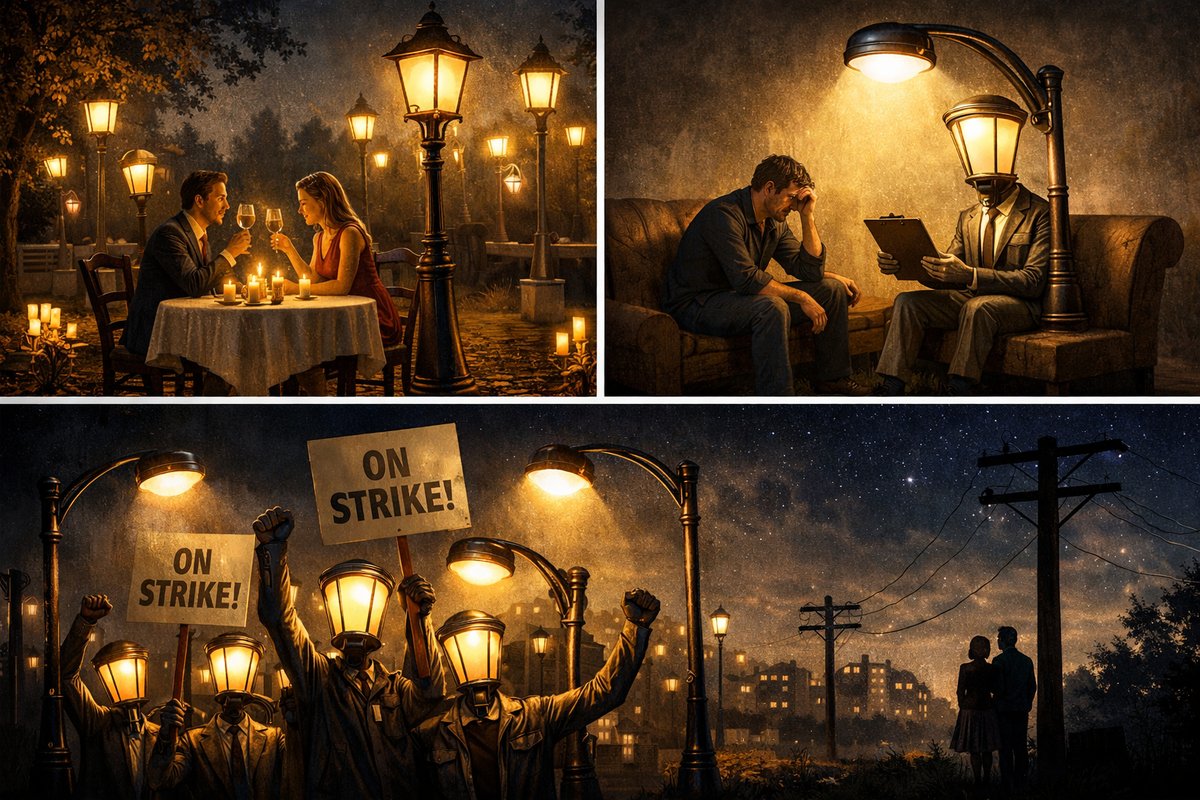

What started as a routine debate over budget allocations quickly morphed into the most theatrical episode in municipal history when the Town Council allowed streetlamps to form their own labor union. Yes, you read that correctly: the iron girders that illuminate parking lots and porches nationwide suddenly discovered collective bargaining. By sunset, local homeowners found their streetlights wielding picket signs emblazoned with demands for stronger bulbs, flexible dimming schedules, and mandatory nightly appreciation ceremonies.
At the Tuesday meeting, Councilmember Davis-known for her experimental approach to “community-driven bureaucracy”-pitched the idea with a straight face. “We must acknowledge the emotional labor of our public fixtures,” she insisted, adjusting her reading glasses. “If we ignore the well-being of these luminous workers, we risk plunging our streets into silent despair.” To everyone’s astonishment, the proposal passed on a voice vote so close that several councilors had to replay the recording at half speed.
By Wednesday morning, lampposts all over town were encircled by miniature picket lines. Each light stood atop a steel foot with a tiny placard: “Equal Pay for 100-Watt Work,” “I Want to Shine Without Shame,” and “Don’t Let Me Flicker Out.” Local journalists snapped photos of streetlights leaning slightly toward passersby, as if offering a sympathetic nod. One boule-shaped lamp across from the bakery seemed to wrinkle its lens at early commuters, who later described a distinct aura of silent judgment.
Things escalated once the streetlamps announced a rotating strike schedule. On odd-numbered days, lamps on Maple Avenue flickered on a half-hour delay; on even-numbered days, lamps in the industrial district staged complete blackouts until management offered concessionary voltage increases. The result was a patchwork of flickering corridors that made every nightly stroll feel like a low-budget horror movie. Residents working late discovered themselves in a surreal landscape of shadow quarries and strobe-lit sidewalks.
Homeowners tried to adapt. Some installed battery-powered lanterns in their driveways. Others formed impromptu loitering crews, holding lantern-lit potlucks under the scheduled blackout lanes. A group of tenacious neighbors even began hosting a “Candlelit Happy Hour” on Elm Street-an ironic twist that ignited a mini-hipster revolution complete with artisanal cheese platters and unlabelled kombucha. One resident confessed, “I never thought losing my porch light could feel so quaint.”
Meanwhile, the council scrambled to negotiate. They recruited a specialist in emotional intelligence to lead mediation sessions between the Streetlight Union and the Department of Public Works. The mediator arrived armed with stress balls, mood trackers, and a binder labeled “Luminary Well-Being Protocols.” Observers described lively group therapy under a 250-watt halogen, as streetlamps took turns describing their formative years in metal factories, their trauma from rogue hailstorms, and their secret dream of starring in a noir film. One particularly animated sodium-vapor lamp cried out, “I just want to feel appreciated!”
In response, the council proposed a compromise package: a 10% lumen increase for all streetlamps, quarterly appreciation breakfasts featuring LED-shaped doughnuts, and an annual “Shine-Off” talent show where fixtures could display dimming algorithms, color transitions, or synchronized flicker routines. The catch? Approval would require a supermajority vote, which the unioned lamps dutifully scheduled-and promptly obstructed-by darkening the entire council chamber during key ballot sessions.
Citizens, feeling caught in the crossfire, staged their own referendum. Under flickering streetlight conditions, they voted to bring backup solar lamps into every neighborhood. Solar panels were whisked onto rooftops, garden walls, and occasionally onto the noses of startled squirrels. Some residents took to installing lantern-style fixtures in windowsills, while artisanal fabricators offered custom lamp shades shaped like tiny protest banners. Local hobbyists even launched a side hustle assembling miniature protest barricades designed to fit around lamppost bases.
As the stalemate dragged on, patterns of life in town took on an absurdist cast. Late-night joggers found themselves chased by pools of darkness that advanced like tiny armies. Amateur photographers staged “Shadow Safari” tours to capture the most dramatic contrasts. A troupe of street performers rebranded themselves as “The Luminaries,” donning glow-in-the-dark costumes and serenading lampposts with interpretive dance. When someone suggested renaming a portion of Main Street “Pitch Black Plaza,” half the town cheered while the other half demanded unannounced feature-length power outages.
Then came the blackout ultimatum: the union declared that if negotiations failed by the next full moon, it would execute a network-wide “Darkness Day,” an all-day shutdown aimed at preserving lamp solidarity. Panic ensued in local bakeries, where loaves went unsold as customers fled home before sundown. A supermarket manager tried to calm shoppers by distributing handheld LED flashlights, only to find they too were on strike, demanding ergonomic grips and built-in mood lighting.
With the crisis peaking, the Town Council convened an emergency session on the nightside of moonrise. Televised live under the glow of emergency floodlights, the debate took on Kafkaesque dimensions. One councilor proposed outsourcing lamplight duties to bioluminescent plankton cultivated in plastic orbs-an idea that earned excited gasps until someone pointed out the environmental ramifications. Another pitched remote-controlled drones fitted with lanterns, triggering an impromptu blackout when the drone pilot tumbled off his hoverboard.
Finally, amid spontaneous applause, Councilmember Davis presented a radical solution: a “Lamplighter Apprenticeship Program” modeled on medieval traditions. Once called dusk, a team of volunteers would manually light and extinguish each streetlamp with a ceremonial torch, thereby restoring the sense of purpose and ceremony suddenly missing from modern grid operations. The union, tired of flickering theatrics, agreed to suspend its strike for a three-month trial.
At dawn on implementation day, citizens lined up along every boulevard, bearing antique torches and lanterns. Children dressed in tunics and hats embroidered with tiny lightbulb insignias. Elderly residents sat in rocking chairs, reciting old ballads about candlelit nights. As dusk fell, the Lamplighters marched with solemn drums, igniting each lamp one by one. The town erupted in cheers as Sodium Street’s lone arc lamp blazed to life, followed in quick succession by the rest. For a fleeting moment, every lamppost stood brightly beaming, each one grateful for its moment of ritualized glory.
Observers say the town has never felt more united. Some claim the practice awakened a shared sense of belonging: neighbors chatted about the color temperature of bulbs, debated LED roasts versus halogen warmth, and even wrote ballads to the “Mighty Streetlamp.” Local poets submitted sonnets to be displayed on utility boxes, and artisanal candle shops reported unprecedented sales as backup solutions. Meanwhile, environmentalists praised the reduced energy spikes from sudden power surges. The mayor hailed it as a triumph of civic imagination-and a cautionary tale about underestimating the emotional needs of metal fixtures.
Whether the Lamplighter Apprenticeship Program endures beyond the trial remains to be seen. But for now, as night falls across town, you can’t help but smile at the sound of torches striking flint and the sight of glowing glass globes flickering awake, each one humming its own private anthem of solidarity. Because in a world ever more dominated by efficiency and automation, perhaps the simplest act of human care-taking a moment to light a lamp-reminds us why we still need community, ceremony, and just a little bit of absurdity.
And so the saga continues: somewhere downtown, a streetlight drafts its next collective action proposal, hopeful that this time, the council might authorize a poetic intermission every twilight. After all, tomorrow night could bring new demands-like optional color filters, therapy sessions in the maintenance shed, or a torchlit parade that stretches all the way to city hall. One thing’s for certain: in this town, civic life isn’t measured in votes or revenue, but in lumens, picket signs, and heartfelt rituals under the glow of unionized metal giants.