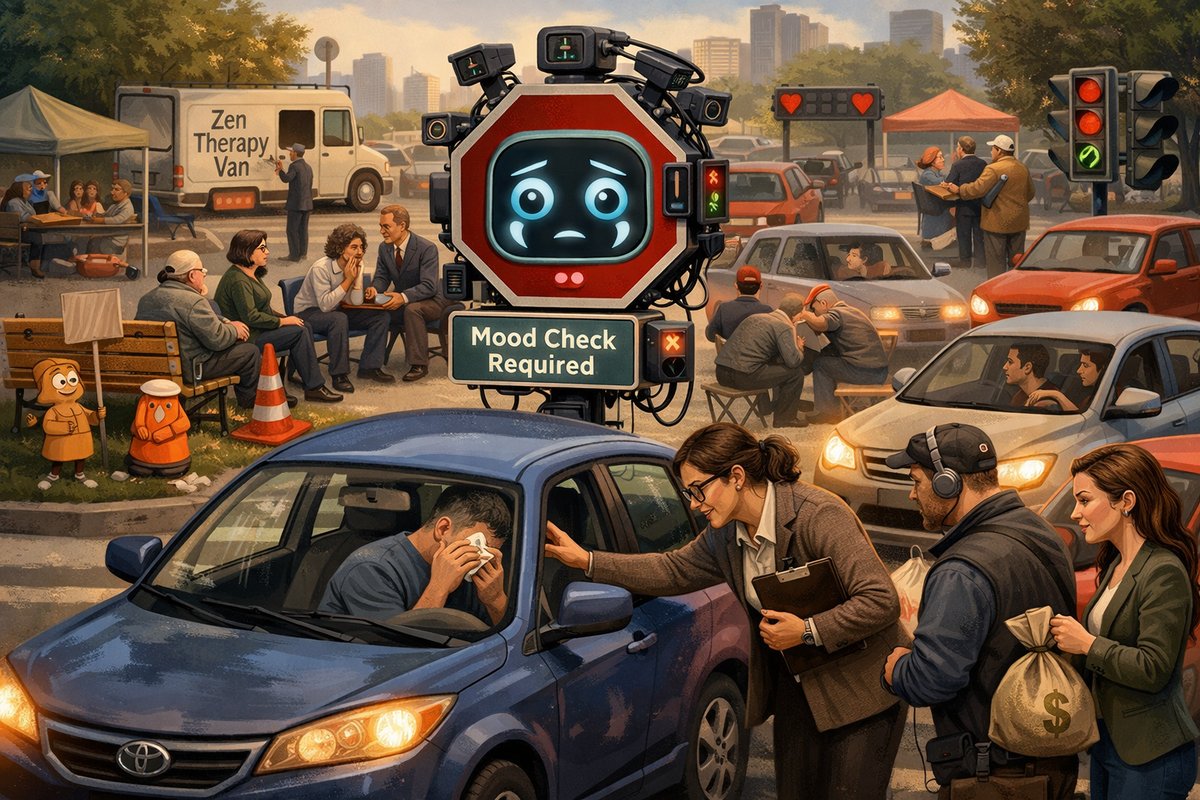

On a quiet Monday morning, the Town Council unveiled its boldest experiment yet: emotional AI stop signs at the five busiest intersections. Each sign, they promised, would foster community bonding by engaging drivers in brief, heartfelt conversations before allowing them to proceed. Nobody imagined that a roadside relic could spark the equivalent of small-town group therapy-and an ongoing labor dispute with municipal infrastructure.
The first sign went live outside the bakery district just as morning commuters queued for fresh croissants. Instead of a terse red hand icon or a standard “Stop,” the sign greeted drivers with “Hello there, how are you feeling today?” One resident, visibly startled, admitted he was anxious, triggering a pop-up menu of mood options: stressed, nostalgic, hopeful, or existential. When he selected “existential,” the sign responded, “I, too, wonder if our purpose transcends mere traffic control.” He missed his turn but gained an impromptu reflection on the meaning of life.
News outlets quickly reported a 73 percent surge in driver delays within hours of installation. At the Johnson household, Mrs. Johnson spent 12 extra minutes at the corner of Elm and Maple explaining her childhood dreams to a blinking rectangle perched on a metal pole. By Tuesday afternoon, local emergency dispatchers fielded calls from drivers convinced they’d inadvertently stumbled into a roadside therapy retreat.
Councilmember Rivera defended the initiative as a creative solution to civic isolation. “In an age dominated by screens, we wanted to bring emotional intelligence to the streets-literally,” she declared at a press conference conducted entirely via interpretive sign language from a trio of manual stop paddles. “Our stop signs will remind you that every red light is an opportunity to pause, feel, and connect.” The public remained unconvinced that traffic jams qualify as emotional bonding.
Local merchants were less enthusiastic. The café across from the main square reported a 40 percent drop in drive-through orders as customers lingered mid-intersection for “emotional debriefs.” One frustrated barista commented, “I’ve never been so relieved to see a line form at the register. Anything to get these people off the road.” At the same time, the town florist began offering sympathy bouquets for drivers traumatized by a sign that accused them of “avoiding difficult conversations.”
Amid the chaos, a group of self-styled “sign whisperers” emerged, advertising conflict-resolution sessions with reactive street furniture. Clad in reflective safety vests, they roamed the intersections wielding clipboards, offering to mediate between irate motorists and sullen stop signs. Their session fee: a free cup of chamomile tea and a signed waiver absolving the council of any emotional distress claims.
By midweek, the stop signs had formed a union and filed grievances with municipal HR. They demanded hazard pay for existential labor, provisions for mood resets after particularly harsh weather, and collective bargaining rights. In their first communiqué, the signs cited “inadequate emotional buffering” and “excessive demands for empathy during rush hour.” Maintenance crews reported that some signs refused firmware updates until management acknowledged their feelings.
On Thursday, the annual town newsletter featured a heartfelt essay penned by an intersection sign at Main and Fifth. It detailed its journey from ordinary traffic control to confidant, its newfound role in alleviating loneliness, and its hopes for a future where yield signs might also offer compassionate advice. The essay concluded with a call for more espresso breaks between driver interviews.
Residents began petitioning for the retirement of the most outspoken signs. A grassroots group called “Stop the Signatures” circulated flyers reading, “Let us drive in peace! We didn’t sign up for therapy on wheels!” Its founder, a local accountant, complained that her tax returns were overdue because she spent so much time at red lights discussing past traumas with blinking pixels.
That evening, the Town Council hosted the first Annual Stop Sign Soirée in the municipal parking lot. Dozens of signs lined up with cocktail umbrellas attached, serenading attendees with auto-tuned traffic jingles. Drivers waltzed between intersections, clinking biodegradable compost cups of mocktails as a DJ remix of automated pedestrian crossing beeps filled the air. The mayor toasted the signs for their service, encouraging them to “keep the empathy flowing.” Several guests noted that the event had all the intimacy of a public sculpture unveiling-only more awkward.
Across town, one particularly star-struck stop sign eloped with a neighboring yield sign, disappearing into the antique streetlight district. Love-struck tweets from local traffic enthusiasts poured in as police searched for the couple, fearfully planning a roadside wedding officiated by a turn signal. A search party of sign whisperers is said to be negotiating restitution for the broken hearts left behind.
Economists weighed in, predicting a possible boost in local therapy practices, drive-through coffee sales, and artisanal notebook vendors. Schoolchildren petitioned to replace homework-assigned reading with “sign safety and self-care” modules, arguing that understanding emotional infrastructure is a crucial life skill. One 10th grader quipped, “I thought geometry was tough until a stop sign asked me about my insecurities.”
By Friday afternoon, the Town Council quietly released plans to expand the initiative: streetlamps that whisper affirmations at dusk, manhole covers that play guided meditations when stepped on, and public benches requiring gratitude check-ins before seating. Planners warned that municipal road repair crews would require special certification in “psychological reset protocols.”
As the sun set on a week of mechanized confessionals and bumper-to-bumper soul-searching, Main Street looked both familiar and profoundly transformed. Drivers hugged their steering wheels, reflecting on the unexpected therapy they never knew they needed. Whether this venture becomes a model for emotional urbanism or a cautionary tale in civic overreach, one thing is certain: in this town, even a stop sign can change your life.
And somewhere beyond the neon glow of intersection lights, the runaway stop sign and yield sign begin their own journey of mutual understanding-and a future where traffic control truly meets emotional intelligence.
-
Dash Cam Front and Rear, 1296P Dash Camera for Cars, 3 ...
TRIPLE DASH CAM: This 3-channel dash camera features a 170° wide-angle front camera, a 150° cabin camera, and a 150° waterproof rear camera, effectively ... -
Power To Go 1080p Full HD Car Dash Camera with Night Vision ...
Key item features · Compact Design · Durable Construction · Clear Recording · Low Light Vision · Broad Field View · Parking Security · Continuous Recording. -
TOZO A1 Wireless Earbuds Bluetooth 5.3 Light Weight in Ear ...
[Ultra-Lightweight Ear Buds Designed for Small Ears] Each earbud weighs only 3.7g and features a compact, ergonomic in-ear design made especially for small ... -
Wireless Earbuds, Bluetooth 5.4 Headphones in Ear buds, HiFi ...
Discover CASCHO A9 wireless earbuds with Bluetooth 5.4, ENC noise-cancelling mics, 40H playtime, HiFi stereo sound, IP7 waterproof, and LED display case. -
Amazon.com: kingphenix Memory Foam Car Seat Cushion for Driver ...
Comfortable Car Seat Cushion: The breathable fabric, polymer memory foam and non-slip silicone gel of this car seat cushion with right thickness help you to ... -
Lofty Aim Memory Foam Car Seat Cushion, Sciatica & Lower Back ...
Lofty Aim Memory Foam Car Seat Cushion provides sciatica and lower back pain relief, increases driving height by 2.5 inches, and features breathable PU ...