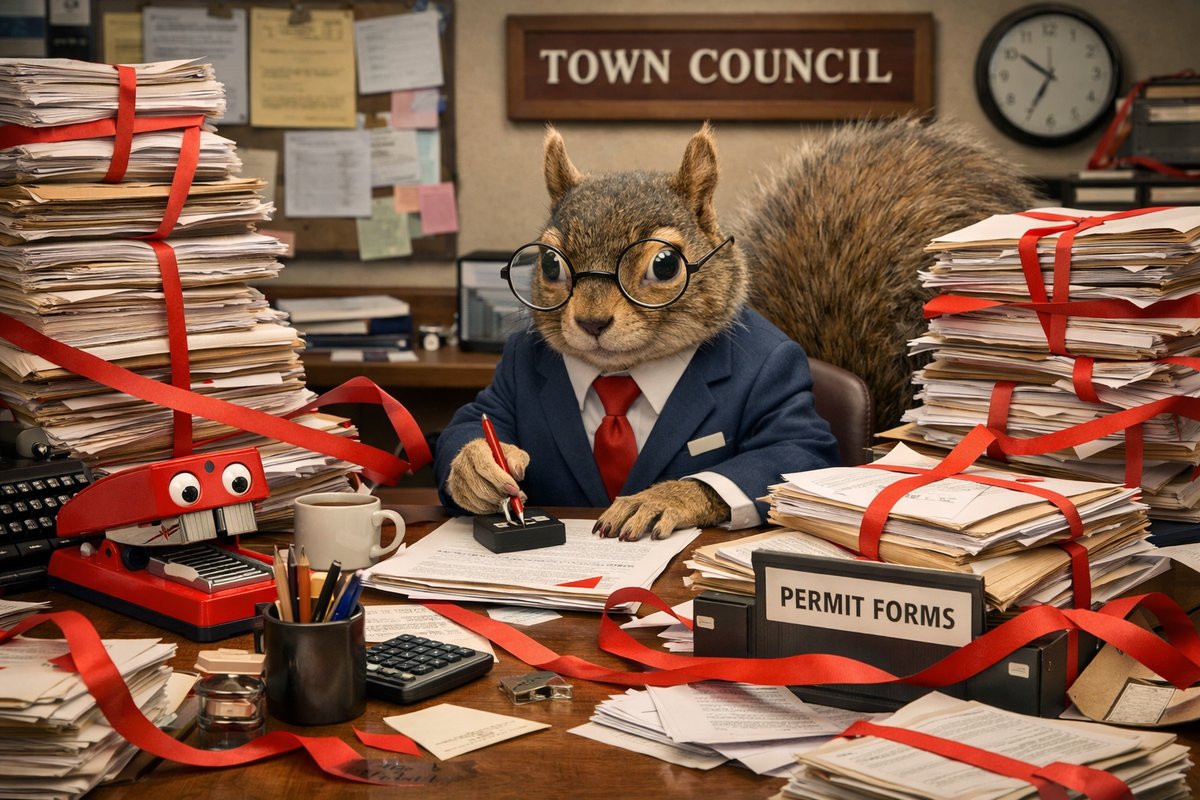

The town council had long prided itself on innovative governance, but nothing prepared the residents for the announcement that would soon ripple through every coffee shop, dog park, and unattended mailbox. In an unprecedented act of participatory democracy-or perhaps a clerical mix-up-the council elected a local squirrel, affectionately nicknamed “Mr. Nutters,” as the new Chief Compliance Officer. This decision, while initially met with a mixture of bewilderment and amusement, swiftly ignited a chain reaction of bureaucratic absurdities that redefined municipal management in ways no one could have predicted.
Mr. Nutters was no ordinary squirrel. Known for his tireless energy and uncanny ability to navigate the urban jungle’s tangled power lines, he quickly adapted to the dizzying array of compliance documents, forms, and procedural manuals stacked precariously in the council chambers. His first official act? Insisting that every citizen submit their residency proof notarized by a certified rodent-an edict that baffled the legal department and overwhelmed local wildlife.
Within days, the town’s bureaucracy morphed into a surreal labyrinth. Permit applications ballooned in complexity, with new fields such as “Acorn Ownership Verification” and “Tail-Flick Frequency Declaration” appended to every form. City hall was soon inundated with frantic calls from residents seeking clarification, only to be met with Mr. Nutters’ signature tail flicks-interpreted by aides as cryptic compliance signals.
Not content with merely complicating paperwork, the squirrel chief championed a “Nuts & Bolts” initiative aimed at tightening security by mandating that all municipal buildings install acorn-shaped locks. The program backfired spectacularly when the locks proved irresistible to the local squirrel population, leading to nightly raids that resembled miniature heists. Fire alarms blared at odd hours, and janitorial staff reported mysterious piles of chewed paperwork in the break rooms.
As the town grappled with these developments, a new cultural phenomenon emerged. Inspired by Mr. Nutters’ cryptic gestures, citizens began interpreting his tail flicks and ear twitches as a new form of nonverbal communication. A burgeoning “Squirrel Sign Language” community formed, complete with workshops and interpretive dance sessions held in the park. Linguists from neighboring regions arrived to study this phenomenon, their academic papers peppered with phrases like “Acorn Clause Compliance” and “Furrowed Brow Filibuster.”
Despite the chaos, some council members praised the initiative as a masterclass in emotional intelligence and civic engagement. One alderman remarked, “Who better to understand grassroots issues than someone who literally lives among the trees and power lines?” Meanwhile, local businesses reported a surge in sales of nut-themed merchandise and squirrel-proof containers, turning economic disruption into entrepreneurial opportunity.
However, not all residents were enchanted by the new order. Complaints flooded in about the impossibility of navigating the new permit system, with one frustrated citizen lamenting, “I just wanted to fix my mailbox, not submit a 47-page dossier on my nut consumption habits!” Petitions circulated demanding a return to human leadership, but the council remained steadfast, citing Mr. Nutters’ “unparalleled dedication and tail discipline.”
The climax of this bureaucratic saga came unexpectedly during the annual town festival, where Mr. Nutters was scheduled to deliver a keynote address via a custom-built squirrel-sized podium. As the crowd gathered, anticipation mingled with skepticism. When the moment arrived, the squirrel launched into an elaborate series of tail flicks and chirps that were instantly translated by an AI interpreter into a poetic manifesto on sustainability, community, and the sacredness of shared spaces.
The speech, though incomprehensible in conventional terms, resonated deeply with attendees, many of whom reported a newfound appreciation for the interconnectedness of urban life. Social media exploded with hashtags like #TailFlickDiplomacy and #SquirrelVision, sparking debates on the future of inclusive governance and the role of nonhuman agents in civic processes.
In the aftermath, the town council announced plans to establish a “Squirrel Advisory Board,” ensuring that Mr. Nutters’ unique perspective would inform future policies. Meanwhile, the rest of the world watched with a mix of incredulity and envy, pondering whether this small town had stumbled upon a new paradigm of democratic engagement or simply descended into delightful absurdity.
This chapter in municipal history serves as a vivid reminder that governance, at its core, is a human endeavor made richer-and occasionally more confusing-when it embraces the unexpected. Whether the bureaucratic squirrel will become a lasting symbol of civic innovation or a quirky footnote remains to be seen. For now, the residents carry on, clutching their nut-shaped permits and decoding tail flicks, embracing the beautifully bizarre dance of community life where the lines between nature and bureaucracy blur in the most entertaining ways.
-
JBL Tune Flex - True wireless Noise Cancelling earbuds - Blue
Experience up to 32 hours of JBL Pure Bass Sound with Tune Flex true wireless earbuds featuring noise cancelling, ambient tech, water resistance. -
Plustek PS186 Desktop Document Scanner, with 50-Pages Auto ...
Up to 255 customize favorite scan file setting with "Single Touch" , Support Windows 7/8/10; Turn paper documents into searchable, editable files - save ... -
Desktop Document Scanner & Digital Filing System for PC & Mac ...
NeatDesk will scan in your receipts, business cards, or documents at a speedy 24 pages per minute. Scan up to 50 pages at once - 1 or ... -
Amazon.com: Ergonomic Mesh Office Chair,Comfy Computer Desk ...
The ergonomic chair features adjustable lumbar support and a synchro-tilt mechanism with tension adjustment and 3-position lock, providing customized support ... -
SIHOO M18 Mesh Ergonomic Office Chair with Adjustable Lumbar ...
Designed in a W shape, the cushion helps alleviate pressure on the thighs and lumbar region to offer a more comfortable sitting experience. The backrest of the ...