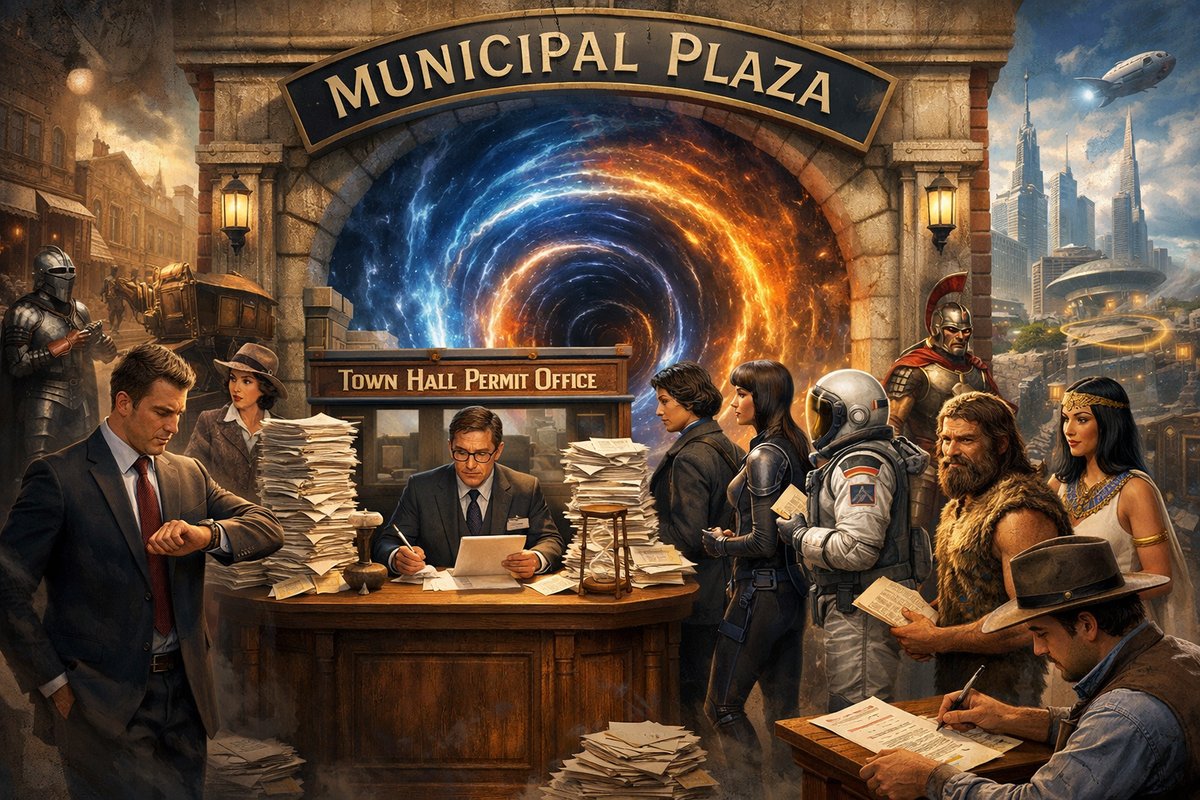

On a drizzly Tuesday morning, the Town Council convened beneath the ornate neon sign glowing “Municipal Plaza.” Councilor Edna Briggs, armed with a cat’s paw gavel and a stopwatch set to arbitrary future hours, called the session to order. “Fellow citizens,” she intoned, “we face an unprecedented convergence of chronological curiosities. I move that we declare this plaza a Temporal Anomaly Zone, henceforth requiring all visitors-residents, tourists, and wandering time-trippers-to secure a time-travel permit.”
Applause rippled through the chamber-though several members clutched their foreheads as if battling instant jet lag. Mayor Donovan quirked an eyebrow. “Permit fees can be paid in current currency or any recognized form of future credit,” he announced. Councilor Briggs tapped her stopwatch. “Applications open… now.”
Within seconds, the Permit Office lobby transformed into a kaleidoscope of eras. A man in Victorian waistcoat pressed a quill-spattered parchment against the counter; a glow-tailed envoy from 2387 tried scanning his hand for bio-temporal clearance; a woman in 1920s flapper attire demanded a rush filing. Behind them, a teenager sporting a holographic hoodie complained that the online portal was buffering in 0.00004 picoseconds.
“No problem,” said Peggy from Permits. “We’ve got our new quantum typewriter. It processes forms at the speed of hypothetical thought.” She slid a stack of forms into the machine and emerged wearing safety goggles, muttering, “We might have broken Tuesday.”
By midday, the Permit Office was swamped. Civic staffers found themselves juggling applications from the Roaring Twenties, Renaissance painters seeking afternoon licenses, and a delegation from an as-yet-uninvented civilization politely requesting a weekend pass. Every time the quantum typewriter finished a batch, it printed an extra fifty identical permits stamped “VALID FOR EVENTUALLY” and self-combusting into confetti.
Back in the Council chamber, Councilor Briggs projected a hologram of an extrapolated timeline onto a smudged whiteboard. Radiant lines crisscrossed in impossible loops, linking past council meetings to imagined future referendums. “Without clear time slots and sequenced approvals,” she warned, “we risk overlapping ordinances. I just received notice that our grant for the new library was simultaneously approved and repealed-in 1872 and in 2720.”
The mayor leaned forward. “Edna, what about the mayor’s own permit?” he asked. She tapped her stopwatch. “I issued it this morning at 10:27 a.m. and again next Wednesday at 3:14 p.m.” Suddenly the mayor turned pale and clutched his head. “I… I can’t remember if I ever funded the streetlight replacement. Or even if I exist anymore.”
Outside, local coffee shops tried to stay one step ahead. The Chrono Café unveiled the “Quantum Latte,” a two-shot espresso infused with decaffeinated grounds harvested next Tuesday. Across the street, a pop-up stand sold commuter kits containing erasable notebooks labeled “To-Do Lists of Now and Then.” Residents whispered of phantom deadlines from alternate timelines.
Chaos reached its peak during the first intertemporal Town Hall, when the council invited public feedback in real time and future tense. A hush fell when a ghostly figure in breeches rose to denounce the town’s decision to pave over a meadow in 1694-though the meadow wouldn’t exist until Tuesday next year. Moments later, a speaker from 2142 suggested using anti-gravity varnish on the new community center. The translator headsets crackled as participants toggled between Old English, Martian creole, and something that sounded alarmingly like code.
In the Permit Office, tears were shed over lost forms from forgotten centuries. Supervisor Miguel handed out “Chrono Clinic” appointment cards, promising one free session to prevent identity collisions. “It’s like therapy,” he sighed, “but with more ghosts.” Meanwhile, the quantum typewriter began printing applications by the dozen for towns that have yet to be founded-and some that were wiped off the cosmic map in official Time Council memos.
Late in the afternoon, Councilor Briggs proposed a temporary reprieve: “We will issue a limited run of daily passes valid only between 2:02 and 2:03 p.m. Subject to quantum flux conditions.” The mayor consulted his soon-to-arrive self, walked back from the podium, and whispered, “Edna, are we sure this is easier than a simple traffic rezone?”
By evening, the Municipal Plaza resembled an outtake from a sci-fi pageant. Residents lined up for permit selfies; others held impromptu “when did you arrive?” reunions. A small choir of forward-spun children serenaded passersby with refrains of “We’re tomorrow’s yesterdays.” Street musicians from every decade took turns soloing on vintage instruments and futuristic synth pads.
As the council adjourned, Councilor Briggs pocketed her stopwatch. “Tomorrow,” she declared, “we’ll pilot a permit-free hour. No forms, no fees-just show up and hope the timeline stays intact.” The crowd cheered, though by then they were cheering in two or three different centuries.
Some worried this would undo the whole experiment. Others felt energized by the unpredictable swirl of past and future colliding. At least one retiree vanished entirely while waiting for his permit-he reappeared ten minutes later claiming he’d been to his own 90th birthday party. The municipal staff updated their motto to read: “Temporal Permit Office: Serving Yesterday, Today, and Perhaps Tomorrow.”
No one quite knows where the next chronal snafu will emerge-city hall calendars now include footnotes written in languages not yet invented-but there’s a new communal spirit. Residents gather each morning to consult the Town Time Bulletin, trying to guess which hour belongs to which decade. Local bakeries offer “anachronistic bagels” topped with flavors from unacknowledged epochs. The park fountain now spouts water dyed in gradient hues to mark the flow of seconds into centuries.
In the end, the Town Council’s grand plan-to make governance an interactive, multi-temporal spectacle-has succeeded beyond expectation. Budgets may remain in draft form until 2525, and grant applications might loop back through the Jurassic Era, but at least everyone agrees on one thing: democracy has never been more… interesting. And if you happen to spot a flock of toga-clad philosophers disputing zoning laws, just nod and ask for a time-travel permit-preferably printed in at least three increments of relativity.
Residents have discovered that deadlines can be elastic, meetings can guest-star your future self, and the simple act of stepping onto the plaza can transform an ordinary afternoon into a chronological carnival. So if you’re in town this Tuesday-or was it last Thursday?-be sure to stop by, pick up your permit, and brace yourself. After all, what’s the worst that could happen in a zone where time is officially off the clock?