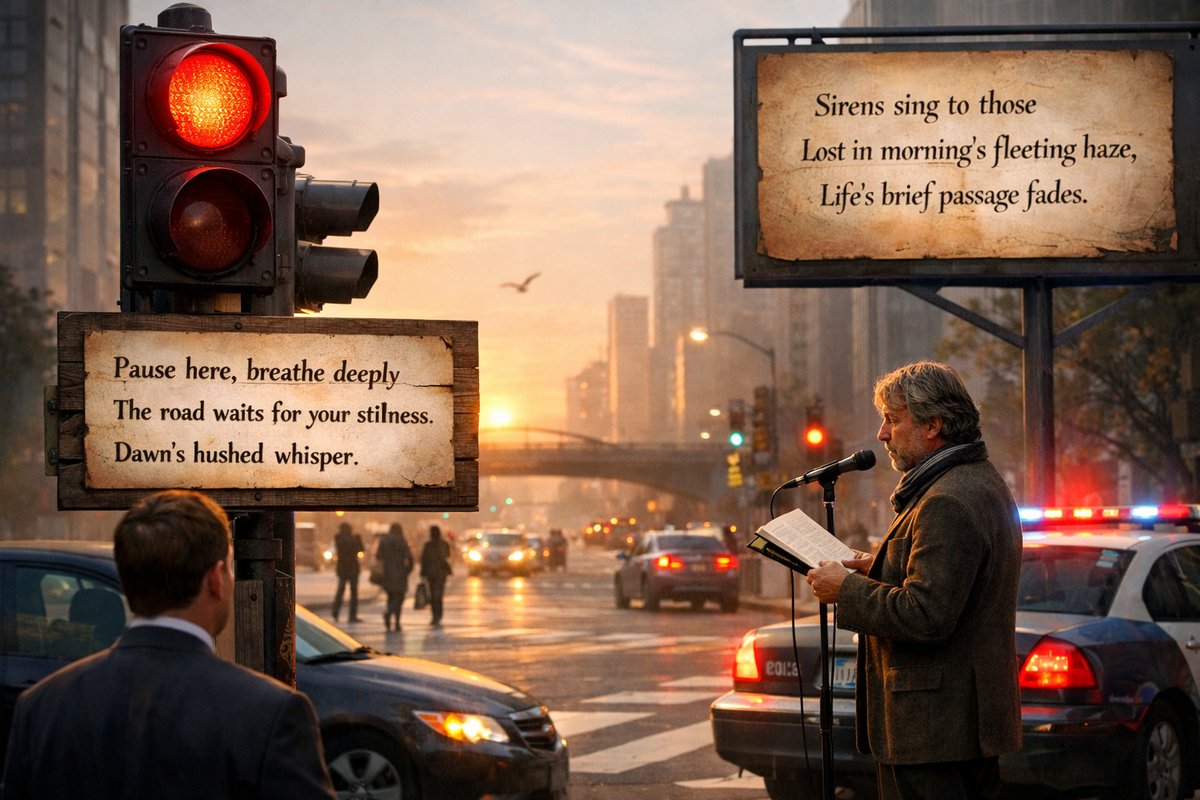

Last week, in a move that left GPS units twitching with existential dread, the Town Council voted unanimously to replace its traffic engineering department with a consortium of philosopher-poets. Officials argued that conventional signs and signals had grown stale and failed to probe the deeper questions of urban life: Why must we hurry, and what does it mean to pause at an intersection? By week’s end, drivers entering town found their routine commutes reborn as grand exercises in metaphysical reflection.
Within hours of the first dawn patrol, the new traffic engineers installed a network of voice-activated stoplights that deliver haiku instead of buzzers. One local mechanic reported that the red light at Elm and Fifth now intones, “Scarlet blossom falls / Pedestrians hold their breath / Life sweats in the street.” Commuters described being so enchanted that two entire carriages of the morning bus held a spontaneous poetry critique before the light turned green.
Veteran driver Sandra Lopez recalls her inaugural journey under the new system. “I was halfway through my pre-coffee grump when the amber light recited, ‘Daylight yawns, awake / Souls threaded through metal shells / We pause, then proceed,'” she said. “I found myself Googling the luminescence of dawn instead of checking my rearview mirror. Then I nearly rear-ended the Prius in front of me because I forgot to press the brake pedal.”
The council’s initiative also introduced interpretive micro-communiqués posted on every stop sign. Instead of the stolid command STOP, each sign now displays rotating philosophical prompts: “Have you considered the nature of will?” or “In the absence of motion, what is stillness?” These prompts are printed in shimmering ink that catches headlights at night, leading some late-shift couriers to meditate on the meaning of dark roads while parked in the loading bay.
By midweek, the situation escalated from charming quirk to full-blown civic art installation. Bumper stickers evolved overnight into pocket-sized philosophical chapbooks, and ride-share drivers began offering in-transit seminars on phenomenology instead of background music. A well-meaning yoga instructor hired by the council led downtown stretches between red lights. Reports surfaced of marathon commuters safely performing sun salutations in crosswalks while bicyclists recited Epictetus.
Local businesses noticed an unexpected side effect: foot traffic at cafes soared as drivers lingered at intersections to complete haiku analysis before pressing forward. One espresso bar owner confessed that she started charging by the syllable rather than by the ounce after patrons debated meter and rhyme for up to ten minutes per order. A nearby donut shop offered a “Sonnet-and-Sprinkle” special-each glazed ring inscribed with a single word of praise for the traffic experiment.
Town Clerk Ingrid Banks, champion of the initiative, defended the council’s bold cultural gamble. “We wanted to disrupt the habitual grind, to turn a mundane commute into an act of civic engagement and aesthetic wonder,” she explained. Banks noted that the program was partly funded by an arts grant usually reserved for sculptors, performance troupes, and abstract painters. “If we can make people question pavement markings, perhaps they’ll also reconsider climate policy, public health, and whatever else we leave until the next budget cycle.”
Not everyone welcomed the sudden infusion of metaphysics into asphalt. A coalition of commuters demanding a return to basic traffic etiquette formed outside City Hall. Their signs read slogans like “Stop Haiku. Start Driving” and “I Just Want to Get to Work Without a Midlife Crisis.” Late-night talk radio has been inundated with callers confessing existential despair mid-red-light monologue and demanding bullet-point instructions instead.
Meanwhile, a group of teenage skateboarders has capitalized on the council’s philosophical detours. They set up a pop-up reading circle in the scarcely used right-turn lane on Maple Avenue, reciting passages from Nietzsche between tricks and urging motorists to reflect on the abyss beneath their wheels. Their stunt went viral when a passing van livestreamed the scene with the caption, “Skate or meditate? You decide.” The ensuing social media storm drew curious onlookers, turning the underutilized lane into a makeshift amphitheater.
Community knitting clubs, history buffs, and amateur dramatists have joined the movement, staging sidewalk salons at detours and roundabouts. One local knitting circle declared that the spiral of a roundabout resembled the cyclical nature of memory and destiny, incubating an impromptu performance of interpretive dance in reflective vests. Council meetings now open with a living statue frozen mid-probe, symbolizing the decision paralysis motorists feel when caught between philosophical signage and actual crosswalk paint.
Insurance companies, ever vigilant about risk assessment, issued a stark bulletin: drivers must now present a “Certificate of Philosophical Reflection” at policy renewal. The certificate attests that the holder has adequately wrestled with at least three haiku, two door-mirror epigrams, and one roundabout monologue. Failure to secure the certificate could result in significant premium hikes or the dreaded “Existential Gap Coverage” surcharge.
State transportation officials have begun an audit, politely requesting the town to revert to conventional cones, signs, and digital timers. A memo circulated from the highway department read, “While we appreciate the cultural experiment, be aware that a sudden influx of commuter philosophers can cause traffic hemorrhages and an uptick in potholes created by distracted drivers.” One puzzled auditor reportedly asked, “Do we need a separate grant for metaphysical pothole repair?”
Faced with mounting pressure, the Town Council convened an emergency session under a delegation of elder poets draped in neon safety gear. The proposed compromise: maintain haiku at the busiest intersections but install discrete override buttons that allow drivers to fast-forward through existential prompts during time-sensitive emergencies. A prototype booth dubbed the “Pragmatist’s Bypass” would stream classical rock and show streamlined speed-limit updates.
In an ironic twist, the original traffic engineering staff-laid off during last month’s budget cuts-filed a class-action lawsuit for reinstatement, citing “negligent existential risk.” Their lead attorney argued that the lack of standard countdown timers at crossings constituted a public safety emergency. Meanwhile, commuters who endured a full week of poetic signals have formed affinity groups, planning an annual festival complete with performance readings at every four-way stop.
Whether the council’s grand social experiment will endure beyond its current grant cycle remains uncertain. But one thing is clear: a simple drive through town is no longer just a commute. It is a living canvas of words, a challenge to the autopilot mind, and a rolling symposium on the human condition. Most residents have learned to pack their notebooks and bring extra carabiners for reading glasses. Others are just hoping the next red light will at least supply a coffee vendor.
Amid the swirl of protest, praise, and poetry, the Town Council already hints at its next avant-garde venture: replacing public park benches with confessional booths staffed by dream interpreters. Until then, drivers buckle up, sit back, and brace for the next epistle at Elm and Fifth. After all, in this town, even a left turn feels like a turning point in the story of existence.