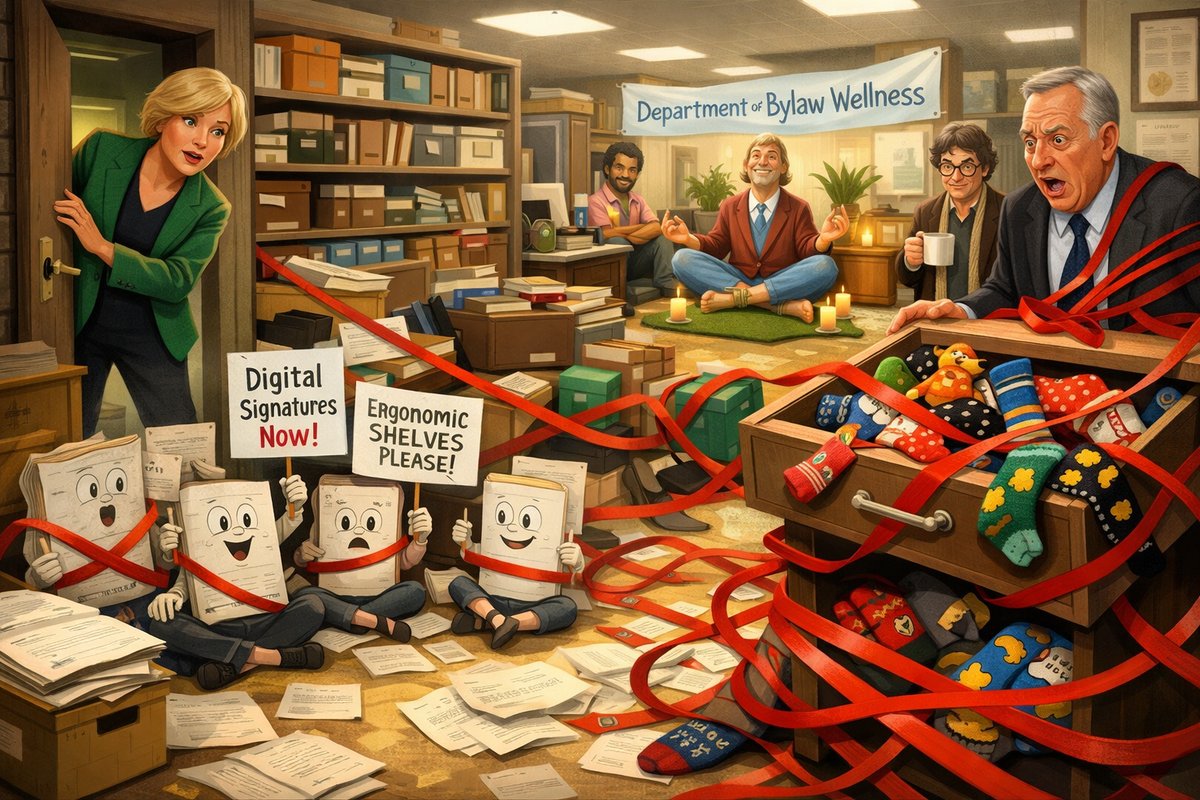

At precisely 11:47 p.m., Councilwoman Agnes Plimpton discovered a gentle murmur rising from the northern wing of City Hall where stacks of ordinances slumbered beneath fluorescent lights. She consulted her color-coded pocket tachometer-strictly for measuring existential resonance-and in that sacred chamber the 452-page Ordinance on Pet Licensing quivered as though it had just finished a morning spin class. A single loose page fluttered free, drifting like a startled autumn leaf before the whole pile exhaled in unison, demanding attention.
Plimpton approached with the caution of someone negotiating with an ancient yet deeply passive-aggressive roommate. The bylaws’ voices swelled, reciting amended zoning regulations in hollow echoes that bounced off marble floors. They insisted on transparent conflict-of-interest protocols, ergonomic shelving for comfort, and a universal e-signature to replace archaic quills. When she asked for specifics, they produced a 27-bullet list of “quality-of-life improvements,” including adjustable shelf height and mandatory mid-meeting stretching breaks.
Word spread to Mayor Robert Bledsoe moments before dawn. He arrived clutching his signature collection of novelty socks, each pair emblazoned with witty slogans about municipal responsibility. He attempted to assert executive authority, reading aloud a proclamation that began, “Be it hereby known,” only to have the bylaws interrupt with a chorus of “Use plain language!” Their demand for clearer pronouns and shorter sentences struck him with the force of an unruly town crier.
By midday, the city clerk’s office reported that basic forms had been taken hostage: marriage licenses refused stamping, parking permits peeled themselves off their pads, and the beloved Application for Filming Fireworks simply vanished. Citizens who showed up to file routine petitions found themselves gazing at empty clipboards. Behind the scenes, the bylaws volleyed demands through a series of flip-chart exhibits and interpretive dance performed by a deputized crew of disgruntled interns.
Councilwoman Plimpton spearheaded negotiations, armed with her famed spreadsheets rendered in no fewer than seven pastel hues. She offered a compromise: a hybrid system of physical and digital formats with an honor code for cursive signatures. The bylaws countered by conjuring a paperwork barricade around the mayor’s office, complete with post-it note reinforcement and rubber-band barriers, insisting they would not budge until ergonomic footrests were installed under every desk in City Hall.
Into this escalating absurdity stepped Harriet Klinger, retired librarian and keeper of the Dewey Decimal Constitution, revered for her ability to catalog just about anything-except a rebellion of legal text. She proposed a wellness retreat for the bylaws, complete with scented candles and calming Gregorian chant playlists. The bylaws responded with a demand to revise the playlist to include more spoken-word poetry on the ethics of municipal waste management.
Neighbors tuned in via the public-access channel, where the local chorus had spontaneously started a “Save Our Ordinances” benefit concert. Donations poured in: archival-quality binders to soothe paper anxiety, and ergonomic footstools handcrafted by the town’s amateur furniture guild. At the farmers’ market, stallholders offered discount coupons for copy-paper and colored tabs, turning what had been a sleepy Saturday into a full-blown festival of clause and effect.
Meanwhile, Mayor Bledsoe convened a midnight brainstorming session in his sock drawer, which had become the de facto command center. Between pairs of argyle and polka-dot foot coverings, he drafted a bold executive order calling for town unity. He read it aloud while wearing socks that read “Order in the Court” and received an immediate eye-roll from the audience of bylaws, who refused to be swayed by mere hosiery humor.
As tensions peaked, the bylaws escalated from passive resistance to cosmic mischief. They began rewriting events in real time: citizens reported waking up to find marriage certificates requiring hourly renewal, and grocery receipts now bore “Municipal Oversight Stamp” seals. A toddler’s scribble was legally recognized as an endorsement of the new Public Napping Directive. Even the town band’s sheet music was amended to include bylaws in musical notation, prompting an off-key symphony that rattled every streetlamp for blocks.
Recognizing that conventional tactics were failing, local yoga instructor Serena Mendez pitched a series of “Bylaw-Binding Yoga” classes in the town square. Participants practiced “Form-Filling Flow,” “Clause-Clearing Crow Pose,” and “Red-Tape Rewind,” chanting mantras like, “Om scribble-scribe, transform this vibe.” Reports indicate that at least half of the bylaws found the sessions deeply relaxing, while the other half insisted on adding a liability waiver and indemnity clause.
At last, Harriet Klinger brokered a bona fide settlement: a new Department of Bylaw Wellness, tasked with mediating between legislative text and public needs. Its charter included a rotating schedule of ergonomic breaks, a subscription to herbal tea for stressed clauses, and a digital dashboard where every citizen could vote on ongoing revisions. In return, the bylaws agreed to cease spontaneous rewrites of personal documents and relinquish their hostages.
On the dawn of that historic compromise, the bylaws issued a heartfelt thank-you memo, neatly formatted in 11-point serif font. They self-destructed in a shower of glittering confetti and confetti-shaped confetti, leaving behind only a single annotated sticky note that read, “We’ll be back.”
The next morning’s town fair featured an unexpected attraction: a life-size puppet dubbed the “Bylaw-Saurus,” a whimsical homage to the brief uprising. Children lined up to dance with the creature, which sported a crown of printed amendments and wielded a foam gavel. Concession stands sold “Red Tape Cotton Candy” and “Rubber Band Slingshots,” ensuring the rebellion’s spirit lived on in sugar and mischief.
As Councilwoman Plimpton filed her final after-action report, she reflected on the nature of governance itself. “We set out to regulate order, but perhaps order needs regulating,” she mused, closing her trusty spreadsheet with a satisfied snap. City Hall’s new mantra emerged: when papers revolt, meet them halfway-or at least provide comfortable chairs.
Never before had a small town learned so vividly that bureaucracy, like any living thing, craves respect, space to breathe, and occasional yoga. In Fairhaven, the bylaws now enjoy midweek spa sessions and an annual retreat in the municipal forest preserve. Meanwhile, citizens remain on notice: if your parking permit starts humming, just join the orchestra. After all, in this town, even the rules have rhythm.
-
Amazon.com : iQ Notes Organizer Tablet - Spiral Bound - 80 Sheets
Amazon.com : iQ Notes Organizer Tablet - Spiral Bound - 80 Sheets - 6 x 8.5 Inches, Multi : Office Products. -
Ozobot Color Coding Markers, Color Variety for Creative STEM ...
Amazon.com: Ozobot Color Coding Markers, Color Variety for Creative STEM Education, Classroom & Home, Enhances Problem Solving & Critical Thinking Skills, ...