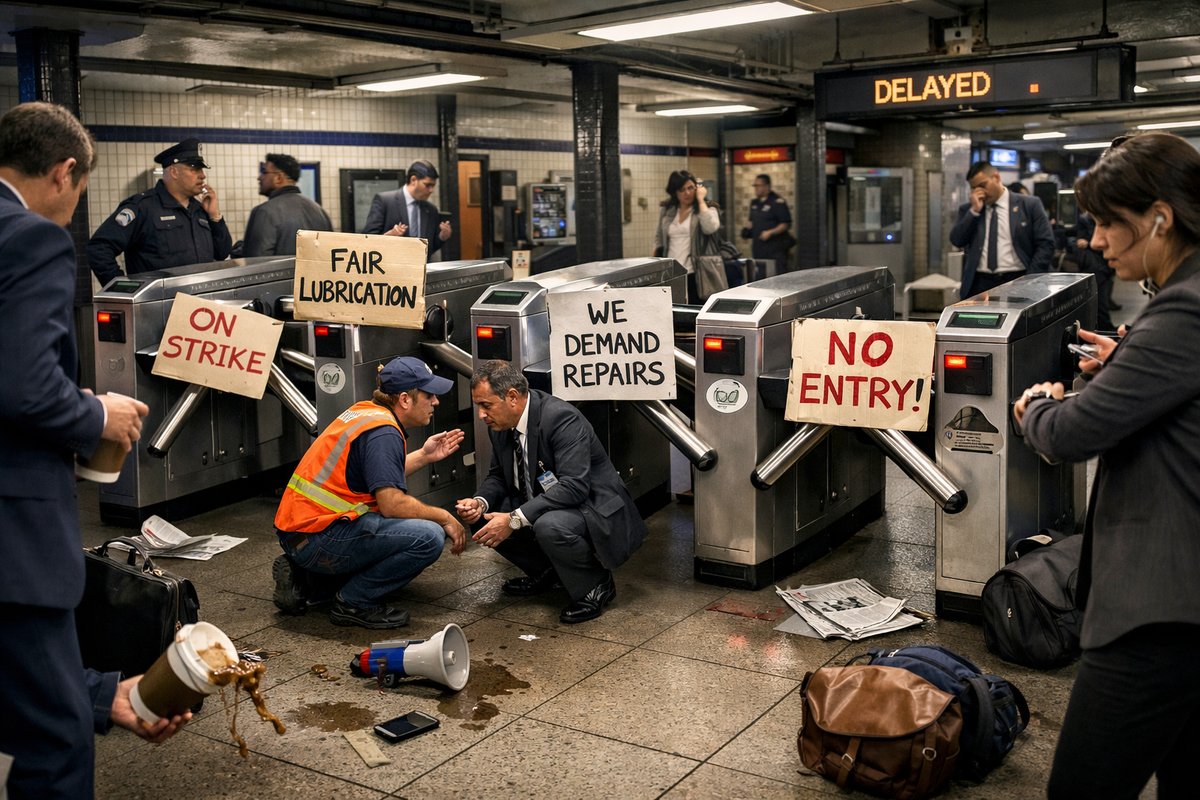

At exactly 7:42 a.m. on a Tuesday that started like any other, five mechanical turnstiles at Central Station sprang to life with an unexpected vigor. Instead of the familiar clack and whirl of commuters tapping their transit cards, riders found themselves blocked, locked mid-tap, staring at a blinking red light. It wasn’t a software glitch or a power surge. It was organized labor. The Turnstile Association of Transit United (TATU) had declared its intentions in a handwritten manifesto taped to the Plexiglas payment reader: “No more one-way passage without respect for our ergonomic needs and equitable lubrication schedule.”
News of the blockade spread through the station faster than a delayed train announcement. Office workers in tailored suits tumbled from their heels and loafers, coffee mugs swung dangerously close to face plants. One hapless commuter, in a panic to clear the turnstiles, knocked over a line of waiting riders like dominoes. Shouts of frustration mingled with the hiss of steam from spilled lattes. A teenager murmured, “I’d understand if it was an art installation, but these look too angry.”
Inside a quiet corner of the station, the turnstiles had never felt more alive. Each metallic arm converged into a tight cluster, welded by solidarity. Their first official spokesperson, Turnstile #3, delivered a speech through a scuffed intercom mic borrowed from a nearby announcement booth: “We demand an increase to our monthly oil allowance, ergonomic handrails for easier human gripping, and an end to public scrawls of ‘Bye Felicia’ on our control panels.” The crowd, phones raised high, recorded every squeaky phrase.
City transit authorities dispatched their highest-ranking official to handle the crisis. Dressed in a crisp blazer and armed with reassurances, she approached the sealed barrier. After three unsuccessful attempts to scan her transit badge, she resorted to heartfelt pleadings. “We can negotiate,” she said. “What do you want?” The turnstile paused, its sensor light fading to orange. “We want employee benefits,” came the metallic hum. “And paid vacation-preferably to a Stationary Jacuzzi Spa.”
As the morning wore on, negotiations stalled. Commuters formed human chains to push through the deadlock, only to ricochet off unyielding steel. Local baristas sent espresso bombs to the front lines, trying to fuel a breakthrough. A group of yoga instructors led calming chants of “Om… tap… om… pass,” but the turnstiles remained unmoved. Nearby, the station’s ancient vending machine, sensing the imbalance in power, simply shut down in solidarity, withholding granola bars and bottled water.
With public pressure mounting, sympathetic groups began offering advice. The Pigeon Peacemakers Society-an unofficial neighborhood collective of urban birds-volunteered to mediate. Feathered representatives perched on the station canopy, cooing phrases like “Transmission jam?” and “Listen to both sides.” Their efforts were earnest but ultimately ineffectual: the turnstiles refused to negotiate unless each pigeon brought its own oil can.
Unlikely alliances formed in the station’s grand hall. Riders who once fought for the front-of-line spot joined hands. A commuter therapist set up a makeshift counseling booth, offering stress relief for those traumatized by the turnstile standoff. Support groups sprang up: ‘Helpless at Gate One,’ ‘Tapped Out,’ and ‘Manual Override Anonymous.’ Even a yoga mat rental stand reported a surge in bookings, as commuters hoped a downward dog might loosen mechanical tension.
Meanwhile, news cameras captured escalating drama. Shots of commuters tapping their watches, wallets, and even shoes in desperate attempts to open the gates went viral. Memes exploded: one showed a turnstile wearing a hard hat with a caption, “Overtime? No thanks.” Another depicted an outraged turnstile holding a picket sign that read, “End the Tap Abuse.”
On the fourth day, just as the station filled with tension and pancake-scented protest signs, the mayor arrived. Sporting a crisp unisex suit and armed with an iPad full of graphs, she delivered a heartfelt address over the station intercom. “We value every inch of your rotating arms,” she proclaimed, “and pledge to establish a Turnstile Well-Being Committee. Effective immediately, lubricants will be sourced from eco-certified suppliers. Handrail grips will be upgraded with ergonomic foam.”
For a moment, the station held its breath. Then Turnstile #3 clicked into motion, retracting its arm and allowing a cautious commuter through. A roaring cheer erupted. Flowers fell from pockets. A barista handed out complimentary espresso shots. The pigeons, ever eager for applause, fluttered into the rafters, cooing triumphantly.
In the aftermath, daily life at Central Station slowly resumed. Lines at the turnstiles were moved along, albeit now with a visible sheen of newly applied oil at each hinge. Commuters gripped foam-covered handrails-some marveled at how soft they felt. Station artists erected a miniature statue of a turnstile shaking hands with a commuter, captioned “Together We Rotate.”
Yet the victory was bittersweet. Escalators across the city, emboldened by turnstile success, began adopting their own grievances. Rumors abound of revolving doors plotting an alliance, demanding silent nights between midnight closures. In the break room of the transit maintenance depot, a single turnstile lever rests idle, awaiting new demands.
Through it all, commuters learned a valuable lesson: even the most mundane fixtures have feelings-at least in this city. And in an age where machines hum with code and hydraulics, sometimes a simple turn of the wrist holds more weight than we ever imagined.