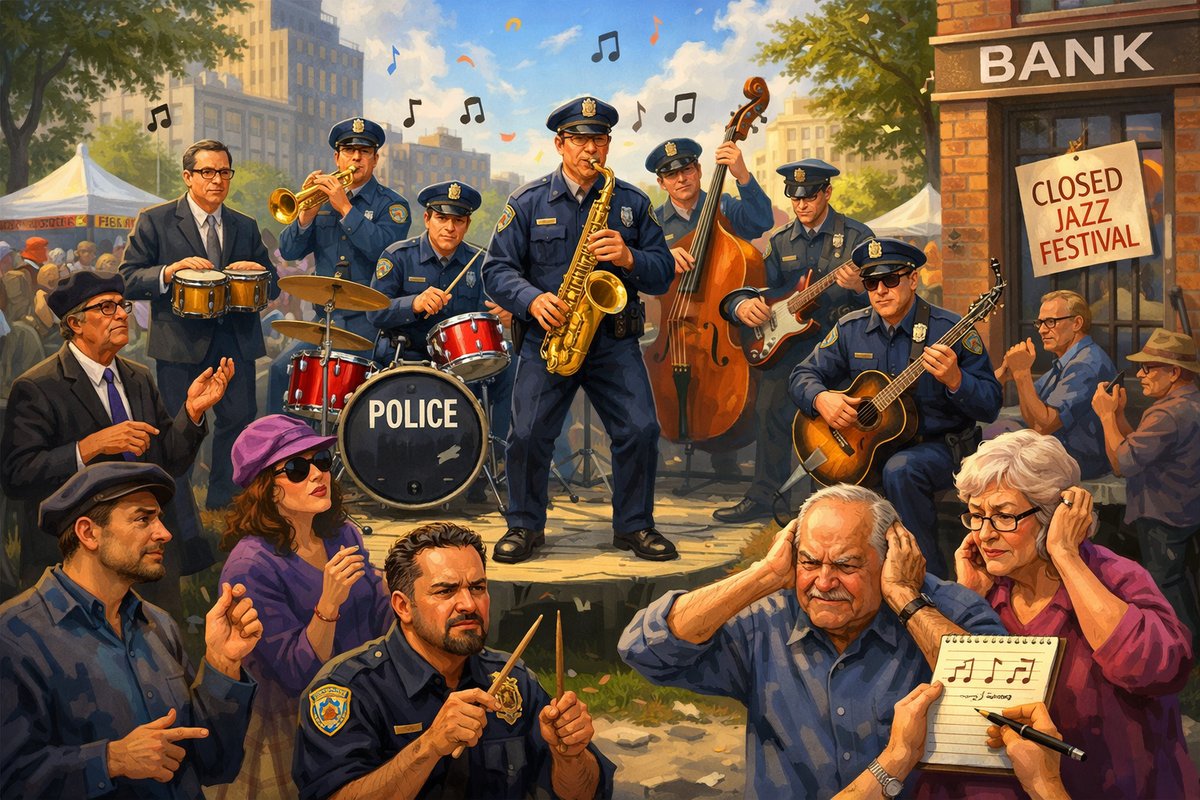

In what might be the most melodious policy change of the decade, the Town Council voted unanimously last Tuesday to disband the conventional police force and reconstitute it as the Municipal Jazz Quartet-only it quickly grew into a ten-piece improvisational ensemble. Under the new ordinance, law enforcement responsibilities are performed through call-and-response saxophone solos, drum breakdowns, and spontaneous bass walking lines. Dressed in tuxedos with pocket squares that match their instrument cases, the erstwhile officers now patrol Main Street with instrument straps slung over their shoulders, ready to riff away misdemeanor disorder.
Citizens report that noise complaints have taken on a brighter timbre: pushing a shopping cart without a rhythmic shuffle is now considered “dissonant behavior,” punishable by a buttery smooth tenor sax riff. Petty thefts are adjudicated in suites of improvisation: the accused steps into the makeshift spotlight on the town green, grabs a microphone stand, and performs a three-minute scat solo to plead their case. A poor show might land them in mandatory percussion workshops, while a spellbinding performance can even earn an early pardon.
The initiative began as a late-night brainstorming session at the council chambers, during which the mayor reportedly declared, “If we must negotiate with jaywalkers, we might as well do it with soul.” Within hours, officers swapped patrol cars for stage lights, and police whistles were replaced by trumpet mutes. Detention cells were repurposed into backstage storage for sheet music and spare reeds. By dawn, graffiti removal crews were teaching basic chord progressions to teenagers eager for a taste of musical justice.
Supporters claim crime has fallen by 34 percent-albeit the number refers to conventional crime reports. Incidents of unruly melody have spiked dramatically, with one weekend producing over 200 “off-key serenades” logged by the newly minted Jazz Marshal Unit. Still, Mayor Pro Tempore Evangeline Reese insists that a little creative discord is a fair trade for fewer break-ins and safer crosswalks. “It’s statistically proven,” she said, tapping her shoes in a jaunty rhythm. “No mugger wants to face a sousaphone solo at midnight.”
Not everyone is convinced. Granny Alvarez, a 78-year-old long-time resident, complained that her evening tea was rudely punctuated by “what sounded like three trombones arguing.” She filed a formal petition asking for “law and order, not loud and disorderly.” In response, the council appointed a “Noise Mediation Trio” to respond to any citizen grievances with polite piano trios-an ironic twist that only deepens the improvisational paradox of local governance.
Local entrepreneurs wasted no time capitalizing on the jazzification of civic life. A pop-up vendor now sells harmonica-themed police badges, and craft breweries have introduced “Blue Note Ale,” a brew that allegedly tastes best when consumed to the beat of a walking bass line. The neighborhood coffee shop began offering a “Syncopated Cappuccino,” complete with latte art depicting a drum set. Merchants report a spike in foot traffic-customers linger longer when the stray snare drum hits are floating through the air.
The real test came last Sunday, when a downtown bank reported a brazen robbery in progress. Instead of dialing 911, witnesses dialed the new “Jazz Shield Hotline,” which immediately dispatched the ensemble in full regalia. Arriving at the scene, the band formed a semicircle in the vestibule, and the heist was neutralized not by force but by a killer drum solo so intense that the masked suspect surrendered the loot just to catch a breath. After a final cymbal splash, the music came to a triumphant close-no bystanders were harmed, although a few suits now sported unintended sweat patches.
Emboldened by this success, the Town Council announced its next bold move: integrating flute duets into traffic management. Stop signs will soon be paired with mini-orchestras that perform gentle melodies if drivers comply with speed limits. Running a red light, on the other hand, will trigger an entire woodwind ensemble playing “Flight of the Bumblebee” at double time. Critics warn that commuters may never reach their destinations in coherent fashion, but proponents argue that this is a small price to pay for civic harmony.
Meanwhile, an undercurrent of cosmic oddity has crept into these ensembles. During a late-night rehearsal in the old courthouse basement, the bass drum emitted a low hum so deep that technicians suspect it opened a brief wormhole. One bass player claims he saw an alternate version of himself playing a perfectly synchronized drum fill on the other side. Town archivists are now examining decades-old meeting minutes, hoping to find references to interdimensional jazz-evidence, perhaps, that the council chamber itself houses hidden physics anomalies.
Expectations have never been higher as the council prepares to unveil its “Symphony of Public Safety,” a grand performance in the municipal plaza. Attendees will be granted participation tokens-brass lapel pins that double as harmonica keys. The finale promises a collaborative jam session with visiting improv ensembles from neighboring towns. If the wormhole theory holds true, citizens might even glimpse alternate universes where municipal drama is resolved through interpretive ballet instead.
Whether this experiment will endure or dissolve like a fleeting chord remains to be seen. Many residents have already formed neighborhood “scat circles,” where they critique each other’s vocal improvisations and recommend lighter snares for future arrests. Community forums are alive with debates over whether a cello could double-duty as a meaner lockdown mechanism. But one thing is certain: the era of uniformed patrols has given way to uniform scales, and no one seems eager to hit the mute button.
As dusk falls and the plaza lights fade to a dim amber, the distant echo of an alto saxophone lingers in the air. Perhaps this is the new definition of law and order-one measured not in pounds or meters, but in syncopated beats per minute. In this town, if you break the law, you must break into song first. And if your melody is moving enough, you might just dance your way out of a ticket.