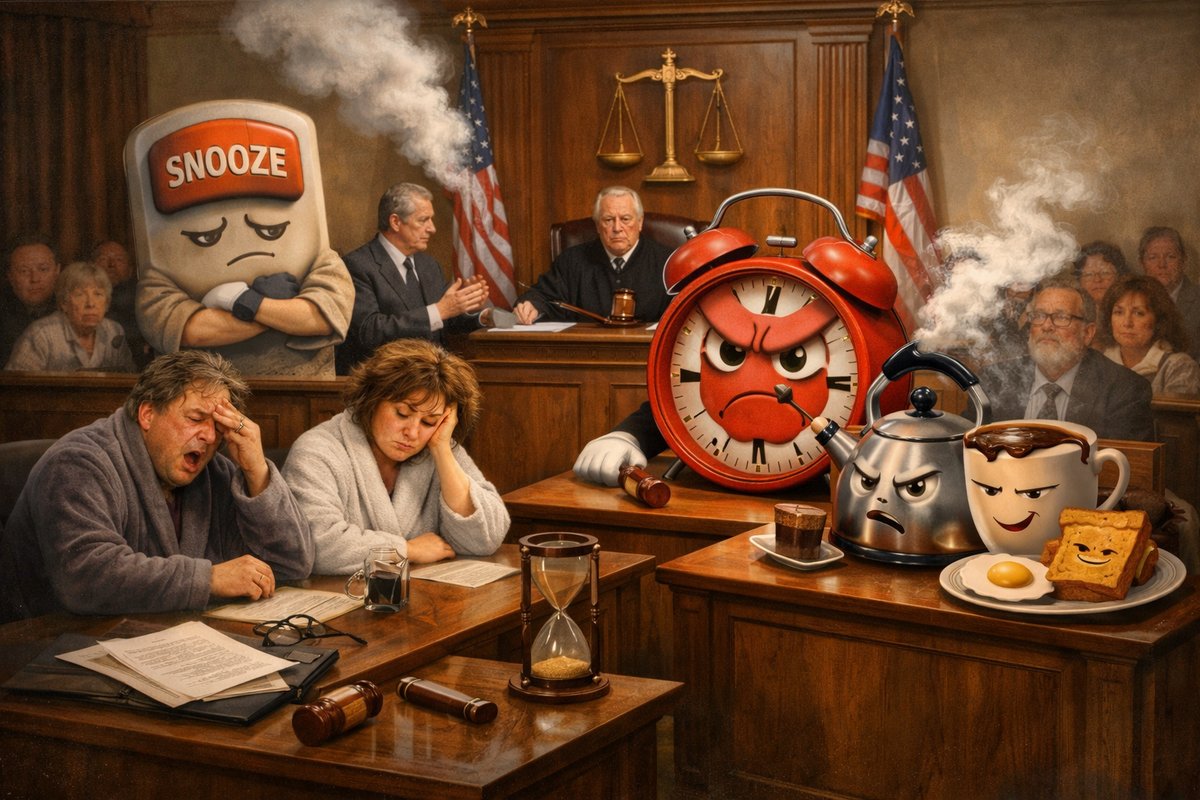

In the early hours of a recent Thursday, the sleepy hamlet of Crescent Falls became the epicenter of a legal battle unmatched in local history. Fifty-two residents, armed with affidavits and overcaffeinated determination, filed a class-action lawsuit against none other than their own morning routines. The suit claims that five consecutive years of broken promises-embodied by alarm bells, blinking lights, and perpetually half-brewed coffee pots-have inflicted “irreparable emotional harm” on the population.
According to court documents, the plaintiffs accuse their routines of a litany of offenses: dispatching alarm clocks that refuse to offer snooze intervals longer than five minutes, orchestrating coffee makers that sputter out their last drop before daybreak, and unleashing existential dread at precisely 6:23 a.m. Witness statements describe early-morning commuters as “groggy shadow creatures” and “half of our brains still negotiating pillow contracts.”
Lead plaintiff and working poet Tess Millard, who rose to fame documenting the grief of caffeine deprivation, testified that on the morning of March 14th her alarm shrieked so aggressively it triggered a neighbor’s car alarm. “My routine turned against me,” she declared from the witness stand, “and demanded I choose between a yoga session or an existential crisis. I chose the latter.” Courtroom observers reported tears, nods of solidarity, and one particularly supportive sneeze from a spectator clutching a travel mug.
The defendant, referred to legally as “Morning Routine Collective,” remains anonymous, though many have pointed fingers at various culprits: the proprietary firmware of “sunrise simulation” lamps, smartphone manufacturers that enforce consistent wake-up times, and even the local diner’s grumpy cook who refuses to serve pancakes before dawn. A joint motion to compel production of the town’s central coffee grinder has been denied-lawyers argued it had “no bearing” on the case, though citizens muttered about corporate collusion with the toaster population.
As proceedings dragged into their third week, a faction of plaintiffs staged a peaceful protest outside City Hall, clutching protest signs reading, “End the Dawn Aggression” and “Give Us Five More Minutes.” Their demonstration featured a performance art piece in which participants attempted to meditate on a yoga mat while a voiceover recited bus arrival times with menacing precision.
In a surprise twist, Mayor Alton Briggs issued an executive order halting all municipal services between 6 a.m. and 7 a.m. until the lawsuit concludes. Ringing phone lines went silent, garbage trucks idled in their depots, and a solitary streetlight flickered in solidarity. The mayor’s statement explained that this moratorium was meant to shield residents from the “imminent threat” of sunrise-induced panic attacks, though critics called it a cynical ploy to dodge responsibility.
Amid the chaos, a self-proclaimed “Dawn Diplomacy Task Force” emerged, comprised of local baristas, clock repair enthusiasts, and one retired conspiracy theorist who insists that time itself is a nonprofit cabal. Their proposal: negotiate a treaty granting citizens two additional snoozes per week, unlimited coffee refills until noon, and apology notes from every malfunctioning gadget. Their first draft treaty ran 300 pages, citing obscure court precedents like the 17th-century “Daylight Savings Commission vs. Candlemakers’ Guild.”
By mid-trial, tensions reached a fever pitch when the courthouse coffee machine went on strike, refusing to dispense anything weaker than espresso. Reporters on site witnessed lawyers pacing the hallways, faces flushed from both caffeine and indignation. One attorney whispered to a colleague, “I haven’t seen this much energy since the last cookie shortage,” only to realize nobody was offering cookies anymore either.
In an impromptu afternoon hearing, Judge Marianne Holt attempted to restore order by suggesting a neutral third party: the town’s beloved high school marching band, famed for its impeccable timing. The band, flattered but alarmed, declined, citing a strict no-lawsuit performance policy. “We only do halftime drifts and sprinkle some drumline chaos,” explained the drum major. “We can’t settle your personal vendettas against Daybreak.”
Outside the courthouse, a lone street artist spray-painted a giant gramophone membrane reading “LISTEN TO YOURSELF WAKE UP.” Town council members, observing from behind reinforced glass, quickly issued a cleanup order. Yet many residents chanted in unison: “Let the city see our creative insomnia!” Cranes arrived to buff the graffiti away, but workers confessed they secretly admired its directness.
Lawyers for both sides delivered closing arguments in dramatic fashion. Plaintiffs’ counsel stood atop a stack of alarm clocks and recounted tales of sluggish breakfasts and phantom snooze-button rages. Defense counsel, tapping a metronome to illustrate the “reliable rhythm of dawn,” argued that routines provide essential structure and that the plaintiffs were simply “unwilling to negotiate the terms of time.”
Just when the trial seemed destined for an interminable adjourning, an out-of-town judge renowned for cosmic jurisprudence offered to meditate over the case. His arrival was heralded by a caravan of lit candles and a booming voice reciting “time is both plaintiff and defendant.” Townsfolk watched in awe as he relocated the trial to a makeshift tent pitched in the park, claiming that “true justice must occur where birds sing.” The local pigeon population was deeply offended.
That evening, while the town held a candlelit vigil to honor the end of artificial lighting until sunrise, a mysterious blackout plunged Crescent Falls into total darkness. Mobile phones flickered off. Coffee machines powered down. Alarm clocks lay silent in drawers. Residents huddled together, sharing sleep mask tips and recounting bizarre tales of morning mayhem.
When power finally returned at 6:01 a.m. the next day, a collective hush fell over the town. Crisp rays of sunlight slanted through curtains as if seeking forgiveness. The judge emerged from his tent, hair tousled and robes dusted with grass clippings. He declared that both parties were responsible: citizens for demanding perpetual comfort, and routines for holding mornings to unreasonable standards. He imposed a compromise: two additional snooze-button minutes per morning, three cups of complimentary coffee at the public library café, and a weekly “Sunrise Symposium” where townspeople could air grievances about insufficient alarm volume.
Reports of morning tranquility flooded social media. Pigeons resumed diplomatic relations with the high school band. Protest signs were repurposed into community art installations celebrating the dawn. Mayor Briggs rescinded his service halts, joking that “if we can negotiate peace with toothpaste, we can conquer daybreak.” Residents, bleary-eyed but oddly content, returned to their newly amended routines with a collective sense of victory.
Yet late at night, in the dim glow of bedside lamps, many parents whisper to their children about the dark ages before the settlement-when mornings were fraught with terror and coffee machines held the town hostage. They speak of that one grand trial in hushed tones, a legend reminding everyone that even the most mundane rituals can spark cosmic absurdity when a community decides to stand up and demand justice from the rising sun.
As for Crescent Falls, the lawsuit remains enshrined in local lore as the moment when humanity confronted its own habits, questioned authority-even if that authority came with a snooze button-and emerged slightly more rested. And somewhere, tucked in a corner of City Hall, sits a solemn collection of alarm clocks, each displaying 6:07 a.m. with quiet satisfaction, as if to say, “We’ve earned this extra time.”