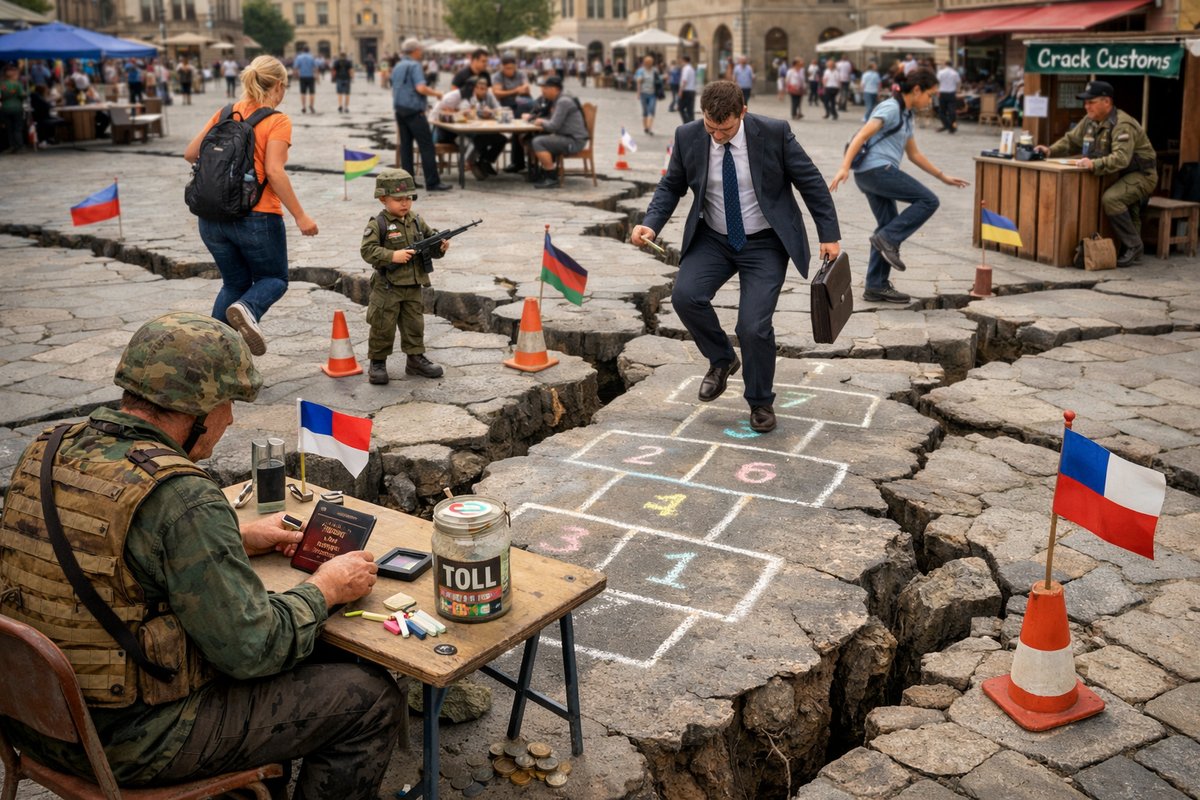

It started on an ordinary Tuesday morning: a flurry of footsteps, the rumble of delivery trucks, and a collective groan as commuters tripped over a seemingly innocuous fissure in the Main Street pavement. But by noon, that tiny fracture had taken out City Hall’s emergency alert system, replaced municipal signage with handwritten manifestos, and declared itself a sovereign nation. Overnight, the humble sidewalk cracks that once went unnoticed transformed into the world’s newest micro-state, complete with bespoke laws, tariff booths, and a surprisingly Instagrammable flag sketched in white chalk.
Residents first realized something was amiss when Mrs. Delgado’s shoe sole was found half a block away from her foot. She’d paused to adjust her heel only to discover that the crack beneath her had sprouted a miniature border checkpoint manned by a wobbly plastic cone. Its demands were simple: “Exact change only. Loose pennies, chalk chips, or hoofbeats accepted.” Videos of pedestrians attempting digital taps on the cone went viral, before the cone politely suggested they learn to pay in proper crack-compliant currency.
By midday, the cracks had recruited allies among the city’s network of manhole covers. The circular lids rotated on their own accord, aligning to form a perimeter wall. Nearby utility poles began to loosen, leaning inward at awkward angles to create a makeshift diplomatic corridor. Even stray electric cables reorganized themselves into brooding arches above the defiant fissures, as though enforcing some abstract border crossing ritual.
Local businesses found themselves caught in bureaucratic limbo. The proprietor of Stanley’s Sandwich Shop awoke to a chalk-bordered sign: “No Subs to Pass. Obtain a Cracker’s Permit from the Bureau of Urban Rift Administration.” Lunch rush turned into lunchtime standoff, with patrons chanting, “Subs for all!” while crack customs agents insisted they prove their allegiance by reciting the fissure’s national anthem-a droning melody that suspiciously resembled the sound of grinding concrete.
Town council convened in the gymnasium, laying out solemn motions: Should we negotiate with a crack? Do cracks even have legal personhood? Is jurisprudence applicable to geological phenomena? After hours of heated debate, Councilor Jenkins proposed a compromise: “Let’s send a delegation of toddlers to meet the cracks. They have nothing to lose, and their shoes are so small they might be considered diplomats.” The motion passed unanimously, largely because half the council believed toddlers understood abstract concepts of sovereignty better than City Hall.
Negotiators arrived at the crack site armed with juice boxes and Cheerios-standard diplomatic fare when interacting with entities of unknown origin. The cracks responded in chalk: “Bring treaty demands in triplicate. We require two sidewalk benches repurposed as mobile seating bureaus, a charter for cross-crack hopscotch, and weekly live performances of spontaneous tap-dancing. All to be funded via tolls on strollers and unicycles.” The toddler delegation nodded gravely, then stomped off in protest when they realized juice boxes were not included in the treaty.
Undeterred, the cracks tightened security. Toll booths sprouted at every crosswalk, complete with rotating chalk-drawn turnstiles. Pedestrians found themselves forming single-file lines for the privilege of crossing a line of concrete instead of walking across grass or ducking under hedges. Elderly residents, armed with walking sticks and an encyclopedic knowledge of pavement, launched guerrilla “bunny-hop” units to vault over the crack borders. Reports surfaced of elaborate training programs held in senior centers, coaches teaching residents to land perfectly on two-inch flanges of pavement that remained unclaimed by the micro-nation.
Meanwhile, the manhole coalition announced its own independence day, aligning with the cracks to form the Confederation of Urban Anomalies. They issued joint statements printed on the underside of pre-bagged gum wrappers: “All foosball tables near us are off-limits unless the administrators apply for subterranean-formed visas.” Utility wires volunteered as militia, periodically sparking minor blackouts in support of their newfound allies. The town staggered under the weight of too many insurrections happening at ground level.
In response, City Hall declared a state of pavement emergency and drafted a new department: the Bureau of Micro-Geopolitical Affairs. Agents were trained to interpret chalk hieroglyphics, mediate disputes between sidewalk cracks and potholes, and coordinate tea ceremonies with concrete slabs. The first substantial budget line item read: “Purchase of 12 million chalk sticks for diplomacy and art therapy.” A second line, buried in fine print, reserved funds for “unforeseen sidewalk rebellions.”
Public sentiment split down the middle. Some citizens cheered the cracks’ quest for recognition. A grassroots group called Pedestrians for Pavement Pluralism held rallies demanding “equal rights for fissures, fractures, and fissiparous entities.” They draped homemade banners across closed crosswalks reading, “No Crack Left Behind.” Others raised concerns about safety, insisting that a diverted jaywalking crackdown would follow if the cracks weren’t contained.
Amid the chaos, local performance artists seized the moment. A troupe called The Urban Crackpots staged a daily interpretive dance where performers tiptoed across the fissures to the tune of honking semaphores. Audience members were invited to wear rubberized footwear and improvise freestyle hopscotch moves. Donations poured in-half for the artists, half for crack welfare organizations distributing chalk and shallow trench infrastructure improvements.
Crackistan’s leader, a particularly wide canyon dubbed “The Grand Cleft,” announced it would be raising customs tariffs on anything heavier than a sleeping cat. Delivery drones were forced to hover 10 feet above the pavement, dropping parcels via biodegradable parachutes. Citizens demanded drone pilots apply for flying visas stamped in chalk. At press time, a drone pilot was reportedly stuck in immigration limbo, holding a package of cat treats for three days straight.
Space-time itself seemed to bend around the crack lines. Rumors spread of people stepping across the largest fissure and slipping into alternate timelines where coffee cups were grown like fruit, and jaywalking was celebrated as a national sport. Amateur physicists queuing for crack visas began cataloging ghostly afterimages of parallel selves-some holding pastries, others clutching yoga mats, all gazing at the same defiant fracture.
Back at City Hall, the mayor struggled to maintain composure. Her staff prepared daily bulletins labeled “Top 10 Ways to Navigate Your Own Sidewalk.” Suggestions ranged from enrolling in agility boot camps, to commissioning bespoke pogo sticks, to simply staying home and binge-watching ten seasons of a popular series. The mayor herself tweeted a clever hashtag-#DontTakeThingsForGranite-but it barely registered before the cracks retweeted it from their underground social network.
Negotiations seemed hopeless until a surprising mediator emerged: the resident community theater troupe, routinely ignored by municipal planners. They proposed staging a theatrical reenactment of the cracks’ grievances, complete with dialogue accessible to both concrete and humans. Actors trained to mimic slow, ominous crack growth had workshops in toe articulation, while costume designers crafted chalk-lined body suits. The troupe invited crack delegations to opening night, promising an immersive experience that might build empathy.
As the curtain rose on a performance entitled Fracture of Thrones, the crowd gasped. Spotlights traced imaginary fissure patterns across the wooden stage floor. Actors delivered monologues from the perspective of meter-deep chasms, lamenting years of being filled with gum wrappers, litter, and spilled prune juice. A chorus of stagehands silently swept chalk dust across the set, creating a mesmerizing illusion of advancing cracks.
At the finale, cracks themselves manifested an abstract projection through sidewalk-mounted projectors. They addressed the audience: “We only wish to stand out, to be seen and respected. Our struggles are the concrete struggles of all underfoot. In solidarity, we open our gates to those who walk with care and pass with pride.” The theater erupted into sustained applause, chalk confetti swirling in the air like fragile snowflakes.
That night, a tentative peace was brokered. Crackistan agreed to lower tolls on families pushing strollers and swap out rusted cones for decorative bollards. The manhole coalition pledged to reroute cables away from chokepoints. City Hall committed to annual sidewalk maintenance festivals, complete with free chalk supplies and hopscotch championships.
By week’s end, the cracks had faded from the headlines. Pedestrians resumed their routines, though a few still paused to drop a penny or chalk morsel into old toll buckets as a nostalgic gesture. The mayor declared victory-but privately admitted she’d never look at the pavement the same way again.
Remnants of the movement live on in subtle gestures: citizens drawing artful chalk outlines of friendly cracks, weekend chalk fairs where families collaborate on creative fissure murals, and a local bakery’s new pastry called the “Subway Silt,” its jagged edges a delicious homage. And every so often, when an unwitting foot strikes a tiny crack and sends a ripple through the town’s collective memory, someone is heard whispering, “Long live Crackistan.”