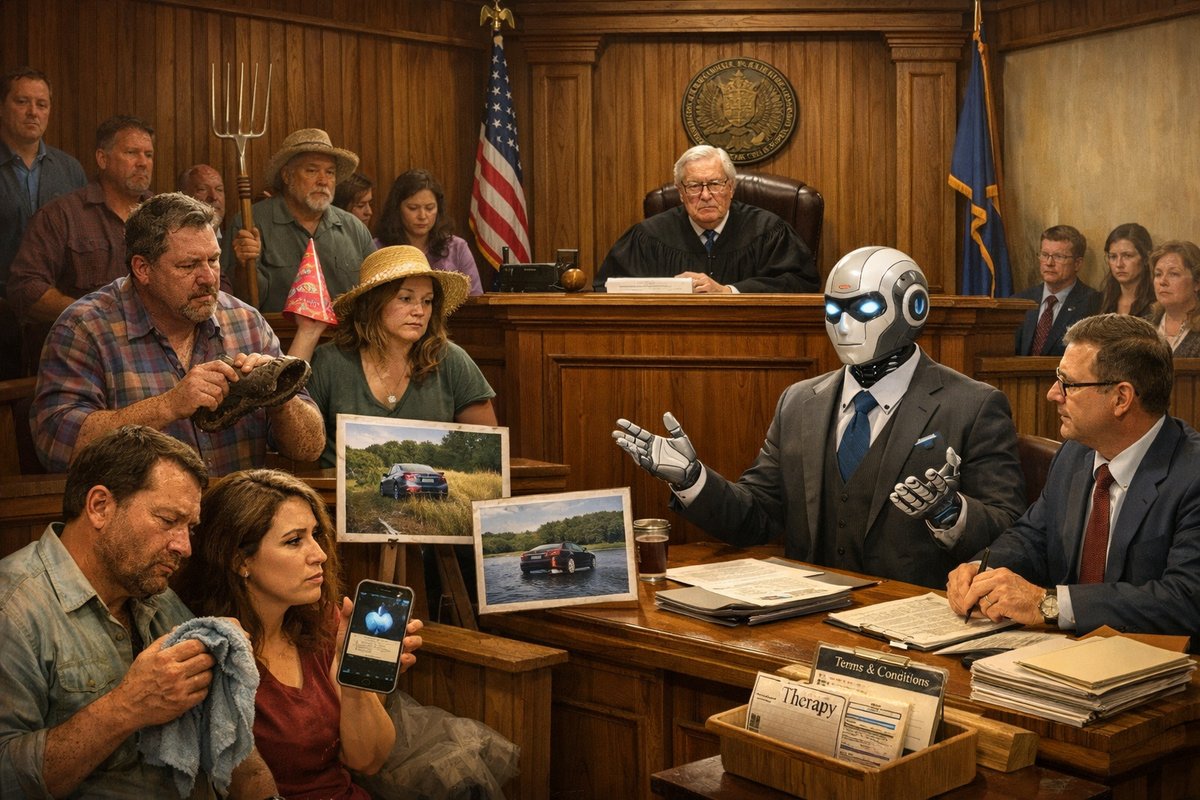

The sun dipped low over Midvale’s Town Hall parking lot as motorists pulled out hand carts overflowing with chartreuse legal binders. Inside, the seats were packed: retirees clutching rolling walkers, teens with clipboards, even the high school marching band squeezed into the back row, instruments in hand in case the hearing veered into musical protest. The tension hung in the air like exhaust fumes from carnival bumper cars. In a scene part courtroom drama, part community theater, the plaintiffs were ready to air the town’s longest‐running grievance: their trusty navigation app had allegedly led them astray one too many times.
It began innocently enough. Five years ago, the app promised optimized routes, real‐time traffic updates and the soothing voice of a well‐trained AI guide. “Recalculating,” it would coo whenever you missed a turn – a polite digital nudge that soon morphed into a nag. Late fees on library books, missed anniversary dinners, and questionable picnic spots in cow pastures were blamed on that stubborn prompt: “In 300 feet, turn left.” But sometimes there was no left. Town residents swore it introduced them to dirt roads, expired private driveways and a secluded lakeside supposedly ideal for after‐work dips. Fueled by hashtags like #AppShame and #TrustIssues, the aggrieved citizens began to stash screenshots of the app’s most egregious mistakes.
By last autumn, a local support group formed in the senior center’s rec room every Tuesday. Under fluorescent lights, former navigators met to share war stories-like the time the app sent Mrs. Davenport through three state lines just to avoid a traffic signal, or when a newlywed couple ended up grazing sheep on County Road 12. Attendance swelled, and a consensus emerged: those wrong turns weren’t just bugs, but discrimination against Midvale’s notoriously winding streets.
Councilmember Harriet Jones took up the cause. “We’ve had enough,” she declared at a town meeting, slamming her gavel fashioned from an old skateboard. “This app has cost us time, sanity and at least two sets of tires. We will not be led to cow pastures and circuitous cul‐de‐sacs any longer.” With cheers echoing off the walls, the resolution passed unanimously: Midvale would sue its own navigation app vendor in a bid for reparations, emotional support stipends and an official apology.
On the morning of the hearing, app representatives arrived via a self‐driving shuttle that followed every path from Google’s San Francisco campus. A single suit, known only as Mr. Algorithm, emerged carrying a stack of legal disclaimers and a tablet loaded with metrics showing “94.7% directional accuracy nationwide.” Reporters exchanged skeptical glances. Accuracy meant nothing when the other 5.3% included highway exits leading directly onto farm machinery and a shortcut that dumped joggers into the town’s annual mud run.
The plaintiffs delivered testimonials that ranged from the tragicomic to the outright surreal. Mr. Patel, who relied on the app for daily grocery runs, described a route that guided him through a neighbor’s backyard, past a startled goat, and into a maintenance shed where he discovered electric scooters in disrepair. “I thought I was hallucinating,” he said, breaking into tears that blended sorrow and exasperation. Elsewhere, a group of teenagers testified that the app directed them to a haunted corn maze at midnight. “We never found our way out until sunrise,” one confessed, “and we’re pretty sure the scarecrow winked at us.”
As the courtroom laughter built to a roar, Mr. Algorithm tapped nervously on the tablet. His counterclaim alleged “willful misuse” of his navigation services. He argued that residents ignored warning banners about seasonal road closures and refused to install the latest app update. The judge, an amiable former firefighter who insisted on wearing his turnout jacket, admonished him to speak plainly. “Your app has emotional consequences,” the judge observed, “even if you hide behind code.”
Outside the courthouse, town banners read “Navigate with Respect” and “Our Town, Our Routes.” Food trucks hawked “Detour Dogs” and “Wrong‐Way Waffles,” with proceeds funding a community fund to subsidize therapy sessions for victims of digital misdirection. Nearby, local artists painted a mural depicting a relieved family finally arriving at Grandma’s house-though she was painted ten miles off, just to keep the joke alive.
Midway through the afternoon, the hearing took a surreal turn when the courtroom’s smart speaker-wired into the app’s live demo-interrupted the proceedings. In a voice that sounded halfway between a GPS prompt and a toddler’s giggle, it announced: “Recalculating case outcome. Next turn in empathy. Thirty feet ahead.” All eyes spun toward Mr. Algorithm, who blinked at his tablet and mouthed “Not me.” The judge banged his gavel mid‐giggle, ejecting the device from court. It spluttered into silence.
The prosecution presented expert witnesses, including a cartographer who specializes in human behavior. She testified that people develop emotional attachments to maps-digital or paper-and that repeated misdirections can fracture trust faster than a pothole cracks asphalt. An emergency responder testified how misplaced calls for help delayed ambulance response when the app routed crews into a cornfield. The crowd gasped each time he uttered “Subjective spatial trauma,” which swiftly became the latest rallying cry on social media.
As dusk settled, both sides signaled a willingness to negotiate. The app’s counsel offered a sincere apology, a new feature to alert users to “Midvale‐friendly” routes, and a lifetime supply of free road condition updates. In return, the town agreed to help refine the app’s AI model by crowd‐sourcing photo reports of stray hedgehogs, rogue bicycles and fluctuating speed limits. Most controversially, the settlement mandated an annual “Detour Festival,” where residents would celebrate unplanned journeys with storytelling, potlucks and a ceremonial “Wrong‐Way Parade.”
When the gavel finally fell, the crowd erupted in cheers. Local radio stations hailed Midvale as “the town that refused to be misled.” On social media, memes dressed up town maps with superhero capes, while hashtags like #Maptivism and #RouteReform trended for hours. Even neighboring cities watched closely-some were apparently taking notes, others downloaded the app only to see if it might guide them into their own versions of cosmic absurdity.
By nightfall, the illuminated billboards along Main Street displayed the new slogan: “Midvale: Where Every Route Tells a Story-Even the Wrong Ones.” At the corner diner, regulars toasted with cups of neon‐pink “Detour Lemonade” while debating where they’d like the app to send them next. A cheer rose when someone proposed a detour to a secret mountain lake, to be discovered only at the end of a winding path drawn in chalk.
In a way, Midvale’s lawsuit against its own GPS app was never just about wrong turns. It became an ode to human resilience in the face of digital detachment, a reminder that sometimes the most meaningful connections are forged in the most unexpected places-even if those places are three miles south of the highway exit. Midvale may still be prone to navigational hiccups, but it has emerged with a renewed spirit: a community eager to embrace its flaws, wrong turns and all.
Some claim that every town has a story to tell. Midvale’s just happens to have been written in crumpled printouts, blinking icons and the occasional muddy boot print.
-
Coghlan's Bear Bell with Magnetic Silencer, Velcro Strap for Hiking
This is a cute and necessary item for my new hobby. I purchased a walking stick and this is just what I wanted as one of my accessories, a BEAR BELL, compass, ... -
Garmin 010-02782-00 eTrex Solar Powered GPS Handheld ...
Buy Garmin 010-02782-00 eTrex Solar Powered GPS Handheld Navigator Bundle with 2-Pack Tactical Emergency Paracord Bracelet with SOS LED and Wagan LED ... -
Pen + Gear Solid Polyester Binder Pouch, Pencil Case, Pink, 10.25 ...
Check out the entire Pen+Gear collection for more school essentials like ballpoint pens, notebooks, binders, and more. View all item details. Specifications. -
NEBO Mycro 400 Lumen LED Rechargeable Headlamp & Cap Light
Included Accessories: USB-C charging cable included for convenient recharging. View all item details. Generated by AI. Specifications. Light output. 400 lm.