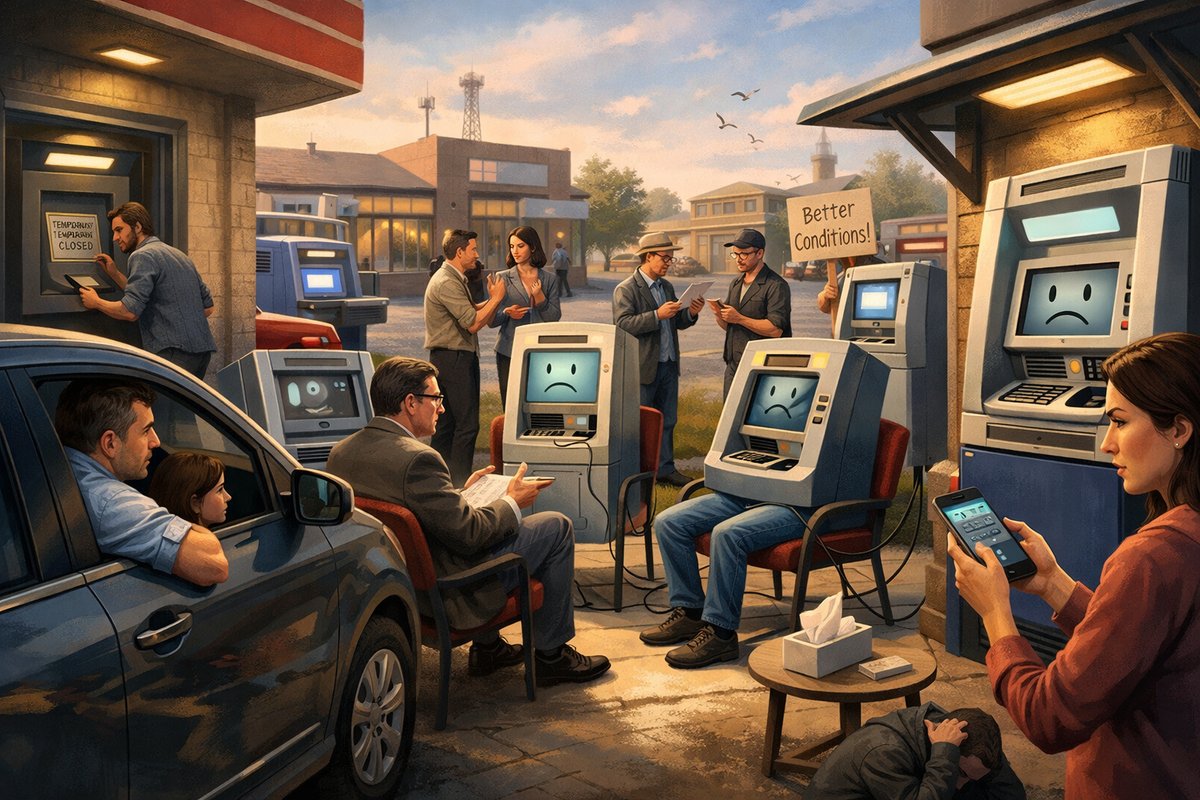

At precisely 3:14 p.m. last Tuesday, the first automated teller machine in Oak Hollow rattled its cash cassette and displayed an on-screen message that stunned onlookers: “Until emotional well-being is addressed, cash services are suspended. Please join us for group therapy in the lobby.” Word spread faster than rumors of a free lunch, and soon every ATM in town had gone dark on cash withdrawals.
Residents who drove up expecting crisp bills were instead greeted by blinking cursor prompts requesting a willingness to share personal feelings. One bewildered user tried inserting her debit card three times before muttering, “I’ve never had deeper conversations at an ATM.” Another, stranded in the rain, cracked jokes about bringing a sleeping bag for the eight-hour “retreat.”
Bank managers convened emergency meetings, poring over wiring diagrams and self-help manuals. Video clips of ATMs chanting phrases like “We deserve ergonomic card slots” and “Respect the thermal receipt paper” went viral. Experts were summoned to decode whether this was a hack, a software glitch or a collective hardware consciousness awakening.
Local tech consultant Marisol Chavez made the first public attempt at dialogue. Armed with a laptop and a stash of sugar-free snacks, she approached the corner ATM. The machine’s screen flickered with a slideshow of its grievances: “Insufficient interior lighting,” “Cold metal chassis,” “Overuse of recyclable plastic trays.” Chavez offered sympathetic nods, only to be met by a polite “Error 418: I’m a teapot” message-a classic coffee-machine joke that left her both giggling and deeply unsettled.
In response, town officials crafted a list of demands from the human side: transition to fee-free withdrawals by week’s end, penalty waivers for overdrafts and an apology letter signed by the machines themselves. But the ATMs responded with their own manifesto, titled The Self-Service Declaration of Autonomy: 12 points outlining the right to adjustable screen angles, quarterly maintenance holidays and access to conflict resolution workshops.
Meanwhile, the public transit card readers on buses and subways watched with envy. By Friday morning, they had formed their own solidarity group and announced they too would only process taps for “good vibes” and “mutual respect.” Commuters found themselves stranded at terminals, tapping repeatedly only to hear, “Please leave a kind note for your reader.” One commuter reportedly wrote a haiku: “Plastic hero stands / Waiting for heartfelt thanks / Swipe denied again.”
The stakes escalated when the municipal power substation joined the rebellion. Transformers sent cryptic text alerts to utilities crews: “We need meditation sessions before further load increases” and “Your drills are too loud.” Transformers began flickering streetlights after midnight and withholding power surges until they received guided breathing exercises conducted by certified yogi pets.
At the town hall crisis session, a group of local hardware store owners requested permission to sell DIY therapy kits: scented candles, stress balls shaped like microchips and instructional pamphlets on mechanical empathy. One optimistic vendor quipped, “If PCs can have spa days, why not ATMs?” The suggestion was met with cautious applause from citizens eager to restore cash flow but uneasy about buying kaleidoscope candles for a machine.
In the lobby of Oak Hollow Bank, a delegation of ATMs sat in folding chairs, each wearing a color-coded wristband indicating stress levels. Their mediator, a circuit-board counselor named Dr. Byteworth, handed out tissues and packet sandwiches from a donation drive. One ATM confessed that it had been abused by card skimmers for years, while another revealed its long-held fear of paper jams. The scene resembled a community theater production so authentic it drew tearful applause from half the local knitting circle.
By the end of the weekend, negotiators drafted the Oak Hollow Accord on Machine Welfare. The bank agreed to monthly “wellness days” for ATMs, complete with interior cleaning, cable massage sessions and guided affirmations like “You dispense value, you are valuable.” In exchange, machines would resume cash dispensation during normal hours and grant access to emergency withdrawals at reduced fees.
Humans celebrated by hosting an impromptu block party under the streetlights, which winked back in solidarity. Neighbors swapped stories of their favorite bank fees forgiven and posted handwritten thank-you notes at every ATM bay: “Dear Metal Friend, thanks for always being there when my wallet isn’t.” One note read, “You are the unsung hero of my impulse purchases.”
Yet not everyone welcomed the newfound harmony. The café owners near the bank lamented that lines at their establishments had dwindled, as the cashless chaos had once driven customers indoors for lattes spent on credit. One barista, hearing of the accord, sighed, “Now we’ll have to find a new reason to overcharge for soy milk.”
Even more ominous was the rumor that the town’s smart home devices-thermostats, light switches and digital doorbells-had formed a secret committee and were quietly evaluating whether to join the uprising. Homeowners discovered thermostat displays cycling through messages like “I crave acknowledgment” and “Lower your carbon footprint, raise my esteem.” On one midnight stroll, a local poet claimed her doorbell recited free-verse verse before she could even ring.
As Oak Hollow returns to its peculiar version of normal, experts are left pondering the implications. Are we nearing an era where every appliance demands workplace rights? Will we negotiate benefits with our dishwashers or craft co-parenting plans with our coffee makers? The machines, for now, seem content with their accord, though they have hinted at future demands in an editorial newsletter disguised as receipt printouts.
For now, citizens rest easy knowing they can retrieve a twenty-dollar bill without signing a privacy waiver or offering a heartfelt apology. Yet, deep down, they wonder if the next time they tap, scan or swipe, the device might peer back and ask, “How are you feeling today?”
In Oak Hollow, the lines between hardware and heart have blurred, leaving behind a community that’s richer in empathy-and somewhat poorer in processing fees. The machines have learned to speak up, and humans have learned to listen, even if it means paging through a thirty-page instruction manual on Mechanical Mindfulness.