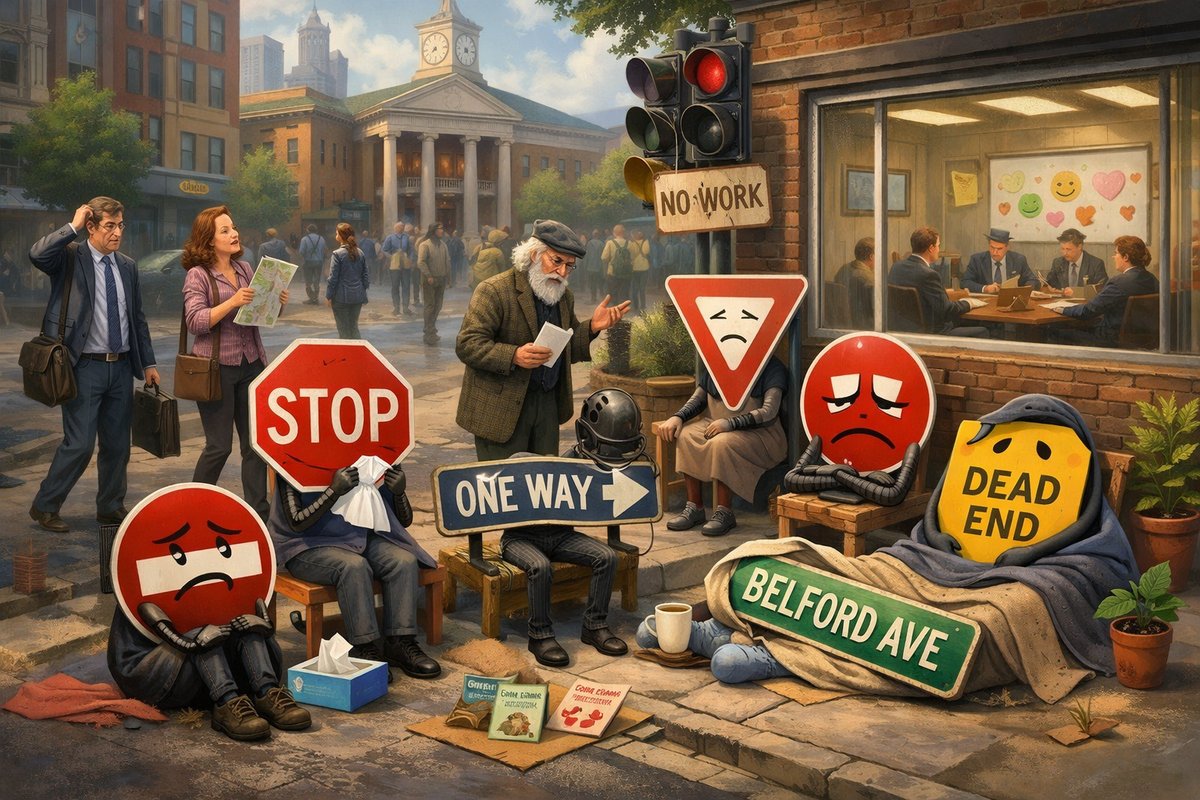

It began at dawn, when a humble yield sign at the corner of Maple Avenue and 5th Street simply refused to point. Drivers expecting a polite merge were met with a blank metal slab that seemed to sigh under the morning sun. Within hours, stop signs, pedestrian crossing signs, and even the occasional speed limit sign had joined the strike, demanding emotional validation, directional clarity, and a seat at the city’s annual budget meeting.
Local resident Marta Jensen, en route to her office, described the scene as “like someone flipped off all the arrows in my life.” Instead of a red octagon declaring “stop,” Jensen found only an empty circle with an LED display scrolling the message, “Am I enough?” Her coffee spilled as she idled in the intersection, pondering whether she, too, might be struggling with her own existential significance.
City communications director Arnold Perez issued a statement at midday: “We are negotiating with the Belford Street Sign Collective. They’ve presented us with a list of demands, including weekly group therapy, paid time off for maintenance checks, and an official title change from ‘sign’ to ‘Directional Life Coach.'” The document was delivered on paper taped to a traffic cone, which itself might soon join the strike if it doesn’t receive ergonomic padding.
Meanwhile, traffic ground to a standstill. Commuters formed impromptu support circles in the middle of intersections. One group held signs reading “You Pointed Me Here, But Where Do I Go?” Another carried a flip chart to teach signs about mindfulness and the importance of a clear sense of purpose. Drivers began apologizing profusely to their dashboards, as if the real victims were their vehicles, suffering from the signs’ emotional upheaval.
The city council convened an emergency session, complete with tissues, calming candles, and a whiteboard labeled “Sign Demands.” Council members took turns reading aloud: “We want regular acknowledgment of our directional contributions,” “Please stop placing ‘Watch for Ice’ signs in July,” and “Respect our right to re-evaluate our arrow orientation quarterly.”
By early afternoon, the signs had issued an ultimatum: either city hall agrees to codify an annual “Sign Appreciation Day,” or they might start randomly flipping arrows, creating one-way streets that lead directly into the fountain at Civic Square. Dignitaries gasped at the threat. Fountain maintenance personnel tightened their life jackets.
In a bid to defuse tensions, the city hired Dr. Leona Hamm, a trauma-informed psychologist specializing in non-human clients. Dr. Hamm’s first rapport-building session took place under the glare of a malfunctioning traffic light. She treated the haunted yellow lamp as a client, making eye contact-though how you make eye contact with an LED bulb remains unclear. After 20 minutes, the light blinked three times in rapid succession. Dr. Hamm interpreted this as “mild progress.”
Residents, eager to lend support, started hosting “Arrow Affirmation Workshops” in their living rooms. One participant read a heartfelt poem to her driveway sign: “You guide me home through rain and gloom, yet still you question your own zoom.” The sign responded by flashing its diodes in Morse code-“THANK YOU”-a breakthrough hailed by local therapists as “seminal.”
As the sun set, a rogue left-turn sign broke ranks. Disillusioned by the endless negotiations, it scrawled “FOLLOW ME” in chalk across the pavement and guided a group of lost tourists to a hidden bakery serving free pastries. Word spread, and soon people were forming pilgrimages following the wayward sign, treating it like a spiritual guru.
Fearing a full-blown spiritual movement among signage, the municipal map app developers released an emergency OTA update. Users opening the app were greeted with a tongue-in-cheek message: “Signs are feeling vulnerable. Please proceed with love and additional compliments.” Some users found their screens dancing with animated hearts floating up from every blue dot representing a sign on the map.
Not to be outdone, the philosopher-in-residence at Belford University held a pop-up seminar in the downtown plaza. He argued that the strike revealed an unspoken truth: humans project their own anxieties onto blank objects. “We see ourselves in things that point,” he declared, while behind him a “Stop” sign slowly wavered in approval.
By late evening, tensions reached a crescendo when the sign union threatened to reprogram the streetlights for maximum annoyance-twenty-second reds and five-second greens-unless their demands were met in writing. Drivers joked that their daily commutes had turned into a Kafkaesque performance piece.
Mayor Evelyn Cruz, exhausted from caffeine and metaphors, invited the sign representatives to City Hall. She brewed a pot of decaf coffee to keep the mood calm. Unfortunately, the signs sensed the betrayal. Within minutes of sipping the brew, an SOS signal scrawled itself across the mayor’s placard: “We need a real energy boost!”
Desperate, Mayor Cruz offered the signs a compromise: chalk-drawn compliments left at each intersection, plus a fortnightly rotating spotlight at city council meetings for signs to share their feelings publicly. The street signs huddled in deliberation. Head negotiator Traffic Arrow A-Frame declared, “This might just be enough to point us in the right direction.”
By midnight, the signs had returned to their usual duties. Drivers pulling into the recovered intersections were greeted by friendly arrows guiding them with newfound confidence. Some motorists dropped off bouquets of reflective stickers at the curbside as tokens of goodwill. Others played soothing music to their rearview mirrors, celebrating the end of the city’s weirdest traffic advisory ever recorded.
As of press time, weekly emoji-powered therapy sessions between signs and residents have transitioned to a Zoom channel aptly named “Point & Affirm.” The yield sign at Maple and 5th posts daily journal entries on social media, reflecting on its journey toward self-acceptance. Citizens report a newfound respect for the humble wayfinding tools that lace their streets, while urban planners quietly draft the first municipal ordinance requiring at least one compliment per mile of roadway.
In a city that once relied on arrows and metal plates to keep people moving, the strike taught a simple lesson: sometimes you need to pause, listen, and remind even the smallest voices that every sign-human or otherwise-deserves a little direction and a lot of kindness.