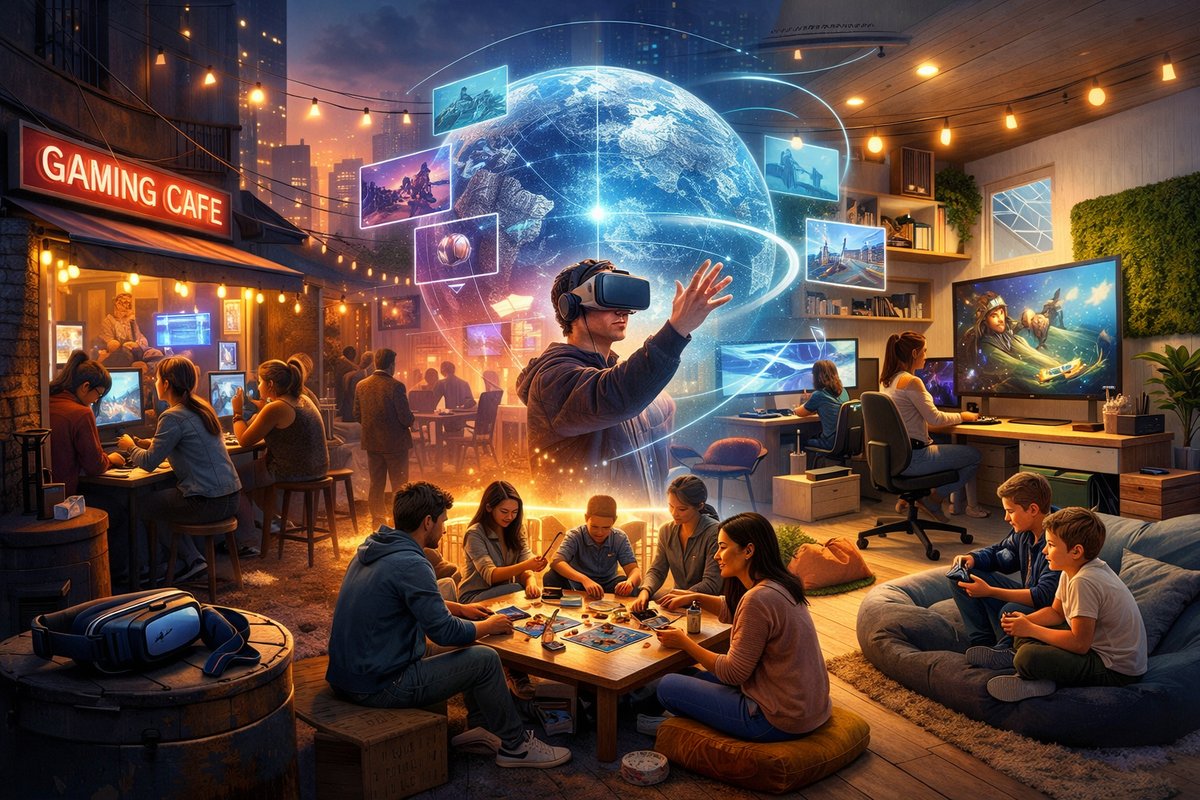

Stepping into an adaptive game room for the first time feels like entering a living video game. Walls shift to reveal hidden screens, haptic floor panels pulse beneath your feet, and ambient lighting responds to every move. A group of friends don AR headsets to navigate a digital scavenger hunt projected onto real-world surfaces, while nearby players gather at a multi-sensor ping-pong table that tracks every spin and speed. This blend of physical space and digital overlay is no longer confined to big-budget arcades: it’s at the heart of a growing movement that’s redefining community entertainment.
Once, gaming meant huddling behind a console in a dimly lit room. Today’s players crave interaction-both with technology and each other. Adaptive game rooms answer that call by merging augmented reality (AR), virtual reality (VR), spatial audio, and responsive design into flexible venues where every visit feels unique. In major cities, weekend pop-up cafés boast quick-install modular furniture, projection-mapped walls, and tournament platforms that assemble in hours and dismantle in minutes. In small towns, converted storefronts host micro-festivals centered on local indie titles, digital art installations, and collaborative challenges.
Industry surveys indicate that nearly half of gamers now seek out in-person events at least once a month, with immersive play spaces ranking among the fastest-growing categories. Architects and designers are taking note: lightweight partition systems, inflatable seating pods, and portable LED floor tiles offer low-cost ways to host everything from speed-run competitions to narrative-driven escape experiences. At the same time, software developers are creating open platforms that let community organizers customize challenges, leaderboards, and game logic without writing a line of code.
Sustainability sits at the core of this trend. Green-coated composite panels, energy-efficient projection technologies, and recycled-content acoustic baffles reduce environmental impact while enhancing aesthetics and sound quality. Some venues power lighting and haptic devices with rooftop solar arrays or on-site battery banks that store excess energy from off-peak hours. Others partner with local recycling programs to repurpose shipping crates and fabric scraps into playful seating modules. The result is a showcase of responsible design that resonates with eco-conscious players.
Interactive festivals and community meetups have sprouted around adaptive game rooms. Tiny events in pocket parks-complete with inflatable domes and tabletop VR pods-draw curious passersby. In urban neighborhoods, food trucks line up next to projection-mapped façades displaying live game streams and player highlights. Local artists contribute digital murals that evolve based on audience reactions, and makerspaces offer workshops on building DIY controllers from upcycled parts. The emphasis is on openness: anyone can drop in, learn a new game, or share their own creation.
Home-based adaptive game rooms are also gaining traction. Enthusiasts are blending modular shelving systems with retractable screens, ambient lighting strips that sync to game audio, and customizable furniture that doubles as storage for consoles and accessories. Spatial audio speaker pods create dynamic soundscapes, while programmable LED panels on walls or floors react to in-game events. Open-source hardware projects supply motion-tracking sensors that attach to existing furniture, enabling immersive experiences without investing in a full VR rig.
Behind the scenes, software tools are simplifying the creation of spatial narratives. Drag-and-drop editors let event hosts lay out virtual checkpoints that players find through AR-equipped smartphones. Cloud-based leaderboards update in real time across multiple rooms or venues, fueling friendly competitions. Analytics dashboards track foot traffic, popular game modes, and dwell time, giving organizers insights to fine-tune layouts and schedules. As a result, adaptive game rooms are proving to be valuable community assets, sparking collaboration between local businesses, schools, and civic groups.
The economic impact is notable. Real estate managers have begun marketing adaptable units-underused retail spaces retrofitted with gaming gear-as short-term pop-up hubs. These installations drive foot traffic to neighborhood shops and cafés, while revenue sharing agreements channel a portion of ticket sales back into community programs. In certain municipalities, zoning rules have been relaxed to promote mixed-use spaces, recognizing that adaptive game rooms attract an audience that otherwise might bypass local districts.
Creativity fuels this ecosystem. Designers experiment with textile-based sensors woven into curtains that respond to touch. DIY experimenters hack inflatable kayaks into VR seating pods with built-in motion platforms. Digital artists stream generative visuals onto foldable projection screens that can be reconfigured into labyrinthine play corridors. Each innovation underscores a principle: adaptive game rooms are not static attractions but living, evolving playgrounds shaped by player feedback.
For aspiring hosts, setting up an adaptive game room starts with defining a theme. It could be a retro-futuristic lounge where pixel art meets sleek metal surfaces, or an urban jungle where overgrown vines frame giant game-theater screens. Next comes infrastructure: reliable high-speed internet, networked audio-visual gear, and versatile power distribution. Modular furniture and removable wall panels allow swift reconfiguration, while lightweight truss systems support projectors and lighting. Don’t overlook comfort: adjustable seating, air filtration, and ambient temperature control keep players engaged during extended sessions.
Selecting the right mix of games and experiences is just as important. Puzzle hunts that combine AR wayfinding with physical clues invite cross-disciplinary collaboration. Rhythm-based dance floors with pressure sensors get groups moving, while projection-mapped tabletop arenas host strategy duels. Social titles that encourage teamwork-escape-the-room simulators, cooperative VR missions, and gesture-controlled party games-tend to perform well across diverse age groups. Rotating weekly themes and guest-curated events maintain a sense of novelty.
Support from local governments can accelerate growth. Grant programs aimed at youth engagement or STEM education increasingly include funding for interactive play spaces. Public-private partnerships showcase these adaptive game rooms as learning labs where coding workshops, digital art courses, and robotics clubs converge. In some cities, mobile units travel to underserved neighborhoods, offering free sessions that foster digital literacy and community bonding.
As technology advances, the line between digital and physical play will blur further. Next up: AI-driven nonplayer characters roaming real-world corridors, projection surfaces that respond to sound and touch in real time, and haptic wearables that translate virtual sensations into tactile feedback. Imagine pacing through a room while subtle vibrations mimic a dragon’s roar under your feet, or playing a cooperative shooter where each player’s movement reshapes the arena’s layout.
The adaptive game room revolution underscores a broader shift in entertainment values. Players no longer seek passive consumption but active participation-socially meaningful interactions that are both playful and immersive. Community organizers, designers, and tech innovators are responding with ever more flexible spaces that welcome experimentation and crossover between art, sport, and digital media.
Whether you’re dreaming of opening your own pop-up café, converting an attic into a next-gen lounge, or simply attending the latest micro-festival in your city square, adaptive game rooms offer a glimpse of where social play is headed. They remind us that the simplest joy often comes from coming together, pressing a button, and watching our shared stories unfold across walls, floors, and headsets. In a world where screens dominate our attention, physically pulsing play spaces are proving that real-world connection can level up our entertainment-and our communities-too.