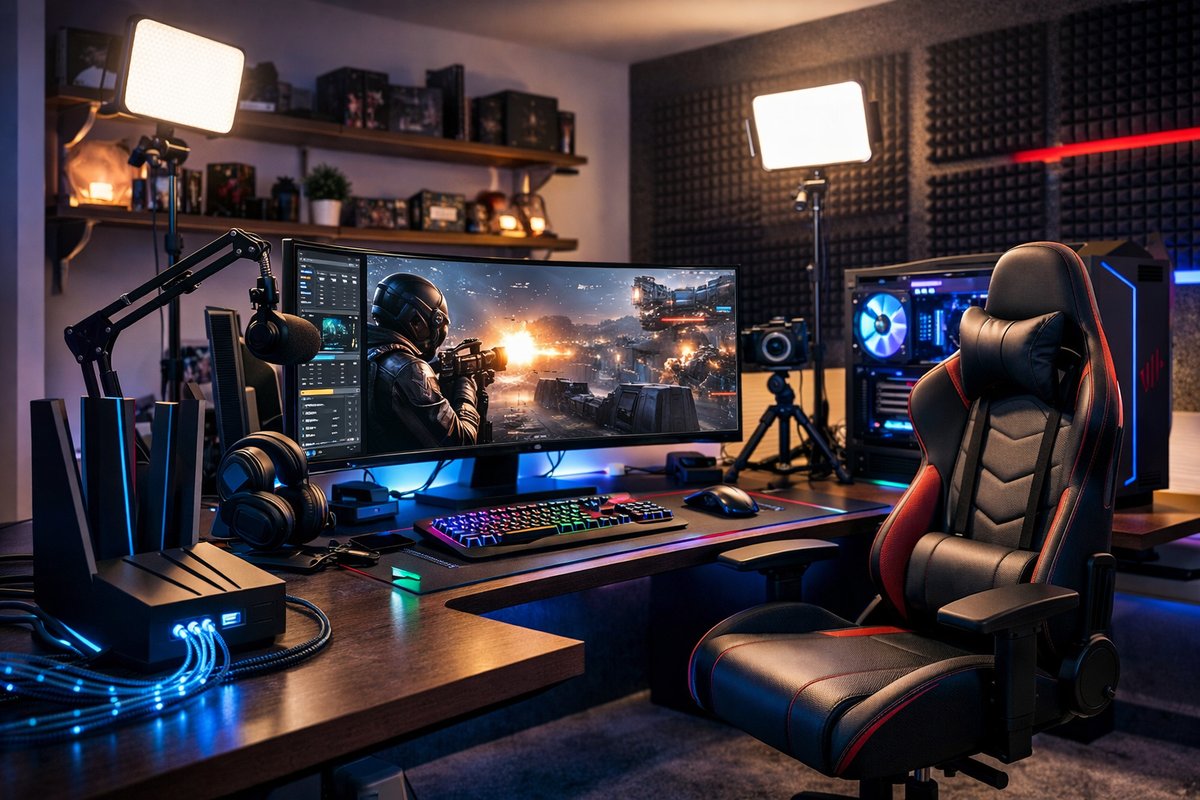

In the past year, gaming has shed the stereotype of solitary couch sessions and vaulted into a realm where home environments mirror professional competition stages. With regional tournaments returning to online qualifiers and hybrid events drawing thousands of remote participants, the living room is no longer a casual lounge but a strategic zone. Players are rethinking every component of their setup-from the glare on their monitor to the latency between controller and console-to carve out an edge as fierce as any LAN center.
This shift has been fueled by several converging trends. The burst of cloud-based gaming services has made high-end hardware less of a prerequisite, allowing midrange PCs and mobile devices to stream top-tier titles. Meanwhile, social platforms embedded in games are fostering in-the-moment collaboration, nudging teams to replicate physical “war rooms” with whiteboards, voice channels, and real-time performance dashboards. At the same time, ergonomics and wellness are stepping out of niche hobbyist corners and into mainstream conversations. After marathon sessions, players are demanding seating that supports posture, lighting that reduces eye strain and soundscapes that balance immersion with mindfulness.
Latency remains a central battleground. In December, a European qualifier for a popular tactical shooter highlighted how a single millisecond advantage can influence clutch plays. That match drove dozens of participants to invest in dedicated 5 GHz routers and gigabit fiber plans. It’s no surprise: when digital reflexes are pitted against latency-sapping Wi-Fi interference, every fraction of time counts. As a result, networking gear manufacturers are rolling out routers with specialized gaming modes, intelligent traffic prioritization and built-in QoS (quality of service) controls so that voice chat packets and gameplay data take priority over background downloads.
Concurrently, the ergonomics revolution has taken tangible form. Designer furniture brands have introduced height-adjustable desks with cable-management channels, detachable monitor arms and built-in USB hubs. A handful of prototypes even feature modular attachments-such as rapid-access drink holders, headphone hangers and wireless charging pads-for quick customization mid-match. Player feedback forums have become incubators for open-source DIY mods that add motion damping or small adjustable monitors for secondary displays like chat feeds, live streams or strategy overviews.
Audio is also rising to prominence. Some competitive teams now employ acoustic panels and noise-dampening curtains in makeshift home arenas to create a consistent sound environment. This not only isolates external distractions-kids playing in the next room or street traffic-but also ensures that positional audio cues in games like battle royales remain crisp and directional. At least one player collective even hosts virtual consultations with acoustics engineers to map ideal reflection points, turning their dens into bespoke audio chambers.
But not all innovations are purely technical. As community managers and team captains look to maintain morale during isolation, many have embraced hybrid watch parties powered by synchronized streaming and in-game integration. These events pair live tournament feeds with interactive overlays-scoreboards, polls and chat lobbies-so armchair spectators can share instant reactions and tactical breakdowns. The result resembles a modern spectator sport where fans aren’t just cheering from the sidelines-they’re inputting clap emotes and unlocking surprise power-ups for their favorite players.
Hardware makers have taken notice. At a recent consumer electronics show, a suite of peripherals designed for “spectator engagement” debuted: multipoint cameras that automatically frame both player and monitor, modular light rings that signal in-game statuses (low health, power boost), and wristbands that vibrate in sync with high-stakes plays. These accessories aim to bridge the gap between player action and viewer immersion, reinforcing the sense that competitive gaming is an all-in experience, even for those watching remotely.
The democratization of content creation is another driving force behind the living-room arms race. With streaming revenue and sponsorship deals on the rise, aspiring creators are setting up mini-studios at home. That entails ring lights for even illumination, green-screen backdrops, professional-grade webcams with autofocus, and audio interfaces to mix game sound with commentary. A quick browse through streaming channels reveals a demand for adjustable broadcast stands that can house microphones, tablets for monitor control and even on-the-fly lighting gels for mood shifts.
Importantly, many players emphasize sustainability alongside performance. Recycled-plastic office chairs, energy-efficient LED fixtures, and power strips with master-slave outlets (which cut power to peripherals when the main rig switches off) are gaining traction. Even gaming laptop manufacturers are marketing low-voltage modes that maintain high frame rates while reducing power draw-a nod to both environmental concerns and household electricity budgets.
On the software front, cloud orchestration tools are streamlining multi-device setups. Imagine a dashboard that monitors GPU temperature on your PC, battery levels on wireless controllers, ping rates on your router, and memory usage on your smartphone streaming party chat-all from a single mobile app. A handful of beta testers report that this telemetry lets them preemptively troubleshoot issues before they manifest in sudden frame drops or audio glitches during pivotal tournament moments.
The rise of pro-am crossover events has only escalated interest in boutique home arenas. Amateur teams often mimic pro configurations-dual-screen layouts, programmable macro keypads, silent mechanical switches-to train in environments that echo top-level competitions. Some grassroots leagues have even started offering “home inspection” guidelines: requirements around desk dimensions, lighting levels and network throughput to ensure fair play. Failure to meet these hoops can lead to disqualification or forced relocation to an official test server.
Naturally, the next frontier may extend beyond simple ergonomics and performance metrics. Early experiments in scent-based immersion-diffusing the tang of ozone during sci-fi space battles or pine when exploring virtual forests-have intrigued a niche of sensory-focused gamers. Haptic seat cushions that deliver low-frequency vibrations tied to in-game explosions are also attracting developer attention, though widespread adoption may hinge on affordability and user comfort.
Regardless of what breakthrough emerges, one principle is clear: players are no longer passive consumers of games in random corners of their homes. They’ve become architects of their own digital amphitheaters, fine-tuning every detail to balance competition, collaboration and comfort. And as tournaments, content creation and community gatherings persist in hybrid formats, the quest for the ultimate home arena shows no sign of abating.
Whether you’re a weekend warrior or a rising streamer, crafting a space that reflects your ambitions and supports your performance has never been more accessible-or more essential. The living room has become the new arena, and the battle for perfect setup has only just begun.