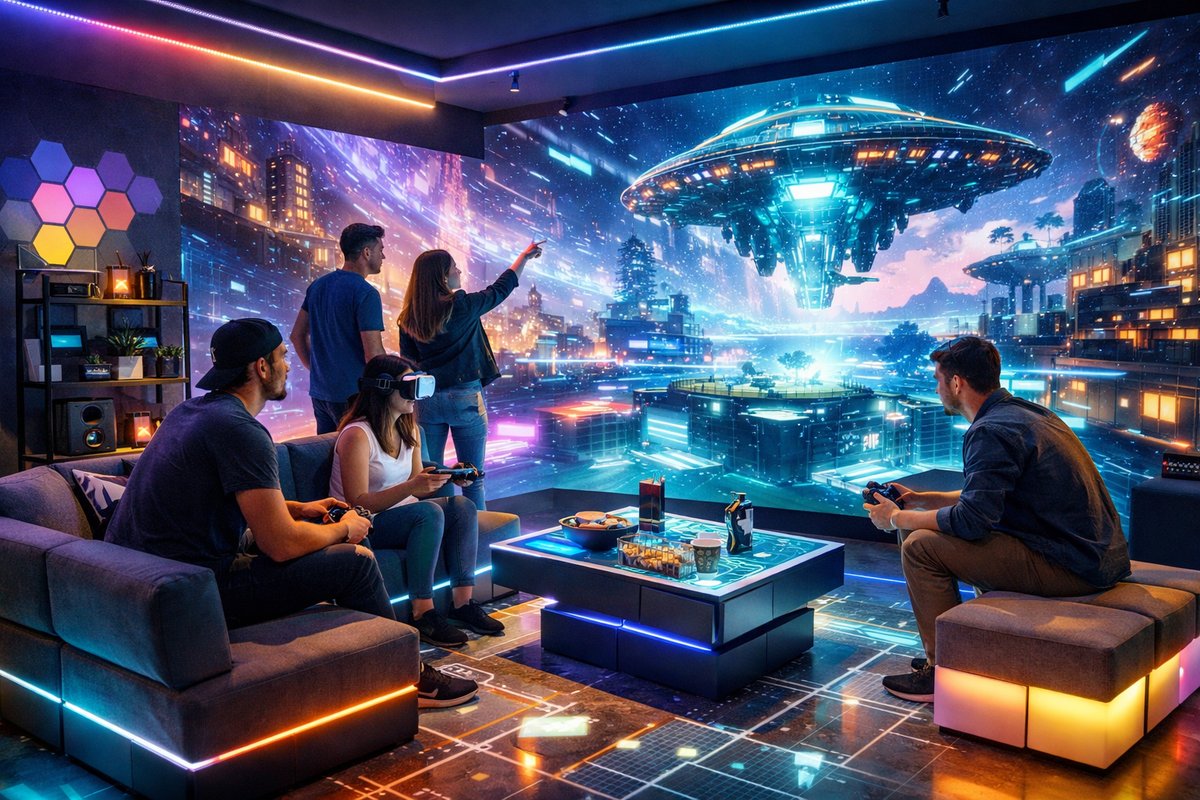

Across neighborhoods and online communities, a new trend is sweeping through homes: transforming ordinary living spaces into bespoke, immersive play arenas. Fueled by advances in projection technology, adaptive lighting, and modular furniture, these DIY game environments blur the line between dedicated game rooms and flexible living areas. Families, friends, and solo players alike are harnessing this ecosystem of gadgets to craft pop-up arcades, interactive movie nights, and virtual scavenger hunts that can be assembled in minutes and packed away just as easily.
In a Chicago apartment complex, a group of neighbors collaborated on a communal setup that unfolds every weekend in a shared lounge. Modular seating pods with built-in speakers and wireless charging docks form a semi-circle around a motorized screen that drops down from the ceiling. A portable ultra-short-throw projector casts high-definition game visuals onto any flat surface, while AI-driven ambient lighting adjusts color schemes in sync with on-screen action. At 8 p.m. sharp, the room hums to life: shadows melt away, pixelated landscapes appear, and players don lightweight haptic vests to feel every explosion and impact.
What began as a one-off experiment soon became a weekly ritual, and the group has since dialed their setup to a fine art. A motion-activated camera tracks group movement to trigger sound effects and ambient cues, from distant thunder in a fantasy quest to engine roars in a racing simulation. When not gaming, the system reverts to a sleek movie-theater mode, complete with cinematic grading and 360-degree sound mapping for streaming premieres. Even homework sessions get a boost: adjustable desk modules slide into place, bringing desk lamps and digital whiteboards into the fold for collaborative study breaks.
Tech startups have taken notice, offering rental models that supply everything from collapsible furniture frames to subscription libraries of projection templates and lighting profiles. A handful of services now deliver lightweight hexagonal wall panels equipped with color-changing LEDs and magnetic mounts. Users simply peel off adhesive backing, snap the tiles into place, and connect via Bluetooth to a phone app that tailors hues and patterns to match game moods or movie genres.
These products underscore a broader shift toward sustainable, shareable gear. Rather than buying expensive, single-purpose consoles and stationary screens, players tap into a circular economy of modular hardware. Some platforms even allow neighbors to borrow and swap components, creating a peer-driven marketplace of chairs, screens, and controllers. This approach not only reduces electronic waste but also fosters a spirit of collaboration-players discover new accessories, test fresh lighting schemes, and remix each other’s setups to spark creative play.
Meanwhile, on the software side, AI-powered tools are automating the design process. Users upload floor plans or room photos, and the system generates layout proposals that account for sightlines, acoustics, and traffic flow. In one recent beta test, the algorithm suggested placing reflective panels behind seating clusters to bounce projector light more evenly, while recommending color zones that minimize glare and eye strain. The result is a truly personalized blueprint that homeowners can fine-tune before unpacking gear.
But it’s not just about equipment. Community events have sprung up to showcase these homebrewed arenas. In Austin, a weekend gathering invited DIY hosts to open their doors for guided play tours. Visitors hopped between six apartments, each decked out with a unique theme: a neon-punk grid room, a forest-themed hideout with projected fireflies, and even a seaside cabin vibe complete with soundscapes of crashing waves. Attendees scanned QR codes to download each host’s layout configuration, then replicated them in their own homes.
Such events spotlight the human side of this movement. In one case, a host built his space around a narrative-driven co-op campaign celebrating diverse characters, using voice-activated cues to introduce plot twists. Players reported deeper engagement and a stronger sense of camaraderie, crediting the technology for bridging physical distance. This is especially vital for families with members living apart-they can drop in virtually or visit local pop-ups to maintain shared rituals.
On the audio front, 3D spatial sound systems are becoming surprisingly affordable. Compact soundbars now use upward-firing drivers to bounce audio off ceilings, creating an enveloping soundstage without the clutter of multiple speakers. Paired with noise-cancelling gaming headsets, players enjoy crystal-clear dialogue and pinpoint directional cues that give them an edge in competitive matches. Streaming fans appreciate how these setups handle blockbuster films, rendering every whisper and rumble with cinematic gravitas.
Augmented reality add-ons, too, are gaining traction. AR glasses link to a smartphone app to layer digital overlays on top of real-world surroundings. Imagine a tabletop grid that springs to life with enemy troop markers during a strategy game, or a virtual scoreboard hovering by the screen during a sports simulation. These lightweight glasses weigh less than standard sunglasses and sync wirelessly, ensuring hours of immersive play without neck strain.
Accessibility innovations round out the toolkit. One open-source project produced 3D-printed controller adaptors that snap onto standard gamepads, enabling custom button layouts for players with limited mobility. Another focuses on color-blind mode filters for projectors, transforming palettes in real time so that vital visual cues remain distinct. Combined with adjustable height desks and easy-grip joystick extensions, these solutions ensure everyone can join the fun.
Looking ahead, experts predict further convergence between gaming, home entertainment, and wellness. Companies are experimenting with chairs that monitor posture and deliver gentle reminders to stand or stretch, as well as lighting systems that gradually shift color temperature to support circadian rhythms. Early trials suggest these features reduce eye fatigue and improve comfort during marathon sessions. In parallel, some platforms propose integrating mindfulness breaks into co-op campaigns, prompting players to take short breathing exercises before tackling a challenging boss.
What started as niche tinkering has blossomed into a full-blown design movement, reshaping how we think about play spaces. No longer confined to basements or dedicated game rooms, immersive gaming can now unfold in any corner of the home. With modularity, sustainability, and community at its heart, this DIY revolution invites everyone to level up their living quarters-and their social connections-one pixel at a time.
-
Learniture Modern Semi-Private Lounge Study Pod Seating
VERSATILE: Create a semi-private seating area or workspace for open-floor offices, libraries, common spaces and more; FUNCTIONAL: Designed to provide ... -
VIZIO 2.1 Soundbar, Wireless Subwoofer w/Dolby Atmos & DTS:X ...
Stereo , Surround Sound , 3D Spatial Audio. Mounting Type. Wall Mount, QuickFit (Compatible with select VIZIO TVs.) Two full-range speakers inside the soundbar ...