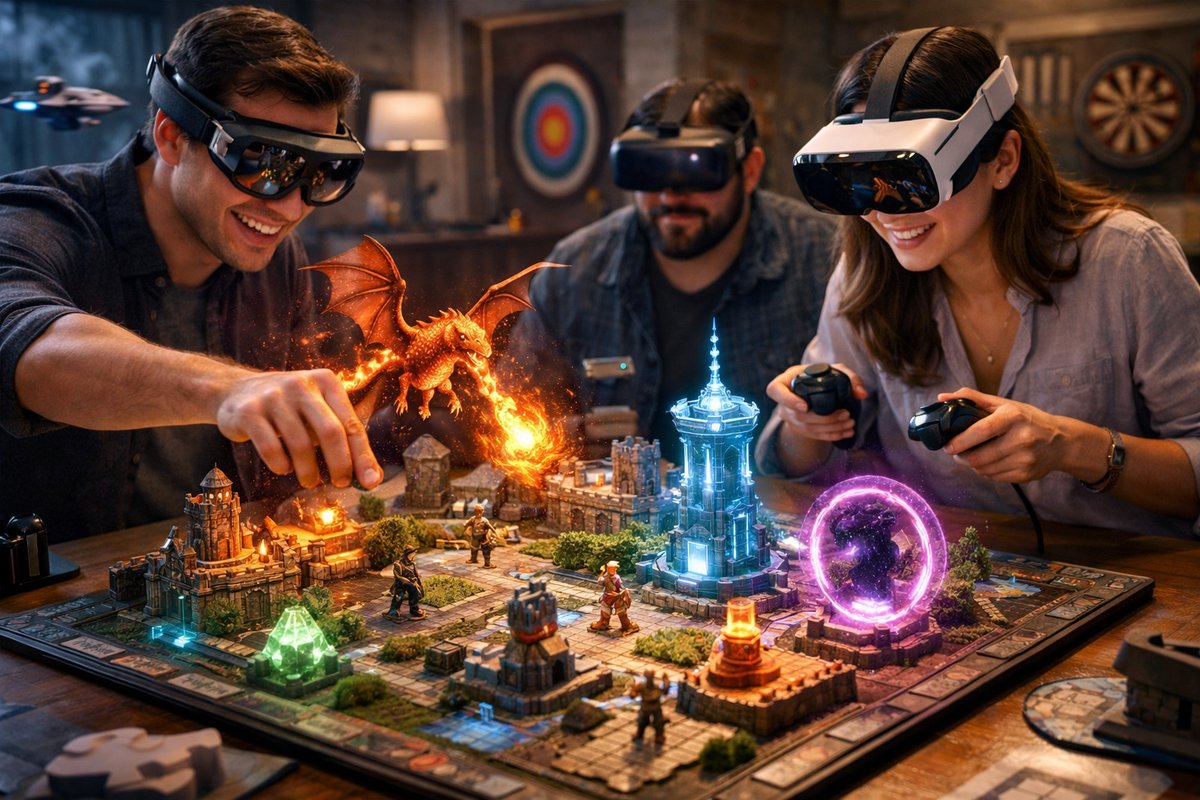

Augmented reality has long promised to bridge the gap between digital landscapes and physical play spaces. Now, a surge of tabletop titles, standalone headsets and mobile-powered experiences are making those visions a reality. Across local gaming cafes and home setups, players are slipping on lightweight glasses or lifting smartphones to watch virtual creatures skitter over printed maps, investigate 3D crime scenes on dining tables and even field armies of digital soldiers on bespoke play mats.
One of the most visible pioneers is Tilt Five, a crowdfunding-backed tabletop AR system that shipped its first wave of units earlier this year. Using a reflective game board, a wand-like controller and patent-pending glasses, Tilt Five overlays vividly rendered characters and environments into physical scenes. Its library includes tactical skirmish games, cooperative quests and even puzzle challenges. Enthusiasts at Gen Con 2022 reported seamless tracking and surprisingly deep immersion, praising the way digital pieces appeared to occupy real space without the bulk or tethering of traditional VR setups.
Meanwhile, smartphone-enabled titles are tapping into built-in depth sensors for an accessible entry point. Chronicles of Crime, an award-winning detective game, now integrates AR reconstructions of crime scenes: players scan printed cards and watch 3D models unfold above their tabletops. Clues hover in midair, evidence glimmers under simulated UV light, and interviews play out in cinematic overlays. This blend of tactile cards and on-device graphics has attracted both hobbyists and families seeking a fresh way to approach cooperative storytelling.
Beyond living rooms, forward-thinking gaming cafes are installing shared AR tables and mixed-reality arenas. In one London venue, groups of four can don wireless headsets that project game maps onto tables below, then wield motion- tracked controllers to draw spells, direct troop movements or solve spatial puzzles together. Operators report that AR stations boost both dwell time and group bookings, as players from casual newcomers to seasoned hobbyists gravitate toward experiences that feel simultaneously novel and social.
On the video game front, manufacturers of standalone headsets are introducing passthrough modes that blend VR and AR. This allows players to switch seamlessly from fully virtual worlds into mixed-reality overlays that anchor digital UI elements-and even game characters-into their real environment. Competitive shooters can now flash opponents in your living room, and platformers might turn your coffee table into a springboard. The technology remains in early stages, but its implications for crossover genres and spectator-friendly events are generating buzz across eSports and hobbyist circles alike.
The allure of AR lies in its ability to foster both immersion and connection. Unlike fully cloistered virtual reality, augmented setups leave players aware of one another and their surroundings. This reduces motion sickness, encourages face-to-face interaction and lends physicality to digital actions. A knight’s sword swing can coincide with a tangible arm movement, while a summoned creature can seem to scuttle around the actual floor. For groups keen on role-playing, strategy or puzzle solving, the blend of body language and virtual spectacle creates a richer, more memorable session.
Nevertheless, challenges remain. High-quality AR glasses and controllers still command premium prices, often limiting adoption to early adopters or funded venues. Battery life, calibration drift and room lighting constraints can interrupt sessions. And developers are learning to balance visual fidelity with performance demands; dense textures and complex shaders can bog down less powerful hardware. Standardizing file formats and tracking protocols across devices also lags behind the rapid pace of experimental releases.
Yet, progress is rapid. Advances in depth-sensing cameras, more efficient GPUs and streamlined content pipelines are driving costs downward. Consumer smartphones with LiDAR or ToF sensors have already unlocked robust AR features, while open-source toolkits let independent designers prototype interactive overlays in days rather than months. Early commercial adopters are betting that the coming generation of AR glasses-lighter, cheaper and less obtrusive-will unlock mass-market appeal by next holiday season.
Community-driven modding and user-generated scenarios are fueling long-term engagement. Enthusiasts are sharing custom map files, 3D asset packs and rule tweaks for AR board games on open forums. Hackathons have sprung up around region-based AR challenges, encouraging coders and artists to collaborate on site-specific renditions that blend local landmarks with fantasy quests. The result is a vibrant ecosystem where creativity and technology intermingle, lowering the barrier to entry for creators and diversifying the catalog of experiences.
Looking ahead, cross-platform compatibility could become the next frontier. Imagine walking into a café with your own AR glasses and controllers, then seamlessly connecting to a house-owned table board and loading your personal profile. Or teaming up with remote friends via linked mixed-reality sessions, where digital tokens traverse physical tables in different locations. These scenarios hinge on reliable networking, standardized tracking anchors and privacy safeguards-areas where ongoing collaboration between hardware makers and venue operators will be crucial.
For now, the fusion of physical play and digital sophistication is already reshaping the entertainment landscape. From living rooms to convention halls, AR gaming setups are enticing players with unexpected depth and social resonance. By delivering tangible interaction with virtual elements, this hybrid medium is filling a niche between analog simplicity and VR’s full immersion. As technology matures and creative communities flourish, augmented reality stands poised to become a mainstay fixture in the future of both tabletop and video gaming.
Whether you’re a collector of miniatures eager to see your armies come to life, a puzzle-lover chasing fresh twists on mysteries, or an eSports fan intrigued by mixed-reality arenas, there’s never been a more exciting time to explore augmented play worlds. The line between board and screen is blurring-and each new prototype, cafe installation and community project brings us one step closer to play experiences limited only by imagination.