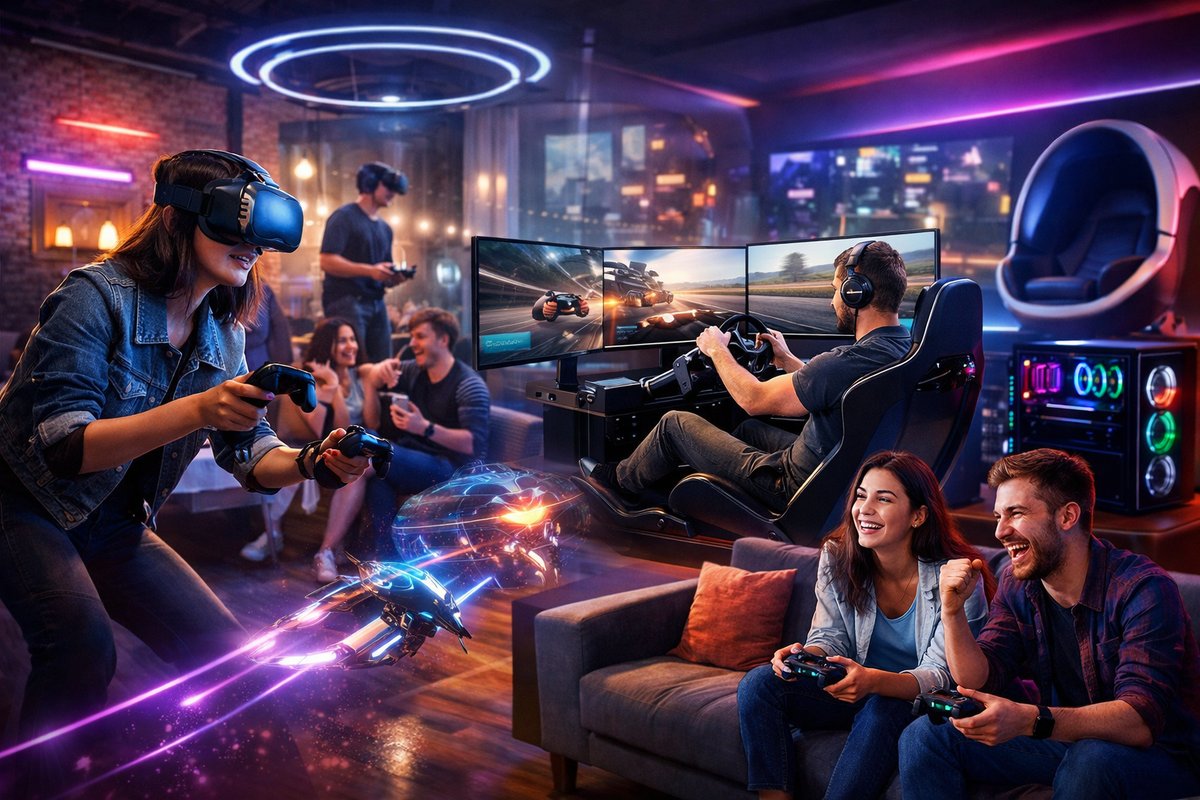

Play has always been more than flickering pixels and button presses. Today, it’s a catalyst for new social rituals and experimental creativity, manifesting as hybrid gaming lounges in repurposed warehouses and meticulously tuned home setups that double as streaming studios. A convergence of immersive technology, flexible spaces and community-driven programming is rewriting the playbook, inviting both casual enthusiasts and seasoned competitors to explore worlds that feel touchable and real.
Across major metropolitan areas, entrepreneurs and designers are turning underused real estate into vibrant “playfoundries.” Imagine stepping off a city street into a converted loft where neon lighting outlines modular gaming booths, motion capture zones let visitors act out epic battles, and shared tables host casual board-game nights paired with kitted-out consoles. These venues fuse the immediacy of arcades with the camaraderie of coworking spaces, offering everything from drop-in VR sessions to curated esports tournaments.
In one flagship location, rotating content keeps regulars engaged. Weekdays host indie-developer showcases where attendees can demo early builds and chat with creators over locally roasted coffee. Weekends pivot to high-stakes showmatches, complete with live commentary and stadium-style seating. Food trucks, craft cocktails and branded merch round out the vibe, turning what might have been a solitary hobby into a full-blown cultural gathering.
Meanwhile, a parallel revolution is underway at home. The pandemic-era surge in remote work and digital socializing accelerated a trend already in motion: the rise of living rooms as multifunctional arenas. No longer content with a simple couch and standard controller, many enthusiasts have reconfigured spare rooms into dedicated gaming pods. Walls are lined with high-refresh-rate monitors, acoustic-paneling dampens ambient noise, and cable management systems keep RGB wiring sleek. Streaming setups complete the picture, with telescoping arms securing cameras and ring lights illuminating reaction-shot close-ups.
This emphasis on personal stagecraft has given birth to new cottage industries. Freelance set designers specializing in gaming interiors offer plug-and-play kits for rent or sale. Consultants advise on lighting schemes that complement on-screen visuals, while software tools dynamically sync ambient LEDs to gameplay cues and audio beats. Subscription services deliver rotating collections of themed décor-think sci-fi motifs one month and retro arcade throwbacks the next-so that at-home venues can stay on trend without buying a lifetime’s supply of gear.
The boundary between public and private play isn’t the only frontier stretching. Augmented reality has begun seeping into daily life, turning city parks and shopping centers into impromptu game boards. A recent community-driven treasure hunt in a downtown plaza invited participants to solve location-based puzzles via smartphone, unlocking digital rewards and pop-up performances by street artists. Similarly, mixed-reality spectacles at pop-up music festivals overlay interactive graphics across stage backdrops, inviting audiences to shape light shows with collective gestures.
At the core of these experiences lies the steady advance of hardware. VR headsets have grown lighter and more comfortable, with next-generation panels delivering sharper visuals and wider fields of view. Wireless tracking systems liberate users from cramped play spaces, while haptic vests offer calibrated feedback for everything from sword clashes to simulated bullet impacts. Even classic controllers have been reengineered for ergonomic precision, sporting adaptive triggers and customizable thumbstick tensions.
Powering all of this is a new wave of edge-cloud gaming platforms. By offloading complex processing tasks to remote servers, these services ensure smooth frame rates on modest local hardware. Gamers can stream AAA releases in 4K with minimal latency, breaking down barriers to entry and reducing the need for frequent costly upgrades. For event organizers, this means smaller on-site rigs and more flexible layouts-ideal for pop-up venues and touring show circuits.
Communities are the secret ingredient fueling this metamorphosis. Online forums, social-media channels and messaging platforms buzz with plans for collaborative builds, from DIY motion-capture rigs to large-scale LAN-party events. Some neighborhoods host “swap nights,” where players trade unused peripherals and prototype custom mods. Others mobilize to teach coding workshops, guiding aspiring designers to transform hobby projects into polished indie titles.
Sustainability is woven into the conversation as well. Many venues and individual builders are recycling aging consoles, repurposing them as digital jukeboxes or social terminals. Hardware-swapping networks redirect components destined for landfill back into active service. Biodegradable packaging and energy-efficient lighting systems help keep the carbon footprint of these spaces in check, proving that the future of play can be greener without sacrificing spectacle.
On the creative front, developers are embracing experimental formats that blend live performance with gameplay. One live-action role-playing company recently mounted a city-wide interactive drama in which participants’ smartphone avatars influenced the story in real time. Local actors improvised scenes in alleyways, drawing on player choices to pivot narratives on the fly. At the same time, tabletop designers are integrating app-driven soundscapes and dynamic card decks, marrying analog tactility with digital flair.
For those who prefer to stay planted at home, streaming networks are ramping up interactive broadcasts. Audience polling affects in-game events, while co-watching parties synchronize feeds across living rooms around the globe. Spectators can cheer players on or trigger challenges-like temporary controller handicaps-that add spontaneous drama. In effect, digital crowds are taking the place of physical stands, yet the one-to-many energy remains just as electric.
All of these threads converge around a central insight: play isn’t a solitary escape from reality, nor is it tethered to the hardware it occupies. It’s a social catalyst, an engine for creativity and a sandbox for community building. Whether gathering in a neon-lit arcade studio, striding through a park chasing virtual artifacts, or fine-tuning a streaming sanctuary at home, enthusiasts are redefining what it means to play together.
What comes next may be even more surprising. Emerging research into neural interfaces hints at mind-mapping controls still years away from mainstream use. Advances in spatial computing promise to merge screens with real-world surfaces, dissolving the last boundaries between the digital and the material. And as audiences grow more participatory, the line between developer and player will blur, opening pathways for co-creation that are still uncharted.
In this evolving landscape, the simple click of “Play” can launch vast social ecosystems-public or private, streamed or in person-that ripple outwards, connecting people across time zones and backgrounds. And as technology continues to weave new threads into the tapestry, one thing is certain: when it comes to the art and business of play, the next level is only a heartbeat away.