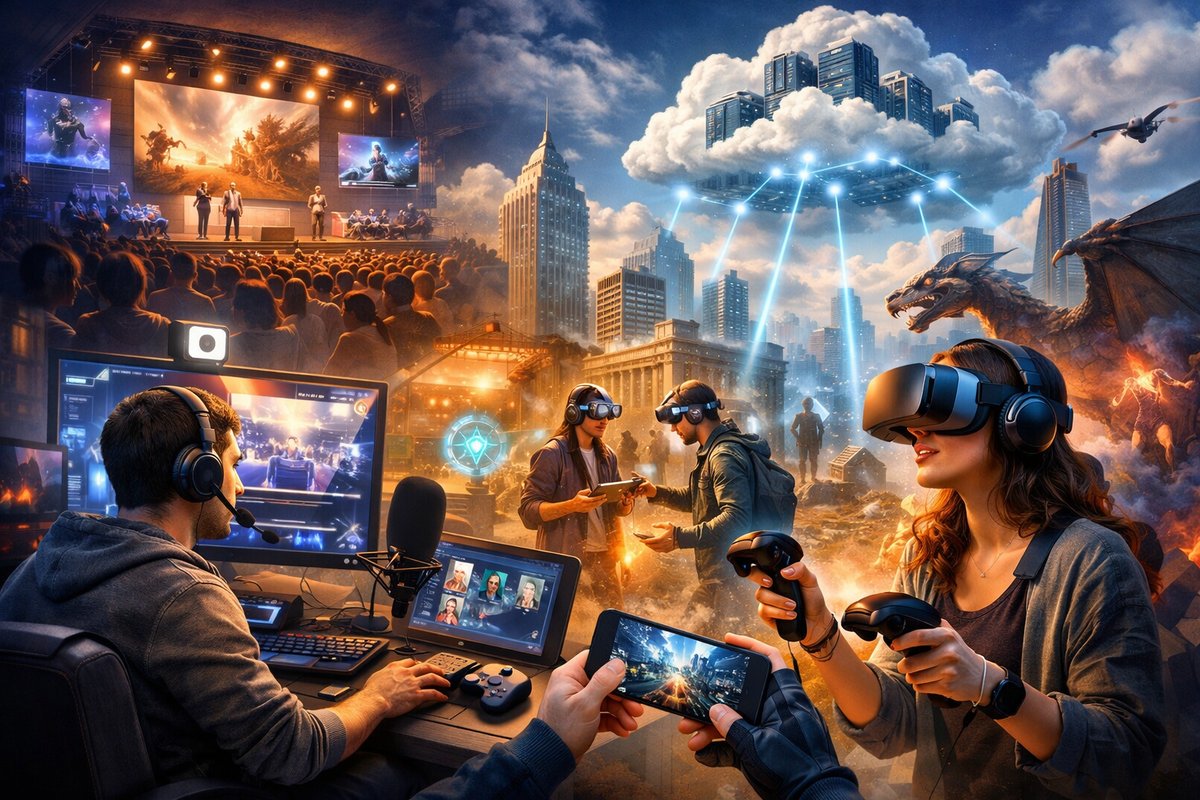

In a cavernous hall converted from an old factory, thousands of attendees don VR headsets, don haptic vests, and queue up for live demos of an augmented reality treasure hunt that will soon spill out onto city sidewalks. Elsewhere, on tiny screens around the globe, desktop PCs and laptops beam AAA titles through data centers thousands of miles away, letting anyone with a stable internet connection take part in the latest blockbuster release without ever having downloaded a gigabyte of assets. What once felt like science fiction is now unfolding across our living rooms, event spaces, and mobile devices, reshaping the way we play-and watch others play-in real time.
The resurgence of hybrid conventions is one of the year’s most striking phenomena. Organizers balance sprawling expo halls with synchronized livestream channels, offering international viewers the chance to vote on panel questions, participate in exclusive giveaways, and even join digital swag bags filled with in-game content codes. Attendees on site experience a blend of interactive stages, cosplay showcases, and timed scavenger hunts using smartphone GPS. More than ever, games events operate like multimedia festivals-part theme park, part broadcast studio-where physical presence and virtual participation happen in parallel.
Behind the scenes, cloud gaming services have become the connective tissue for this new ecosystem. Rather than relying on powerful local hardware, players tap into remote servers outfitted with high-end graphics cards and sprawling data pipelines. Titles that once required six-figure rigs are now accessible on entry-level laptops or even mobile phones. For developing markets where gaming PCs are scarce, cloud play is opening doors to competitive e-sports, creative sandbox titles, and narrative adventures that were previously unreachable.
Streamers and content creators are another driving force. Live broadcasts of playthroughs, speedruns, and casual “let’s talk” sessions generate millions of hours of viewership each week. Interactive overlays let audiences cast votes on in-game decisions or send virtual cheers that trigger pyrotechnics onstage. In some hybrid festivals, remote viewers can influence on-ground challenges by dropping digital tokens-effectively blurring the line between spectator and participant. The result is a multi-directional flow of entertainment, where communities shape the experience as much as game designers.
Immersive hardware is keeping pace with these social evolutions. Next-generation gaming headsets boast spatial audio engines that track head movement and place sound cues in 3D space, guiding players toward hidden pathways or alerting them to enemy footsteps. Haptic suits deliver micro-vibrations tuned to in-game textures, from the staccato blitz of a sci-fi blaster to the faint tremor of shifting earth beneath virtual boots. Meanwhile, modular controllers allow users to swap thumbsticks, paddles, or even fold-out touchpads mid-session, catering to accessibility needs and personal comfort without skipping a beat.
Indie developers, too, are thriving in this climate of fluid access. Without the need for customers to download large files or invest in specialized gear, small teams release bite-sized experiences-ranging from interactive poetry to experimental rhythm puzzles-directly through browser-based cloud platforms. These micro-jobs of digital artistry turn short play sessions into communal events: drop into a live server, solve a quick puzzle alongside strangers, then bounce out to compare notes in a dedicated chat channel.
At home, family game nights are evolving into cinematic affairs. With streaming devices bridging PCs and smart TVs, households queue up co-op titles right alongside indie films and gaming documentaries. Ambient LED lighting syncs with on-screen action, flickering like real fire or pulsing to a synthwave soundtrack. Some households even assemble multi-room setups, dedicating one area to VR exploration and another to board-game-style adaptations of popular IPs, all while sharing a single cloud gaming account that swaps sessions in seconds.
E-sports organizers are capitalizing on these innovations by experimenting with mixed-reality viewing stands. Picture a basketball-sized hologram hovering over an arena floor, showing real-time player statistics and positional overlays as viewers roam around it. Meanwhile, at satellite fan zones, clamshell-style gaming kiosks let visitors experience pro-level graphics without the fuss of setting up hardware. Tournaments now broadcast not only player faces but also live biometric data-heart rate, reaction speed, and stress markers-adding a new layer of drama to every clutch shot or brutal boss fight.
Behind these spectacles is a growing emphasis on privacy and sustainability. Cloud providers refine data-center efficiency to reduce energy consumption per streamed frame. Developers ship modular software updates so that players only download essential assets instead of full game packs. And event organizers rethink swag: instead of mass-produced T-shirts, they issue digital collectibles with limited-edition artwork that fans can mint on blockchain networks if they choose.
From a social perspective, the lines between gamer and spectator continue to blur. Community managers host live watch-along sessions where developers break down their own design choices mid-stream, fielding questions from global audiences and testing patches in real time. Collaborative moderation tools ensure chat channels stay welcoming and inclusive, elevating voices that might otherwise be drowned out by toxicity. This focus on emotional intelligence and respectful interaction creates safer spaces for new players-especially those from underrepresented backgrounds-to dive in.
Looking ahead, the next frontier may lie in AI-driven content creation. Procedural engines that generate side quests on the fly, personalized to each player’s historical actions and emotional reactions, are already in closed alpha. Imagine a horror game that learns from your fear response and dynamically tweaks enemy behavior or environmental details to maintain tension without resorting to jump scares. Or a fitness-focused title that adjusts its difficulty curve based on real-time biometric feedback captured by wearable sensors.
As ecosystems expand, so do opportunities for creative crossover. Musicians compose adaptive soundtracks that swell when competitive moments arise, then taper into ambient piano during exploration. Fashion designers collaborate with avatar-creation tools to offer downloadable outfits that blur the lines between real-world couture and pixel art. And educators deploy sandbox simulations for climate modeling, urban planning, and historical reenactment, making games a cornerstone of experiential learning.
Ultimately, the convergence of hybrid events, cloud play, immersive hardware, and community-driven culture suggests that games and entertainment are maturing into an ever-richer tapestry of shared experiences. Whether plugging in from home, stepping into a converted warehouse, or tapping into a browser window during a lunch break, players now occupy an interconnected world where the only limit is imagination-and the only price of admission is curiosity.
New technologies will continue to shape what we see, hear, and feel in virtual realms. But the heart of every interactive experience remains the same: a chance to play, to explore, and to connect with others, transcending physical distance and traditional media boundaries. In that sense, the future of games isn’t just about pixels and processors-it’s about people discovering new ways to share wonder, excitement, and the simple joy of play.