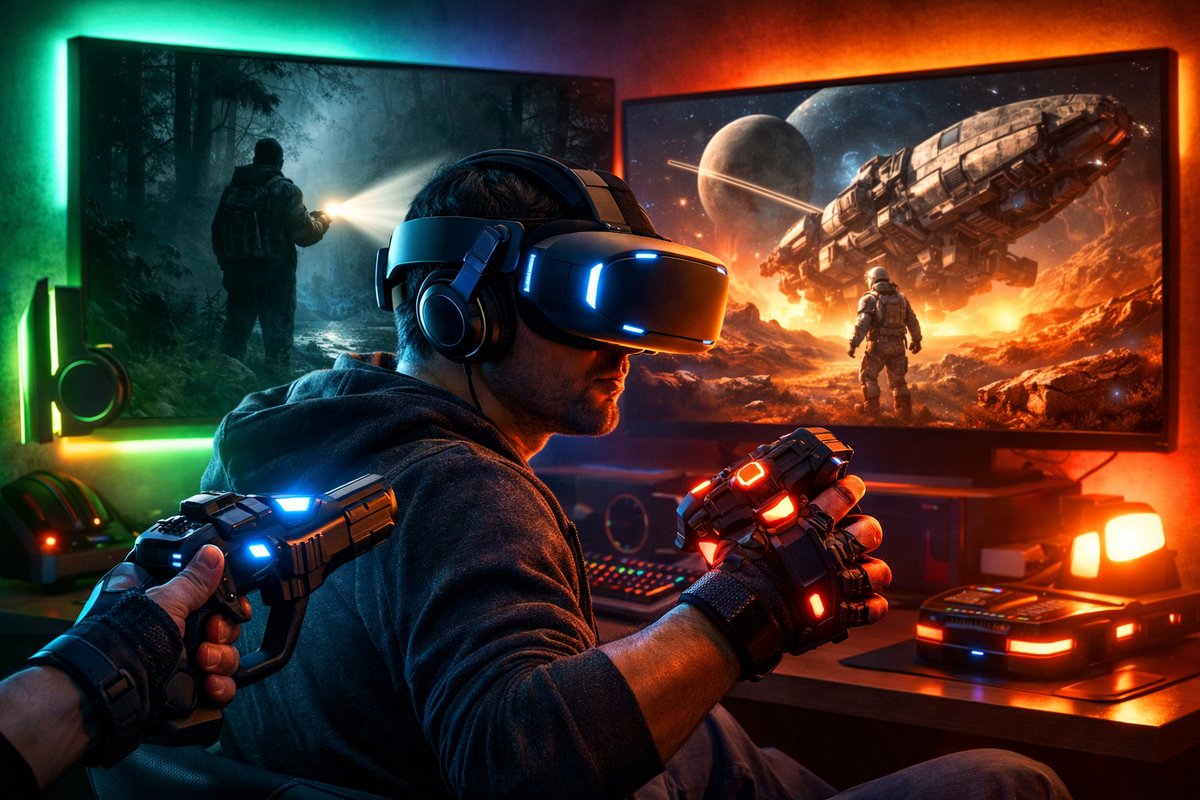

When the credits roll on an atmospheric horror title and your heart is still pounding, you realize that the game world has reached its fingertips. Cutting-edge software has always driven blockbuster success, but today’s most memorable sessions combine rich storytelling with physical gear designed to hook players more firmly in the experience. Demand for deeper immersion has sparked a wave of peripherals and accessories that transform reflexive button-mashing into a truly multisensory journey.
Recent releases such as Alan Wake 2 demonstrate how next-gen consoles and high-end PCs can render light shafts, volumetric fog, and dynamic audio in ways previously reserved for cinematic trailers. Yet as developers push graphical fidelity, hardware innovators are racing to reimagine what it feels like to play. VR headsets slip us fully into alternate realities, haptic feedback controllers let us feel every collision, and ambient room lighting paints walls with game-driven color. Suddenly, the divide between screen and space dissolves.
Consider Starfield, a sprawling open-world RPG that tasks players with exploration among the stars. A conventional setup-monitor, keyboard, controller-conveys epic vistas in sharp detail. But add a set of programmable LED lights synced to in-scene colors and dynamic audio via a surround-sound headset, and those crimson sunsets and neon ship corridors spill off screen and onto walls. Each laser blast, each footstep in the engine room, resonates not just in speakers but in your peripheral vision.
The push for tactile realism has inspired a new generation of gamepads. Controllers equipped with advanced haptic motors can reproduce subtle textures: the grit of a cobblestone street in a medieval RPG or the splash of water droplets after a dive into a hidden grotto. In horror titles like Resident Evil Village, these pulses in your palms mirror every moment of dread, drawing you closer to every creak and distant whisper. And for those venturing into VR shooters, tactile feedback gloves and vests deliver even richer sensations-pressure, vibration, temperature shifts-all synchronized to virtual events.
Audio technology has not been left behind. Traditional stereo speakers have given way to spatial audio and surround-sound headsets with dozens of microdrivers. When an enemy sneaks up behind you, the precise positioning of footsteps can be life-saving. Situations once rendered as left-channel or right-channel blips are now real-time auditory landscapes. Dolby Atmos or its equivalents create a sphere of sound around the player, letting raindrops patter overhead, rockets roar beneath, and distant creatures call from behind. It’s less “playing” and more “inhabiting” a living world.
Meanwhile, VR hardware is emerging from niche hobbyist circles into mainstream awareness. Tetherless designs have replaced tangled cables with sleek wireless solutions, offering freedom of movement in larger play zones. Optics have improved, reducing glare and motion blur to deliver higher resolutions and wider fields of view. Room-scale tracking systems can now map furniture and obstacles, blending your living space seamlessly with virtual terrain. Mounting a headset has become as routine as donning a pair of goggles before a dive-and the payoff is an uncanny sense of presence.
Beyond input and output devices, displays themselves are evolving. High-refresh-rate gaming monitors-240 Hz and beyond-render sub-100 millisecond frame times, eliminating motion judder and screen tearing. Variable refresh-rate technologies ensure frames sync perfectly with a GPU’s output, maintaining silky-smooth motion even during chaotic action sequences. For split-second timing in competitive shooters or precise camera pans in exploration games, every millisecond counts.
No discussion of immersion is complete without room ambience. Gamers are increasingly integrating LED lighting kits that react dynamically to on-screen colors and events. Strips can line monitor bezels, wrap around desks, or trace the outline of a living room, instantly bathing the space in thematic hues. In stealth games, shadows might spill cool blues and deep purples across walls; in fantasy adventures, every spell blast ignites the room in blazing oranges and reds. The result: each session feels like a private screening, complete with custom stagecraft.
Comfort also plays a surprising role in sustained immersion. Ergonomic chairs, wrist rests, and adjustable mounts reduce fatigue so that players can lose themselves without distraction. Textiles engineered for breathability and cushioning keep shoulders relaxed during marathon quests. Even simple accessories like noise-cancelling acoustic panels and heavy-duty desk mats contribute to an all-in-one environment where nothing pulls you out of the moment.
While triple-A releases dominate headlines, indie developers are equally incentivized to embrace these peripherals. Puzzle games now incorporate controller vibrations to suggest hidden mechanisms; narrative experiences use spatial audio to reveal secret dialogue. Environmental storytelling is richer when every creak, shimmer, and gust of wind feels less like recorded data and more like real phenomena around you. This creative synergy between software and hardware ensures that the next wave of standout titles will focus as much on sensory detail as on narrative arcs.
Competitive gaming has also ridden this tide. Pros invest heavily in monitors with sub-1-millisecond response times, precision mice and keyboards with programmability down to the actuation depth, and headsets with built-in audio equalizers that prioritize footsteps and reload cues. Their setups often include ambient lighting that visually signals match status-health bars, cooldown timers, round winners-so they can react at a glance. It’s not just about raw muscle memory; it’s about building a feedback-rich ecosystem where information flows at warp speed.
For casual audiences, the bar continues to rise. As more titles launch with native support for ambient lighting and haptic features, entry-level gear has followed suit. Starter kits for room lighting automation, plug-and-play haptic controllers, and affordable surround-sound headsets make it easy for newcomers to test the waters. Subscription-free game streaming platforms also factor in, helping players stream demanding experiences at high fidelity with minimal hardware investments.
Looking ahead, the intersection of AI and immersion promises to unlock even deeper levels of engagement. Real-time scene analysis could drive smarter environmental lighting, adjusting brightness and color temperature based on game events or even your mood. Adaptive haptics might learn your playstyle and fine-tune feedback strength for optimal sensation. Networked peripherals could sync across multiple players in the same session, letting teammates feel each other’s actions and strengthening cooperative bonds.
Ultimately, the future of gaming relies on more than pixels per inch or next-gen polygon counts. It rests in the synergy between developers, hardware engineers, and players seeking ever more powerful connections to virtual worlds. Immersion has transcended mere visuals, expanding into every sense. When you reach for a controller, you should feel the grain of its texture, the whisper of haptic pulses, and the glow of lights that echo your digital adventure. In that space-where software and hardware entwine-play truly becomes serious business.
So the next time you enter a haunted manor, chart a starship’s course, or race across a neon cityscape, consider not just the game itself but the tools that bring it to life. Ambient lighting, haptic feedback, spatial audio, and ergonomic design work in concert to blur reality’s boundaries. Embrace these evolving technologies, and prepare to step deeper into any world you choose. After all, why merely observe when you can be fully, gloriously immersed?
-
Danglers VR Cable Enhancement Kit - Wireless Like Experience - Etsy
May 13, 2022 ... Valve Index Cable Strain Relief Clip, VR Headset Cable Support, Secure Fit for Valve Index, Reduces Tension and Prevents Cable Damage. -
Virtual Reality | Wayfair
Shop Wayfair for the best Virtual Reality. Enjoy Free Shipping on most stuff, even big stuff. -
Sony PS5 DualSense Wireless Controller - Icon Blue - Walmart.com
Experience immersive gaming with the Sony PS5 DualSense Wireless Controller in Icon Blue, featuring haptic feedback, adaptive triggers, built-in microphone.