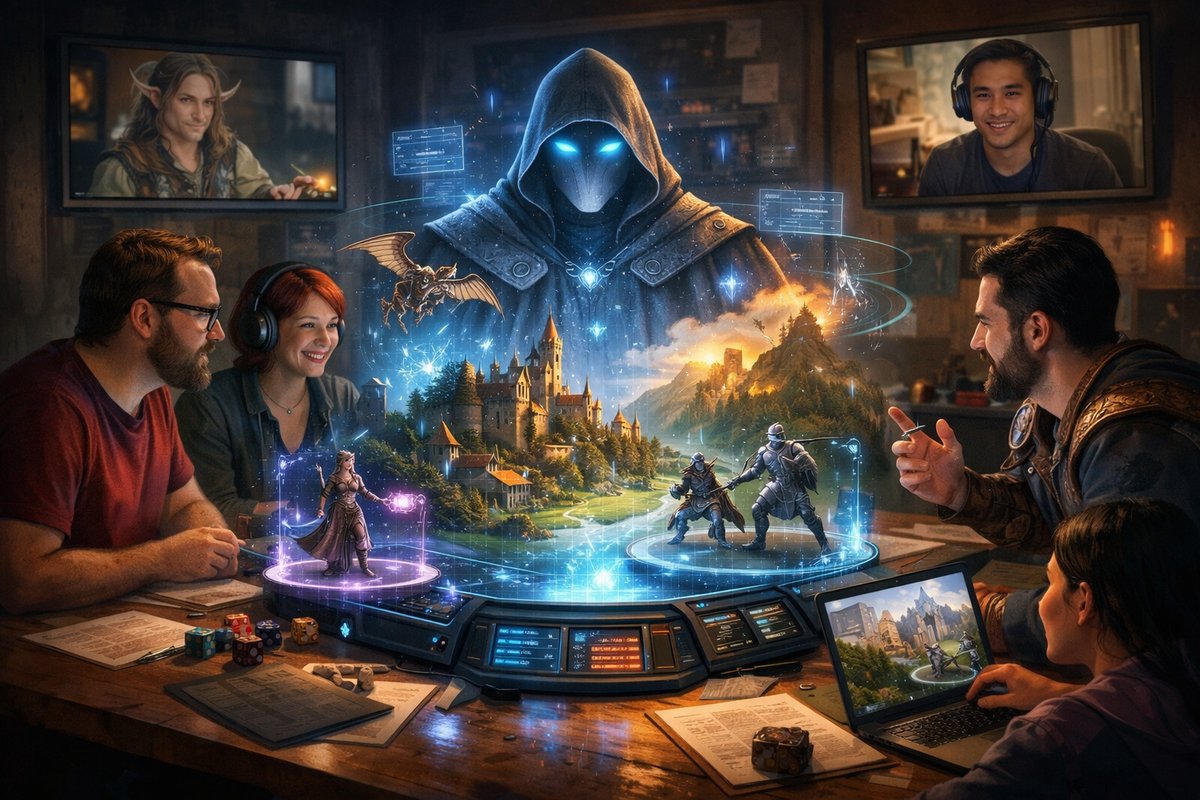

In a crowded neighborhood game store last month, a circle of players gathered around a long wooden table, not to wait for a human Dungeon Master but to interact with an AI storytelling engine projected onto the play surface. As the afternoon sun slipped through the storefront windows, characters in the digital map responded to player choices in real time, and the narrative unfolded without a single scripted encounter. This blend of physical miniatures, theatrical lighting, and an artificial intelligence narrator signals a new chapter in tabletop roleplaying, one in which algorithms guide the story as easily as any seasoned human host.
The concept of an AI-driven Dungeon Master may sound like a distant dream, but it’s become a reality thanks to breakthroughs in natural language processing and game design tools. Early experiments with chatbots and conversation agents laid the groundwork, but recent advances allow fully interactive, context-aware worlds to emerge. These systems scan character notes, recall past choices, and generate fresh encounters on demand. For groups pressed for time or lacking a dedicated storyteller, AI DMs can pilot entire adventures, freeing players to focus on strategy, roleplay and cooperative problem solving.
Behind the scenes, most AI Dungeon Masters rely on a modular stack of software and hardware components. Core narrative systems run on local mini PCs or cloud platforms, interpreting text or voice inputs and rendering descriptive feedback. Layered on top, table-mounted projectors or augmented reality glasses project maps and environmental effects onto physical surfaces. Optional haptic gloves or vibro-tactile devices allow players to feel virtual hazards-a gust of wind or the tremor of an underground beast. All these elements work in concert to blur the lines between the tangible tabletop and the digital frontier beyond.
At a recent West Coast gaming expo, independent developers unveiled several new engines that integrate seamlessly with popular virtual tabletop platforms. One demonstration featured a projector that can turn any plain surface into a responsive map complete with fog of war and dynamic lighting. Another showcased a conversational AI module that reacts not only to scripted cues but also to off-the-cuff player banter, adjusting tone and difficulty based on the group’s energy. Attendees lined up for demos, eager to see if an AI could handle the improvisational demands that stump even veteran Game Masters.
These AI systems are finding a home in hybrid sessions that mix in-person gameplay and remote participation. A local gaming lounge in the Midwest began offering weekly AI-DM nights, where one table is equipped with motion sensors and microphones. Remote players can speak through a simple chat window or join via voice link, and the AI DM tracks the entire party. Observers note that having a neutral facilitator eliminates awkward pauses and maintains a steady pace, while still preserving the chaos and excitement of spontaneous decision making.
Reactions from long-time roleplayers have been mixed. Some welcome the reliability of an AI host, especially for one-shots or beginner-friendly events where player counts fluctuate. Others worry a machine can’t capture the emotional nuance of a human storyteller-those sly smirks, improvised jokes, or dramatic pauses that heighten suspense. Yet even skeptics concede that AI DMs are tools, not replacements. Human moderators can still step in, tweak story beats, or trade off with the algorithm. In this light, the technology becomes a collaborative assistant rather than a Silicon usurper.
One of the most compelling aspects of AI-driven narratives is the emotional intelligence layered into the code. Advanced systems analyze voice tone, text sentiment and recent game history to sense when the party needs a morale booster or a moment of calm. If combat encounters drag on too long, the AI might spring an unexpected narrative twist to break the tension. If characters are struggling, it can introduce a helpful NPC ally. This reactive storytelling fosters empathy and keeps players invested, much like a skilled human DM shaping scenes around the table.
Data privacy and sustainability have emerged as key considerations in this burgeoning field. Rather than sending every recording to a central server, some developers are opting for local processing that keeps session logs on a private mini PC inside the game store or a player’s home. This approach reduces bandwidth usage and ensures game data-character backstories, plot twists, party secrets-stay under the control of the group. On the environmental side, many studios are exploring energy-efficient chip designs and low-power projection units to minimize the carbon footprint of immersive play.
Not everything is smooth sailing. AI DMs sometimes produce improbable plot threads or misinterpret contradictory inputs, sending players on wild goose chases. There’s also the risk of homogenized storytelling-if every group uses the same engine, adventures may begin to feel formulaic. To counter this, open source add-ons allow hobbyist writers to create custom scenario modules, exotic creature packs or cultural lore expansions. Community-driven content repositories ensure a constant influx of fresh material, much like fan-made expansions for classic board games or video games.
Looking ahead, developers envision deeper sensory integration. Voice-controlled stage lighting could paint the room in moody hues to match the narrative beat. Haptic chairs might rumble with nearby magical earthquakes. Even scent diffusers could release subtle fragrances of pine forest or salty sea air during key moments. While some of these add-ons remain experimental, the trajectory is clear: a push toward multi-sensory immersion that engages sight, sound, touch and even smell.
For newcomers curious about exploring AI-assisted play, the barrier to entry is surprisingly low. Many narrative engines offer free tiers or trial builds that run on off-the-shelf mini PCs. A basic projector attachment and a decent microphone can bring virtual maps and AI narration into living rooms or game lounges. Most platforms support standard tabletop accessories like miniatures, terrain tiles and dice, so players don’t have to abandon their favorite tools. Community forums buzz with tutorials, sample configs and troubleshooting tips to help groups get set up in an afternoon.
As AI storytelling gains momentum, game stores and convention organizers are adapting. Some venues now advertise “AI DM demo nights,” pairing newcomers with algorithmic guides to ease them into roleplaying. Homebrew competitions test new modules and reward creators whose scripts yield surprising plot twists. Online streaming channels dedicate weekly slots to AI-run one-shots, letting viewers vote on key decisions in real time. These events foster a sense of shared discovery and illustrate how automation can amplify creativity rather than stifle it.
Whether you’re craving the unpredictable flair of a human DM or the steady consistency of an AI host, the future of roleplaying is more diverse than ever. Automated Dungeon Masters are carving out a space in gaming culture, offering fresh ways to connect, collaborate and explore imaginary worlds. As technology continues to evolve, players and storytellers alike will find new frontiers to chart-some guided by human intuition, others by lines of code. Either way, the next great adventure is only a roll of the dice away.