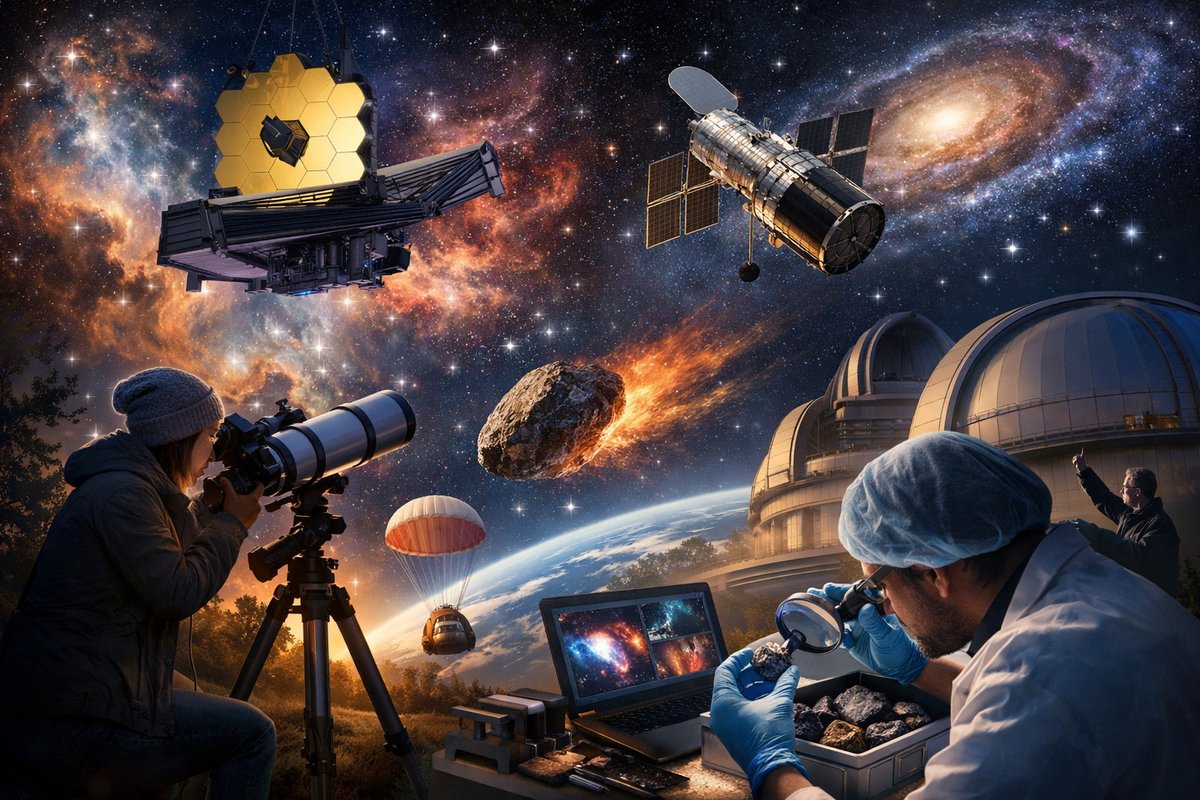

In recent months, the steadily rising tide of space missions and groundbreaking observations has stirred a collective awe that transcends laboratories and lecture halls. From the mesmerizing infrared vistas delivered by the latest orbiting observatory to the first grains of an asteroid whispering secrets of the solar system’s birth, cosmic curiosity is experiencing an unprecedented renaissance.
It began when a cutting-edge space telescope unveiled swirls of star-forming regions cloaked in interstellar dust. The image-captured in wavelengths invisible to the naked eye-revealed filaments of glowing gas, each tendril hinting at stellar nurseries where new suns are about to ignite. Once reserved for academic journals, these breathtaking visuals now flood social media feeds, inspiring artists, poets, and preschoolers alike to imagine their place in the cosmic tapestry.
Meanwhile, a daring sample-return mission touched down on a distant asteroid, delivering milligram-sized flakes of primordial rock. Scientists clad in cleanroom suits gingerly peeled these grains from specialized containers, preparing to peer back in time at conditions that prevailed over four billion years ago. Every fragment holds clues about how planets coalesced from the swirling disk of dust around our young sun.
“When you hold a piece of an asteroid that’s older than Earth itself, you’re literally touching the dawn of our solar system,” explains a planetary geologist working with these samples. “It’s a visceral reminder that we carry our origins in rock and cosmic dust.”
Public fascination hasn’t been confined to professional circles. Amateur astronomers report record attendance at community observatory events, where visitors line up to glance at Jupiter’s cloud bands, Saturn’s rings, and even faint smudges that mark remote galaxies. Online platforms dedicated to stargazing have seen user numbers double, with thousands uploading time-lapse videos of meteor showers and satellite transits.
One weekend brought a surprise: a bright fireball streaking across several states. Mobile alerts pinged smartphones as people looked up to see a glowing trail racing against the dark sky. Amateur radio operators triangulated its path, while wildlife biologists noted a spike in nocturnal animal activity triggered by the sudden illumination. The episode served as a vivid illustration of how space phenomena can ripple through daily life on Earth.
Backing this surge of enthusiasm, crowdfunding campaigns are fueling small-scale projects that once struggled for resources. Hobbyists are building custom spectrographs to analyze star compositions, backyard astronomers are stitching together ultra-wide mosaic images of the Milky Way, and high-school students are participating in real research by classifying galaxy shapes from telescope archives.
Educational initiatives have also seized the moment. A digital planetarium initiative distributes low-cost projection units to community centers, turning village halls into windows on the universe. Free workshops guide participants through constellation mapping, basic astrophotography techniques, and safe solar viewing methods. Libraries are hosting “cosmic story hours,” blending children’s literature with presentations on black holes, nebulae, and exoplanets.
Such hands-on experiences are proving more than just entertainment-they’re incubators for future scientists and engineers. Surveys of students who attend space-themed outreach events show a marked increase in interest for STEM subjects, with many citing that first awe-inspiring glimpse through a telescope as the spark that ignited their academic passions.
Yet the renewed cosmic curiosity isn’t solely about observation and discovery; it’s shaping conversations about humanity’s role and responsibility in the universe. Discussions around space debris mitigation, planetary protection, and the ethics of resource extraction on asteroids are seeping into public forums. Artists are collaborating with ethicists to create immersive installations that challenge visitors to consider the long-term impact of our cosmic footprint.
As private aerospace ventures prepare for crewed missions to lunar orbit and beyond, the public’s watchdog role becomes more vital. Transparency around launch trajectories, environmental monitoring of rocket emissions, and equitable access to data are now central talking points. Enthusiasts are urging openness in mission logs and seismic data sharing, arguing that every individual has a stake in the stewardship of space.
Back on Earth, home-grown innovations are blossoming. A surge of do-it-yourself radio telescopes-assembled from recycled satellite dishes and open-source electronics-is enabling citizen researchers to track pulsars and solar flares. Software developers are tuning algorithms that automatically flag transient events, distributing alerts to global networks in real time.
Remarkably, this blend of professional and amateur exploration is accelerating science. A recent coordinated study used backyard meteor detectors to catch fragments of an incoming comet, allowing follow-up observations from major observatories that refined the object’s trajectory. Collaborative publications now often list both university labs and dedicated hobbyists as co-authors.
Meanwhile, there’s an emerging poetic dimension to cosmic curiosity. Writers are weaving speculative dispatches from imagined far-flung worlds, while musicians translate pulsar rhythms into haunting melodies. Visual artists are projecting interactive nebulae onto architectural facades, inviting passersby to manipulate clouds of simulated gas with their own movements. All of these creative endeavors are fueled by the latest astrophysical breakthroughs-and in turn, they help translate complex science into human experience.
In the near future, a network of small satellites may paint the sky with a faint cosmic grid, offering low-cost positioning for interplanetary navigation. Deep beneath urban light pollution, compact lab-on-a-chip systems might let students analyze cosmic rays passing through their schoolyards. And as machine learning systems become more adept at filtering space weather noise, real-time solar storm warnings could become as commonplace as daily weather forecasts.
For now, the present moment is a testament to the power of wonder. Whether you’re peering through a lens at the rings of Saturn, marveling at the spectrum of a distant star, or holding a grain of asteroid dust in your gloved fingertips, each encounter connects us to a story billions of years in the making.
More than ever before, cosmic curiosity is a collective adventure-a journey you don’t need a launch pad for. All you need is an open sky and an inquisitive mind.
As our tools for exploration multiply and our community grows, we stand on the threshold of discoveries that could redefine our understanding of life, matter, and the fundamental laws of nature. And that quest-rooted in the same awe that stirred early stargazers-remains as human as breathing.
-
Celestron Travel Scope 80 Portable Refractor Telescope – 80mm ...
Buy Celestron Travel Scope 80 Portable Refractor Telescope – 80mm Aperture, Fully-Coated Glass Optics – Includes Tripod, Smartphone Adapter, ... -
Astromania Telescope Photo Adapters, Metal Extendable Camera ...
Astromania professional-quality camera adapters permit a rigid coupling of standard 35mm SLR cameras to reflecting or refracting telescopes. The adapter is ... -
Maps International Glow in the Dark Constellation Map – Illuminates ...
Glow in the dark: constellations charge by absorbing light during the day, then glow clear and bright at night time. Extra large wall map: poster measures ... -
Meteorite Identification Kit - Amazon.com
Geosciences Industries-92373 Mineral Identification Kit, Rock Samples for Studying Geology and Earth Science (Set of 20) · Sorting Skill. Add to cart. -
Planetarium Projector Pro for Bedroom, 13 in 1 Star ... - Amazon.com
Buy Planetarium Projector Pro for Bedroom, 13 in 1 Star Projector Galaxy Light, Ceiling Night Light Milky Way Mood Lighting with Timer, LED Space Galaxy ... -
Things That Join the Sea and the Sky: Field Notes on Living
Inspired by his own journal writing across 15 years, the book shares with us some of Mark's most personal work. Many passages arise from accounts of his own ...