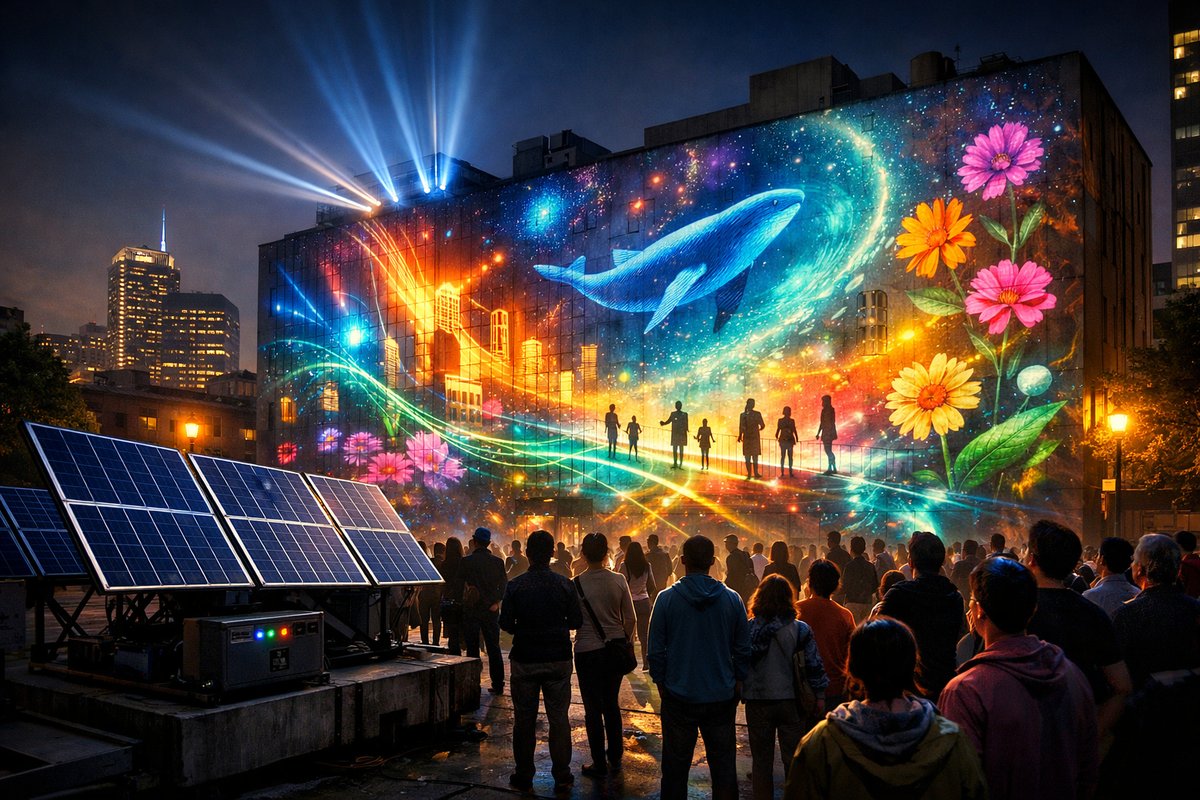

As dusk settles over city rooftops, a hush falls on the streets-only to be replaced by a silent crescendo of light. Across once-dormant building facades, living murals emerge with the last rays of sunset: shifting patterns of organic forms, cascading geometric shapes, and bursts of color that seem to pulse in harmony with passing traffic. These aren’t mere projections-they’re part of a growing movement that uses solar power, motion sensors, and projection mapping to make urban walls breathe and interact with us.
At the heart of this transformation is a commitment to sustainability and community engagement. Traditional projection shows often rely on grid electricity and elaborate cable networks. By contrast, solar-powered systems combine photovoltaic panels, battery storage packs, and energy-efficient LED projectors to free installations from fixed power sources. Panels rest atop rooftops, light poles, or even portable scaffolds, quietly soaking up daytime sun before releasing that energy as dazzling art when night falls.
One recent showcase took place in a once-neglected district of a mid-sized city, where a local arts collective teamed up with a group of environmental engineers. The result was an interactive sequence of projections that responded to ambient temperature and pedestrian movement. As the evening cools, swirling cooler-tone hues deepen; warmer tones bloom when crowds gather in front of the mural. A built-in sensor network measures foot traffic and ambient conditions, feeding real-time data into a custom mapping engine running on a compact single-board computer. The effect feels alive-an artwork that listens and adapts to the rhythm of its neighborhood.
This technological leap builds on the decade-long evolution of projection mapping. Early experiments relied on static content and pre-calculated warping to align imagery with complex architectural forms. Today’s installations go further: some blend generative algorithms that reference weather forecasts to morph cloud-like forms, while others integrate open data streams-air quality measurements, local transit updates, or energy consumption figures-to visualize the hidden flows that pulse through our cities. Projectors themselves have grown more efficient, often boasting ultra-low power consumption and high lumen output, making them ideal for off-grid use.
Beyond hardware, software has become a key enabler. Open-source frameworks allow artists to prototype interactive scenes in hours instead of weeks. Community workshops demystify the process, inviting residents to suggest visual themes, color palettes, or data points they care about. In one workshop, participants mapped local bird migrations across a brick wall, using motion sensors that triggered flocks of luminous silhouettes whenever someone walked by. The final piece highlighted the fragile interdependence of urban wildlife and human activity, stirring conversations about habitat preservation.
These installations also spark conversations about who gets to shape public space. Unlike large-scale murals that require permits and professional teams, pop-up projection shows are nimble and often temporary. They can appear on underutilized surfaces-empty storefronts, abandoned factories, retaining walls-turning forgotten corners into stages for imagination. By keeping projects modular and portable, organizers sidestep bureaucratic hurdles and encourage diverse participation. High school students, neighborhood associations, independent digital artists, and small design studios all share access to the same solar-powered projection kits.
Emission-free projections offer another layer of impact. Urban lighting can consume significant energy and contribute to light pollution. Solar-driven setups, carefully calibrated to avoid excessive glare, reduce overall power draw while delivering striking visual experiences. Batteries charged during the day can sustain multi-hour exhibitions, and some systems even feed surplus energy back into local microgrids. At night, the soft glow of mapped artwork replaces harsh spotlights, fostering a calmer urban ambiance and preserving the natural view of the sky.
Critics might question whether projection mapping should be considered ‘real’ art, given its reliance on technology and impermanence. Yet proponents argue that the medium’s ephemerality is precisely its strength. No single image becomes a permanent fixture, and each performance evolves with the environment-weather, crowd behavior, time of year. When a sudden rainstorm sends droplets cascading over brickwork, the projected forms momentarily distort, creating unplanned moments of beauty. These interactions underscore the collaborative spirit of the work: artists design the framework, technology enables it, and nature and viewers complete the composition.
Educators have also seized on projection mapping’s potential as a hands-on teaching tool. STEM programs in urban schools partner with local art centers to guide students through building simple solar charging arrays, coding basic interactivity, and experimenting with image warping. By merging technical skills with visual storytelling, these initiatives break down barriers between disciplines and show learners how sustainable design can drive creative expression. A student might start by programming a single light-to-color response-step on this patch and a petal blossoms-and eventually scale up to orchestrating an entire facade transformation.
As cities grapple with climate pressures, community fragmentation, and shrinking budgets for public art, solar-powered projection mapping offers a fresh toolkit. Municipal planners are watching closely, considering how flexible, low-impact installations could animate new developments or highlight ecological priorities-like drawing attention to green roofs, stormwater retention basins, or edible urban gardens. Unlike murals that require new paint coats every few years, projectors need only occasional maintenance, making them cost-effective at scale.
One particularly ambitious proposal envisions creating a network of these installations across a waterfront district. Each projection site would highlight a different theme-water conservation, biodiversity, sustainable transport-creating a walking tour powered by free public Wi-Fi. Visitors could download an app that triggers audio narratives as they approach each location, enriching the visual spectacle with local history and environmental education. By layering media and data, the city aims to foster a deeper connection between residents, visitors, and the living systems around them.
While barriers remain-ensuring weather-resilient setups, securing safe mounting for panels and projectors, navigating light-permission regulations-the momentum behind solar projection mapping is undeniable. Artists and technologists are sharing blueprints, sensor designs, coding libraries, and case studies on collaborative forums. A spirit of openness and experimentation drives the field forward, inviting anyone with curiosity and a commitment to sustainability to join in.
In neighborhoods where sunlight once only signaled the end of a workday, buildings now awaken at twilight, their blank walls transformed into canvases of possibility. These installations remind us that art need not be confined to studio walls or expensive galleries. By fusing renewable energy, interactive electronics, and generative design, a new chapter of visual expression is unfolding-one where every passerby becomes a participant, every surface a stage, and every sunset an invitation to wonder.