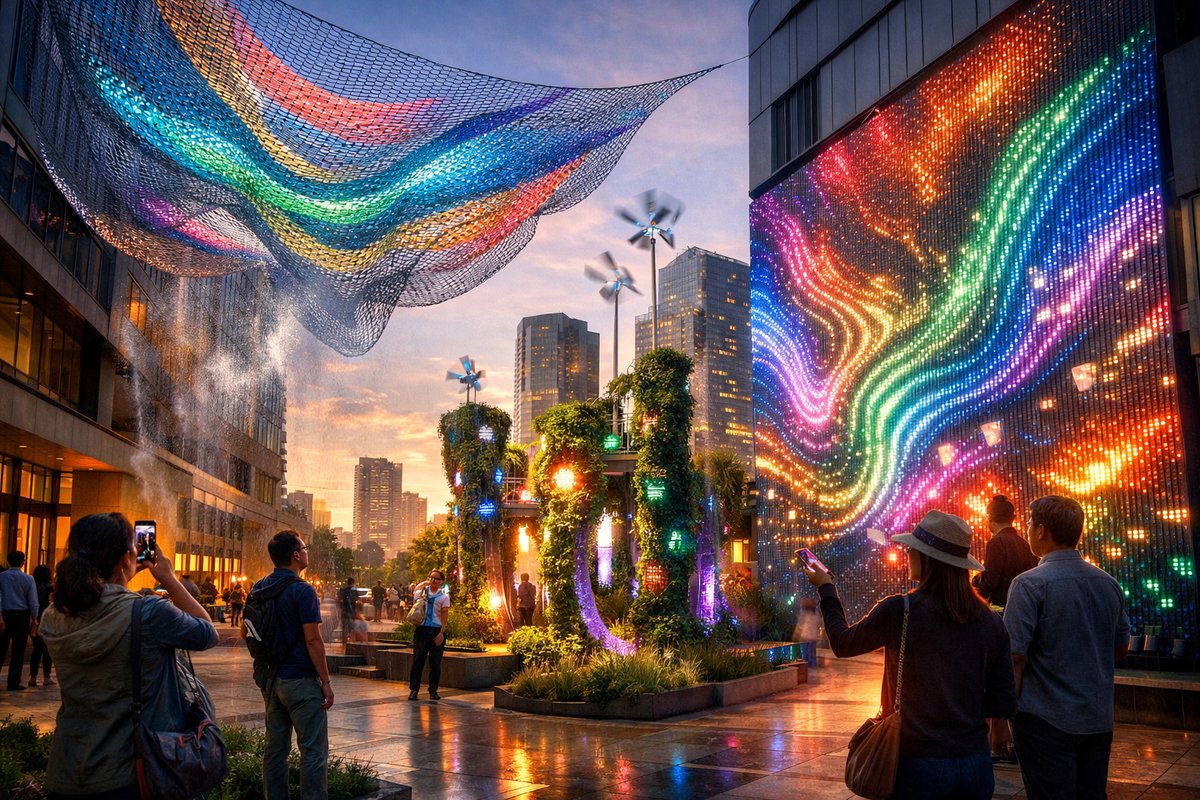

Across international biennials and design festivals, a striking convergence is unfolding: threads that compute, murals that listen, and sculptures that evolve with every passing moment. Far from static displays, these new forms of visual expression harness artificial intelligence, embedded sensors, and eco-responsive materials to create artworks that live and breathe alongside city dwellers. In Lisbon’s Textile Art Biennial, New York’s street-level interventions, Tokyo’s augmented reality trails, and Berlin’s neighborhood light festivals, the line between viewer and creator is fading. The latest projects invite passersby to become collaborators, shaping form and function through everyday interactions.
At the heart of Lisbon’s landmark exhibition are AI-woven fabrics produced by a collective of experimental weavers and code artists. By training neural networks on centuries of textile patterns from around the globe, they generated hybrid designs that blend traditional motifs with abstract data visualizations. Embedded within each tapestry is a network of tiny temperature and humidity sensors. Over the course of the show, the fabrics subtly change color as the gallery environment shifts-murmuring a visual record of human traffic, seasonal breezes, and even the museum café’s steam emissions.
In New York’s arts district, a series of sensor-embedded murals has turned city walls into living canvases. Motion detectors and low-power microcontrollers activate hidden pigment layers when pedestrians pass by. A once-dormant gray facade erupts in waves of color, washing across letters and shapes that morph in real time. Late at night, the walls go quiet again, conserving energy, and stand ready to greet the morning rush. Passersby report feeling an uncanny sense of companionship, as though the city itself is greeting them by name.
Meanwhile, in Tokyo’s historic gardens, augmented reality sculptures bloom through smartphone lenses. Visitors point their devices at blank pedestals, and digital flowers unfurl in 3D space, responding to ambient noise levels and wind speed. Some petals swirl like calligraphy strokes; others ripple in patterns derived from data on local air quality and pollen counts. By overlaying the physical and the virtual, designers invite a dialogue about impermanence, nature, and the hidden rhythms of the metropolis.
Over in Berlin’s Kreuzberg neighborhood, a community-driven light installation has taken shape on a reclaimed factory wall. Residents contributed stories of migration, hope, and resilience, which were transformed into generative light sequences. Solar-powered LEDs shift in hue to match sunrise and sunset, cycling through palettes inspired by the contributors’ memories. The project emphasizes sustainability as much as storytelling: recycled glass beads and plant-based resins coat the surface, offering a tactile warmth beneath the glow.
Underlying these experiments is a shared philosophy: design that listens. Artists and engineers are crafting systems that gather data-temperature, motion, sound, even emotional feedback from voice-activated prompts-and translate it into color, form, and texture. The goal isn’t passive spectacle, but active dialogue. Machine learning algorithms suggest variations; human hands refine them. The result is a loop of reciprocal creativity, where tool and user influence each other in real time.
Material innovation plays an equally vital role. Many of these projects rely on fibers made from recycled plastics or bio-polymers derived from agricultural waste. Pigments are sourced from algae, mushrooms, or mineral byproducts previously destined for landfills. Conductive threads woven alongside cotton strands become subtle data conduits, while plant-based adhesives hold layers together without toxic solvents. The emphasis on closed-loop cycles challenges the notion that high-tech art must come at high environmental cost.
Emotional intelligence emerges as a guiding principle in these works. Designers program their systems not just to collect data but to interpret mood-detecting traffic noise levels as proxies for stress, mapping crowd density to feelings of isolation versus community. Color shifts and kinetic elements respond accordingly, offering moments of calm or bursts of energy. In a world of constant digital bombardment, such installations provide a rare pause for reflection and human connection.
Curators note that audience participation is no longer an afterthought. One gallery director observed that visitors become caretakers of the work: adjusting sensor thresholds, calibrating light patterns, or even swapping out thread spools. This hands-on involvement turns exhibition spaces into living laboratories, where mistakes are celebrated as much as successes. The public’s desire for agency in shaping visual experiences is reshaping how museums and festivals commission and present art.
Technical challenges abound. Balancing algorithmic autonomy with human oversight requires constant iteration. Sensors must endure outdoor elements without sacrificing sensitivity. Data privacy and consent become pressing concerns when installations record sound or proximity. Artists collaborate with privacy experts to anonymize inputs and encrypt sensitive information. The result is a set of best practices that prioritize audience trust as much as creative ambition.
Looking ahead, many creators see modular platforms and open-source toolkits as the next frontier. By sharing code libraries for adaptive textiles or low-power sensor arrays, they hope to democratize interactive art. Workshops in community centers teach local residents to build their own responsive murals or wearable fabrics. This participatory approach extends the life of installations, enabling neighborhoods to customize projects long after festival lights have dimmed.
In studios and hackathons around the globe, designers are exploring satellite data streams, voice-activated sculptures, and even biofeedback-driven projections. Wearable art could soon harvest a wearer’s heartbeat or brainwave patterns to generate evolving patterns on a jacket sleeve. Public parks might boast interactive benches that glow in response to birdsong or foot traffic. Each new experiment deepens the conversation between technology, ecology, and human experience.
Ultimately, this movement reflects a broader yearning for connection-to place, to community, and to the unseen forces that shape our environment. AI-woven threads, murmuring murals, and ephemeral AR blooms invite us to slow down, to listen, and to co-create. In doing so, they offer a renewed vision of art as a living, breathing system-one where every passerby becomes an integral node in an ever-evolving network of form and feeling.
As galleries and public spaces continue to embrace these hybrid visions, the city itself turns into both canvas and collaborator. What emerges is a collective tapestry of light, motion, and story-an urban ecosystem that thinks, feels, and evolves alongside its inhabitants.