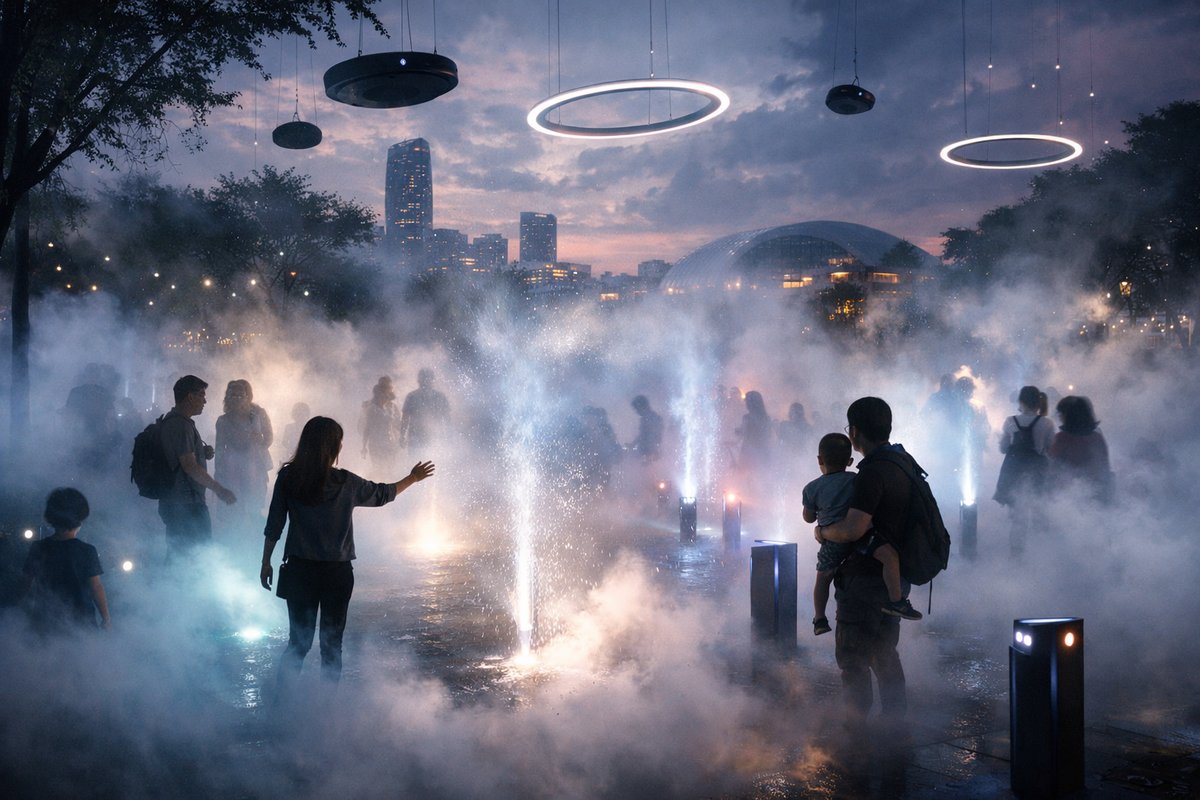

Across city plazas and green spaces from Berlin to Chicago, a subtle revolution in public art is unfolding. Sculptors and technologists are teaming up to turn ordinary park corners into dreamlike landscapes of vapor and light. Unlike traditional monuments cast in bronze or stone, these works dissolve on the wind, constantly reshaping themselves in response to ambient sound and human movement.
At the heart of each installation is a bank of ultrasonic fog nozzles that atomize water into a fine mist, creating walls and clouds of suspended droplets. Speakers hidden in planters capture laughter, passing conversation, and the hum of traffic, translating real-time audio data into patterns of mist emission. When ambient sound exceeds a threshold, the mist pulses in rhythmic waves-whispering sculptures born from the city’s own sonic footprint.
One recent prototype activated in a leafy corner of a Central European park invited visitors to speak or clap and watch as a swirling ring of fog expanded and contracted in time with their voices. Designers say this feedback loop fosters emotional intelligence, reminding city dwellers how their collective energy shapes the shared environment. Families gathered on benches, children chasing ephemeral halos and attempting to “catch” mist rings before they vanished.
LED fixtures nestled among the nozzles add another layer of expression. By modulating color based on sound frequency bands, installations can glow in soothing blues during quiet evenings or blaze with fiery oranges when crowds gather. Code running on compact microcontrollers ties sensors, lights, and fog nozzles together. Open-source libraries make it straightforward for artists to experiment with sound-to-light mappings and mist patterns without deep technical backgrounds.
But the movement is more than a tech spectacle. For many artists, ephemeral fog sculpture raises profound questions about permanence, memory, and the politics of public space. These transient forms resist appropriation. You can’t photograph them once and hang them forever; you must be present, in real time, sharing a fleeting encounter. In a world obsessed with documenting and owning images, mist art gently underscores the beauty of things that vanish.
Environmental considerations also shape design decisions. Early projects consumed thousands of liters of municipal water, drawing criticism during dry summers. Today’s practitioners are incorporating recirculating reservoirs and rainwater harvesting systems to minimize waste. Solar panels power microcontrollers and LED fixtures, while induction pumps cycle water to the fog nozzles with minimal energy draw. Some teams even capture condensate and feed it back into the closed system, creating self-sustaining micro-ecosystems.
Weather remains a fickle collaborator. Gusty winds can disperse mist before it forms coherent shapes, while temperatures below freezing risk icing nozzles. In coastal environments, salt air corrodes metal fittings, demanding specialized materials like marine-grade stainless steel or plastic composites. For pop-up exhibitions, designers often deploy temporary windbreaks and modular covers to stabilize conditions, but many admit the most rewarding moments occur when art truly dances with the elements-clouds of mist skittering across flags and lampposts in unpredictable patterns.
Beyond urban plazas, this approach is inspiring indoor and campus installations. A university atrium hosts a daily performance where students feed live sound data from lecture halls into a towering fog sculpture overhead. The result: a living barometer of campus energy levels, with gusts of vapor sweeping through corridors as lectures crescendo. In art festivals, mist-and-light tunnels have turned abandoned warehouses into spectral passageways, inviting visitors on a journey that blurs the boundary between architecture and algorithm.
Collaborations between sculptors, acousticians, and climate scientists are sparking new research too. By analyzing how mist disperses in different humidity levels, scientists refine urban microclimate models. Designers use these insights to sculpt fog volumes more precisely, forging a feedback loop between art and environmental data. Some propose deploying mist installations as passive cooling systems in heat-prone districts, with sculptural beauty doubling as functional climate adaptation.
Public reaction has been overwhelmingly enthusiastic. Social-media tagging blooms whenever a mist sculpture debuts, but the most poignant responses come from seniors who recall childhood games in morning mists and dew. For them, the installations awaken buried memories, weaving personal narratives into the communal fabric. Planners are taking note, considering mist art as a low-cost catalyst for pedestrian foot traffic and neighborhood cohesion.
Challenges persist. Cost remains a barrier for smaller municipalities; a fully outfitted system of nozzles, sensors, LED arrays, and weather-proof controllers can run into the tens of thousands of dollars. Artists are experimenting with DIY toolkits and community workshops to democratize access. By using off-the-shelf components-microcontroller boards, ultrasonic transducers, battery packs-makers can host hackathons to prototype scale-models in under a week. These grassroots efforts aim to seed countless local iterations, from neighborhood squares to school playgrounds.
As public art directors scout for the next big thing, mist sculptures stand out for their blend of sustainability, interactivity, and poetic resonance. They remind us that art needn’t be heavy or permanent to be profound. Sometimes the most powerful moments are the ones that dissipate, leaving only a chill on your skin and a whispered echo in your mind.
With each new iteration, these installations refine their choreography, harnessing open-source software, renewable energy, and community participation. They chart a course toward urban spaces that breathe, respond, and inspire. In a time when cities can feel rigid and unyielding, mist art offers a gently persuasive counterpoint-proof that public space can be as fluid and alive as the communities it serves.
In the coming years, we may see neighborhoods adopting mist corridors as cooling promenades, cultural festivals commissioning floodlit vapor to honor local traditions, and environmental agencies using fog sculptures to visualize air-quality data. Whatever form the next wave takes, one thing is clear: art that vanishes before your eyes may leave the most enduring impressions.