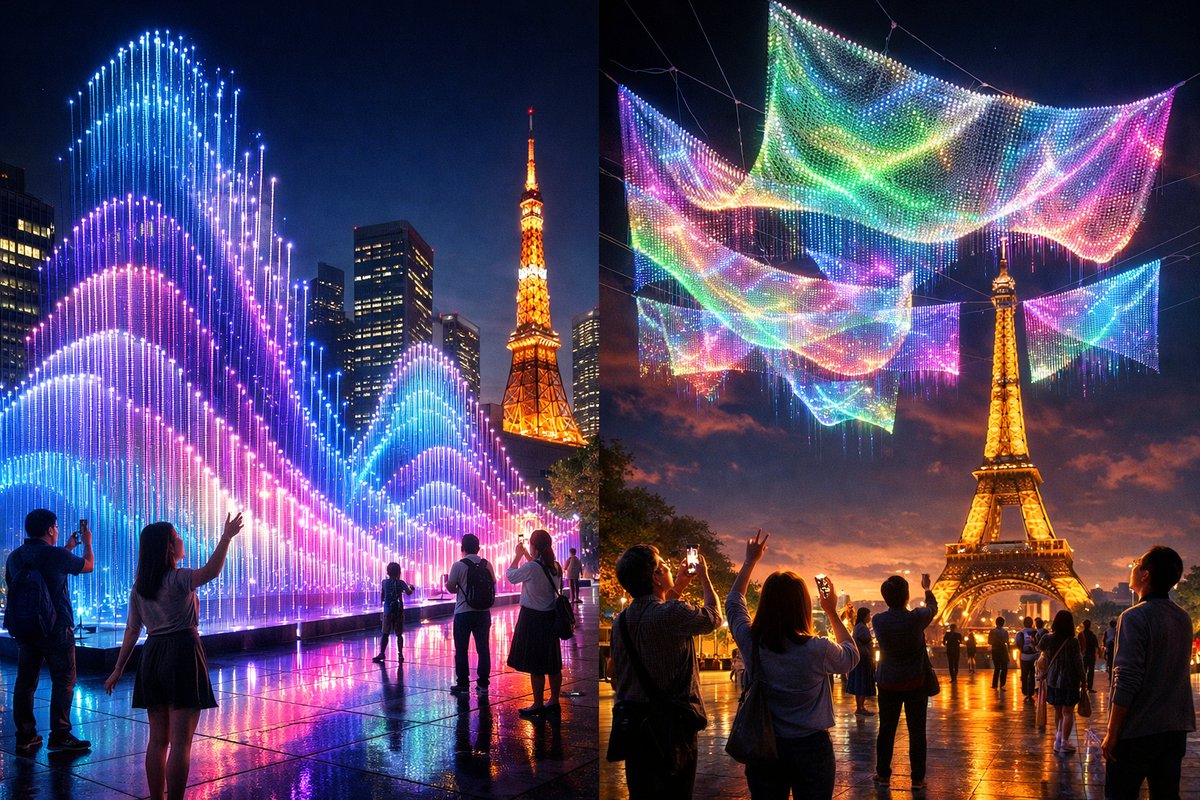

On a crisp spring evening in Tokyo’s reclaimed waterfront district, commuters pause on a bridge to watch hundreds of glowing strands rise and fall like fields of bioluminescent grass. This is the debut of “Aura Tapestry,” an interactive kinetic weave that marries motion sensors with programmable LED fibers. As footsteps and bicycle wheels brush past, the strands dance in ripples of color-emerald greens, electric blues, and sunrise ambers-creating a living canvas that never repeats the same pattern twice.
The installation is the centerpiece of Tokyo Design Week’s nightly program, but its roots reach back to a small workshop on the outskirts of the city. A collective of engineers and designers, known informally as Sōka Collective, spent two years experimenting with flexible light filaments and custom software. Their aim was to craft an artwork that responds not only to human movement but also to ambient noise, weather data, and even air quality readings. When sensors detect a spike in vehicular traffic or a drop in humidity, the weave shifts in texture-sometimes pulsing in tight clusters, other times unfurling like ribbons in the wind.
“We wanted to break away from the static billboard approach to public art,” explains one collective member, gesturing toward a wall of motion-tracking cameras. “Instead of a fixed image or sculpture, we’re offering an ecosystem of light that evolves in real time. Every passerby is both an audience and a participant.”
Meanwhile, across continents in Paris’s Seine riverbank art zone, visitors encounter an even more ethereal spectacle. Floating above the water is “Loom of Echoes,” a series of translucent satellite discs projecting holographic patterns onto drifting mist. Using drones equipped with laser projectors, the installation creates sprawling geometric motifs that mirror terrace lights from the opposite bank. Gentle gusts of wind cause the mist to swirl, distorting the projections into new shapes and leaving viewers in a state of continuous wonder.
Here, the line between sculpture, performance, and digital light show blurs entirely. Small groups gather on stone steps at dusk, recording the shifting tapestries on their phones. Some use bespoke mobile apps to upload ambient recordings-snippets of river water splashes or snatches of conversations-which then translate into new color sequences within the holograms. The result is a multilayered dialogue: human voices, natural elements, and advanced optics in constant dialogue.
Back in New York’s industrial Bushwick neighborhood, a different approach to interactivity is on display at a reclaimed warehouse gallery. “Touch the Light” invites visitors to manipulate giant luminescent forms made of bio-resin and embedded LEDs. When compressed or twisted, internal sensors trigger soundscapes-ambient drones, whispered chimes, and granular rain effects-that emanate from hidden speakers. The audience is encouraged to explore each form tactilely, blurring the barrier between viewer and artwork.
Curators here emphasize sustainability. The resins are plant-based composites that degrade harmlessly under regulated conditions, and the LEDs draw power from on-site solar panels. Even the packaging materials for transport are compostable. In an era when the carbon footprint of large installations can be enormous, “Touch the Light” points toward a future where immersive experiences and environmental responsibility go hand in hand.
What unites these disparate installations is a commitment to interactivity, adaptability, and ecological empathy. In Tokyo, sensors tap into real-time data streams. In Paris, holograms dissolve under natural forces. In New York, physical engagement triggers auditory and visual feedback. Each piece transforms public spaces into living laboratories of perception, inviting individuals to slow down, experiment, and reflect on their relationship with technology and the environment.
Technically, these works rely on a convergence of hardware and software innovations. Custom microcontrollers and embedded systems process inputs from LIDAR units, motion detectors, microphones, and environmental monitors. A layer of generative algorithms then translates raw data into visual or auditory outputs. Machine learning models refine the patterns over days of operation, ensuring that each interaction leads to unexpected forms. And because the systems continuously log performance metrics, designers can iterate remotely, deploying software updates overnight to tune sensitivities or introduce new aesthetic presets.
Some critics argue that such technologically driven art risks feeling cold or overly engineered. Yet proponents counter that this marriage of code and light can deepen the emotional resonance of a public work. Instead of static monuments that commemorate the past, these installations are ephemeral narratives, shaped by those who experience them. The art is never a finished object but an ongoing exchange.
In cities where digital screens already dominate the visual landscape, kinetic public art offers an antidote to passive consumption. It asks for participation. It rewards curiosity. It offers a sense of wonder that can be fleeting but profoundly memorable. On Tokyo’s waterfront, commuters linger late into the night, drawn by the kinetic field’s gentle allure. Teenagers cluster along the Seine, sharing audio clips in a playful experiment of communal storytelling. In a former factory loft in Brooklyn, families push and pull glowing sculptures, discovering that art can be as tactile as it is visual.
Looking ahead, designers are exploring new frontiers. Some are developing biodegradable photochromic filaments that shift colors under sunlight, eliminating the need for power cables. Others are experimenting with wearable light weaves-garments that respond to heart rate and body temperature, turning the human form into a living sculpture. Architects at a recent symposium suggested embedding interactive fiber optics directly into building facades, creating dynamic surfaces that breathe with the communities they serve.
There are logistical challenges, of course. Permits for sensor-laden installations can be complex to secure, as city planners weigh issues of public safety, data privacy, and visual pollution. Maintenance crews must learn electronics repairs in addition to conventional cleaning routines. And funding models are evolving; public-private partnerships and crowdfunding campaigns are becoming essential to support these expensive, high-tech undertakings.
Yet the momentum is undeniable. From Asia to Europe to North America, more municipalities are allocating budgets for experimental public art programs. Universities and technical institutes are collaborating with artists to push the envelope of possibility. Local businesses see potential in sponsoring installations that drive foot traffic, boost tourism, and reinforce a neighborhood’s cultural identity.
Ultimately, these kinetic light weaves signify a turning point in the philosophy of public design. No longer is a work of art a monologue from creator to audience-it’s a continual conversation between environment, technology, and human presence. By embracing interactivity, artists challenge us to reconsider our role in shaping the urban tapestry. We are no longer mere spectators, but active participants in the stories that light can tell.
As early adopters share their recordings online and social media tags proliferate, the installations take on new lives beyond their physical locations. Coders remix data feeds into public APIs. Architects propose permanent versions of these ephemeral pieces. Planners imagine entire districts where buildings pulse with real-time energy usage or air quality, creating living architectures that adapt to the city’s heartbeat.
Whether viewed through the lens of art, design, or urban planning, the rise of kinetic light installations marks a profound shift in how public art can engage, inspire, and unify. From Tokyo’s waterfront to Paris’s riverbanks to Brooklyn’s repurposed factories, a new era is unfolding-one where light not only illuminates, but breathes, dances, and converses with the world around it. And as cities across the globe watch these experiments unfold, they’re beginning to ask: if light can take shape, what else might our public spaces become?
A Kaleidoscope of Tomorrow
In the end, the most enduring legacy of these works may be their invitation to imagine. What if every park path shimmered with responsive filaments? What if murals sang with the voices of passersby? What if our everyday environments were alive, data-driven, and ever-changing? The technology already exists, the creative impetus is strong, and communities are hungry for wonder. All that remains is to bridge the gap between imagination and reality-one glowing thread at a time.