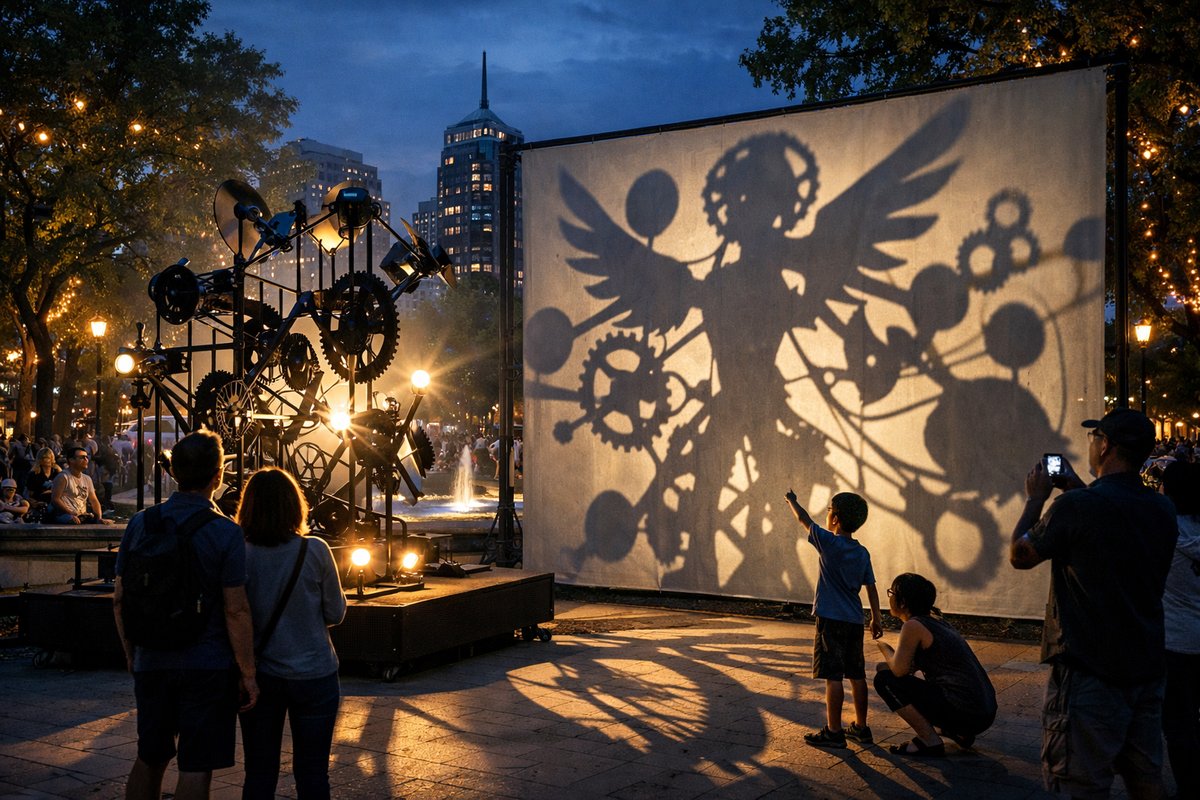

Along winding promenades and open plazas, a subtle revolution in public art is unfolding. Far from static murals or glass-encased galleries, a wave of kinetic shadow sculptures is taking root in urban settings. These installations pair rotating frameworks with precisely aimed lights, projecting evolving shadow forms that respond to both mechanical programming and ambient influences.
One recent highlight unfolded in a downtown park, where an installation dubbed “Shadow Bloom” greeted morning commuters. Comprised of interlocking metal petals mounted on motorized spindles, it slowly unfolds and retracts, its silhouette shifting from delicate floral outlines to abstract geometries. At dusk, concealed LED arrays illuminate the piece from below, sending shadows dancing across the pavement and nearby foliage. Passersby pause to trace each flicker, feeling as though they’re stepping into a living sketchbook.
While the concept of shadow art isn’t new, the marriage of programmable kinetics and compact lighting technology has accelerated its growth. Advances in miniature stepper motors, wireless power solutions, and high-efficiency LEDs let artists deploy self-contained units in remote corners of the city. Solar panels and rechargeable battery packs can now sustain days of operation, reducing reliance on external wiring and grid power.
At a recent outdoor design festival, several artists showcased variations on the theme. One piece featured rotating screens etched with intricate cutouts; as the motor spun, patterns overlapped and receded like spiraling mandalas. Another leveraged motion sensors: each time a viewer passed, hidden shutters snapped open, sending a brief flurry of animated shadows across a blank wall. The element of surprise transformed a familiar back alley into a stage for ephemeral storytelling.
Beyond the technological allure, kinetic shadow sculptures provoke deeper questions about perception and time. Shadows are ephemeral by nature, defined only by the interplay of light and obstruction. Adding slow, methodical motion extends that temporality, offering viewers a chance to witness transformation-an invitation to slow down and observe subtle shifts often lost in the rush of urban life.
Art critics have noted that this genre taps into a universal fascination with light as both medium and metaphor. By recontextualizing shadows-usually relegated to negative space-as the central focus, these works challenge us to reconsider absence as presence. In parks, plazas, and even inside repurposed shipping containers, shadow sculptures carve out new experiential pockets amid concrete and glass.
Material choices in these works often reflect sustainability concerns. Reclaimed steel beams or salvaged sheet metal serve as skeletal supports, while the lighting modules sometimes harvest solar energy for daytime trickle charging. A handful of creators are experimenting with biodegradable plastics for delicate filigree panels, aiming to marry ecological stewardship with artistic expression.
At the edge of a reclaimed industrial site, one installation used discarded bicycle spokes soldered into fractal-like formations. During daylight, those same spokes glinted beneath the sun, teasing a premonition of the shadows to come. After dusk, an integrated projector cast sharp silhouettes onto surrounding walls, transforming rusted facades into a shifting tapestry of lines and curves. The resulting interplay of past and present materials underscored the project’s ethos of renewal.
For municipalities looking to enliven underused spaces, kinetic shadow art offers a compelling model. The minimal infrastructure footprint-often a single power line or a solar panel-coupled with modular assembly makes it easier to pilot installations, gather community feedback, and iterate. In some cases, temporary setups have extended beyond their initial run, prompting councils to commission permanent versions.
Community engagement is another standout feature. Several artists host informal workshops where participants help assemble shadow panels or experiment with light placement. By inviting local residents to co-create, the projects foster a sense of ownership that can endure long after the lights are switched off.
Educational institutions have taken notice as well. Art and engineering students collaborate to prototype miniature kinetic modules, testing different gear ratios and light diffusion techniques. These experiments feed back into public installations, creating a cycle of innovation that bridges academic labs and urban streetscapes.
Critics warn, however, that the novelty could overshadow accessibility concerns. Placing installations in high-traffic tourist zones risks commodifying public art, while remote or underfunded neighborhoods might be left out. A balanced approach calls for equitable distribution-ensuring that kinetic shadow sculptures enrich diverse communities rather than becoming mere photo ops in favored districts.
Looking ahead, some artists envision interactive features that respond to environmental data. Imagine shadow petals that sway faster as wind speeds rise, or silhouettes that shift hue in tune with air quality readings. By embedding sensors for temperature, humidity, or pollution, future works could transform shadow art into a real-time barometer of urban health.
As daylight fades and artificial lights take over cityscapes, kinetic shadow sculptures present a poetic counterpoint to the neon glare. They ask us to look beyond the shine, to find beauty in the contours of absence. More than a passing trend, this movement underscores a broader shift in public art: toward experiences that unfold over time, that invite participation, and that reframe overlooked elements-like shadows-as sources of wonder.
Whether installed along a riverbank or anchored in a subway concourse, kinetic shadow sculptures have already begun to reshape how we interact with our surroundings. By marrying simple mechanics with carefully directed light, artists are crafting installations that pulse with life, inviting us to step into a quiet interplay of form and void. As this language of moving shadows continues to evolve, urban environments will gain new dimensions-spaces where light truly dances with form.