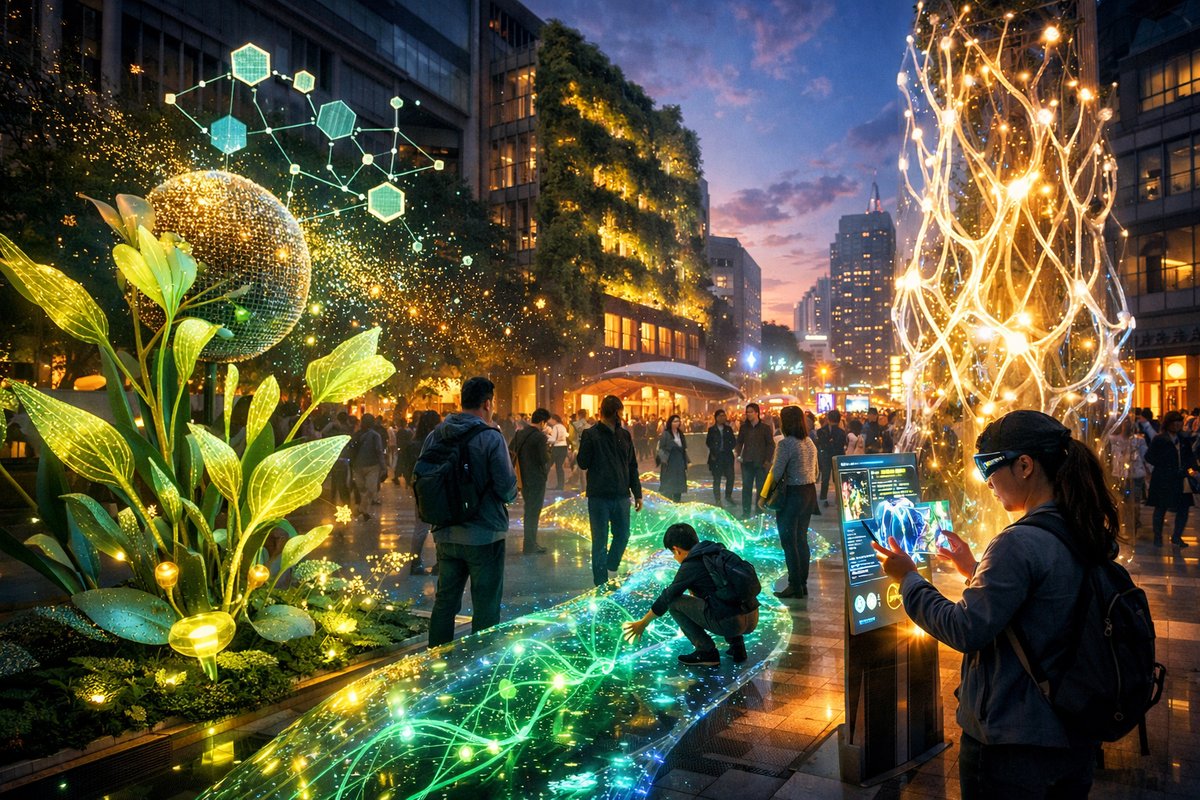

The heart of a city often pulses beneath its pavement, but recently that pulse has been made visible. Passersby through Paris’s winding alleys or Berlin’s grand boulevards are encountering installations that breathe, shimmer and softly hum in response to foot traffic, air quality or the pattern of shifting shadows overhead. This new breed of public artwork blends living materials with responsive electronics and generative software, shifting the boundary between spectator and spectacle.
In a narrow courtyard off the Seine, a cluster of tall, translucent pillars filled with microalgae and nanocellulose fibers glows faintly at dusk. Sensors embedded in the base monitor temperature and humidity, feeding data into an on-board processor. As evening cools the air, the pillars brighten in emerald pulses, mimicking the organisms inside as they photosynthesize. A few blocks away, a spray-painted mural in Berlin’s Kreuzberg district flickers with projection mapping that tracks pedestrians’ trajectories, leaving behind ephemeral trails of color that fade like footprints in the wind.
Both works are part of a growing trend unveiled at last month’s Paris Design Week and Berlin Festival of Lights. Artists, architects and technologists are teaming up to build multi-sensory installations that evolve in real time. Unlike static statues or painted murals, these creations can react to environmental shifts and audience interaction, forging a living dialogue between human and habitat.
Collaborative Creations
Behind each installation stands a core duo: a biologist or materials engineer paired with a digital artist or interaction designer. Take the collective known as Fluid Form Lab, whose recent pavilion in a refurbished industrial park combined bioluminescent bacteria with an open-source control system. “We’re interested in systems that grow, respond and adapt, rather than just sit still,” explains one of the founding members, whose team spent months optimizing a petri-dish mix that glows under near-infrared light.
Their pavilion’s exterior was clad in modular hexagonal tiles filled with living cultures. Visitors could tap a touchscreen kiosk to adjust nutrient flows, changing the colony’s growth patterns and luminosity across the surface. The project required input from microbiologists, electrical engineers, urban planners and UX designers-each discipline shaping the final piece.
Material Alchemy
At the heart of this movement is a fascination with unconventional materials. Bio-inks derived from seaweed extracts, phase-change polymers that shift opacity with temperature, and conductive paints loaded with carbon nanotubes are just a few examples. In London’s Shoreditch district, an installation of floating light orbs uses shellac-based microcapsules. When the air temperature rises above a certain threshold, the capsules release a fine mist of magnesium phosphate, refracting internal LED beams into iridescent halos.
Designers are also exploring living textiles. One fashion collective embedded photosynthetic algae strands into wearable fabrics for a Paris runway event, creating dresses that changed hue under different light spectra. These experiments have trickled into public art, where foldable screens woven from fungal mycelium adjust their shape based on sound amplitude from passing vehicles or conversation.
Software and Sensors
Responsive art relies on more than novel materials-it needs a framework for gathering and interpreting data. Many creators are adopting open-source platforms commonly used in interactive theater and installation art. Lightweight microcontrollers collect sensor readings-from air-quality monitors to accelerometers atop lampposts-and relay them to custom dashboards. Generative code written in environments like Processing or TouchDesigner turns raw inputs into real-time animations and light sequences.
At Milan’s recent Light Nights event, an artist duo connected urban noise meters with an array of robotic mirrors. As honking horns and footsteps rose, the mirrors tilted to scatter beams of colored light across adjacent walls, creating a visual echo of city soundscapes. The underlying script was compact enough to run on battery-powered boards, making it feasible for month-long deployments without external wiring.
Engaging Audiences
A defining feature of these installations is audience participation. By inviting passersby to influence the artwork, creators foster a sense of shared ownership and collective play. In Tokyo’s Roppongi Hills, an “interactive river” comprises a long pool of smart water rippling with ultrasonic actuators. Visitors toss small floating tokens embedded with RFID chips; as tokens enter reading zones, corresponding LED strips ripple outward, mapping individual gestures onto a synchronized light choreography.
In Portland’s Pearl District, a series of responsive benches are outfitted with capacitive touch sensors and wireless speakers. Sitting triggers Bluetooth beacons that cue local musicians’ improvisations, transforming quiet rest areas into impromptu jam sessions. Projects like these reframe public infrastructure as platforms for creative expression rather than mere functionality.
Urban Implications
While these installations delight, they also invite deeper reflection on cities’ ecological and social fabrics. By making invisible data visible-pollutant levels, noise intensity or foot-traffic density-public art can surface hidden patterns and spark conversation about urban health. One sculptural gateway in Copenhagen channels real-time bike-traffic statistics into a pulsing arch of neon tubes, prompting commuters to ponder the environmental impact of daily choices.
Cities themselves become co-authors in these works. Municipal authorities are increasingly enthusiastic, allocating public spaces and utility connections in recognition that dynamic art drives cultural tourism and civic pride. Some pilot programs even involve local schools and community centers, granting residents access to workshops where they can tweak sensor thresholds or remix generative algorithms before installations go live.
Ethical and Practical Challenges
Creating living, interactive art raises questions around sustainability and maintenance. Living materials require nutrients and stable climates; electronics need power and occasional firmware updates. Curators are experimenting with solar-powered microgrids and biodegradable components to reduce environmental footprints. Maintenance teams often receive training in microbiology basics or code debugging, ensuring that artworks stay healthy and bug-free throughout their run.
Privacy is another concern. Cameras and microphones embedded in public installations can inadvertently capture sensitive information. To address this, many artists funnel raw data through on-device filters that extract only aggregate metrics-volume levels, crowd counts-before discarding underlying audio or video. Transparency reports detailing sensor types, data retention policies and user rights are becoming standard accompaniments to major projects.
Looking Ahead
As living, interactive installations proliferate, designers are pushing boundaries toward fully self-sustaining ecosystems. Early prototypes explore closed-loop nutrient cycles, where waste from one organism feeds another component of the sculpture. Others envision wearable extension kits that allow individuals to carry micro-habitats on bicycles or backpacks, turning entire neighborhoods into roaming galleries.
In parallel, advances in low-power electronics and flexible photovoltaics promise longer deployments with minimal human intervention. Imagine a sculptural grove of solar leaves that self-adjust orientation by sensing local light intensity, or an ambient sound installation powered by piezoelectric strips under cobblestones capturing footsteps as energy.
Ultimately, this movement reframes both art and design as living, evolving processes rather than static products. When art breathes, it invites each person to become a curator, collaborator and caretaker. In a world grappling with climate change, urbanization and social fragmentation, these installations offer a vision of creativity that is responsive, regenerative and profoundly human.
A New Canvas Emerges
Cities have long served as canvases for graffiti, murals and public sculpture. Now, they are transforming into dynamic ecosystems where light, biology and code merge. The next time you stroll down a leafy avenue or pause at a transit stop, watch for a subtle glow pulsing in time with your footsteps, or listen for a gentle hum that responds to the wind. Behind these moments lies a growing community of practitioners who see design as dialogue and art as living architecture.
In this age of rapid technological and ecological change, the boundary between spectator and creator grows increasingly thin. As installations sprout across plazas and parks, they beckon each of us to shape the world around us-one responsive tile, one living light strand at a time.