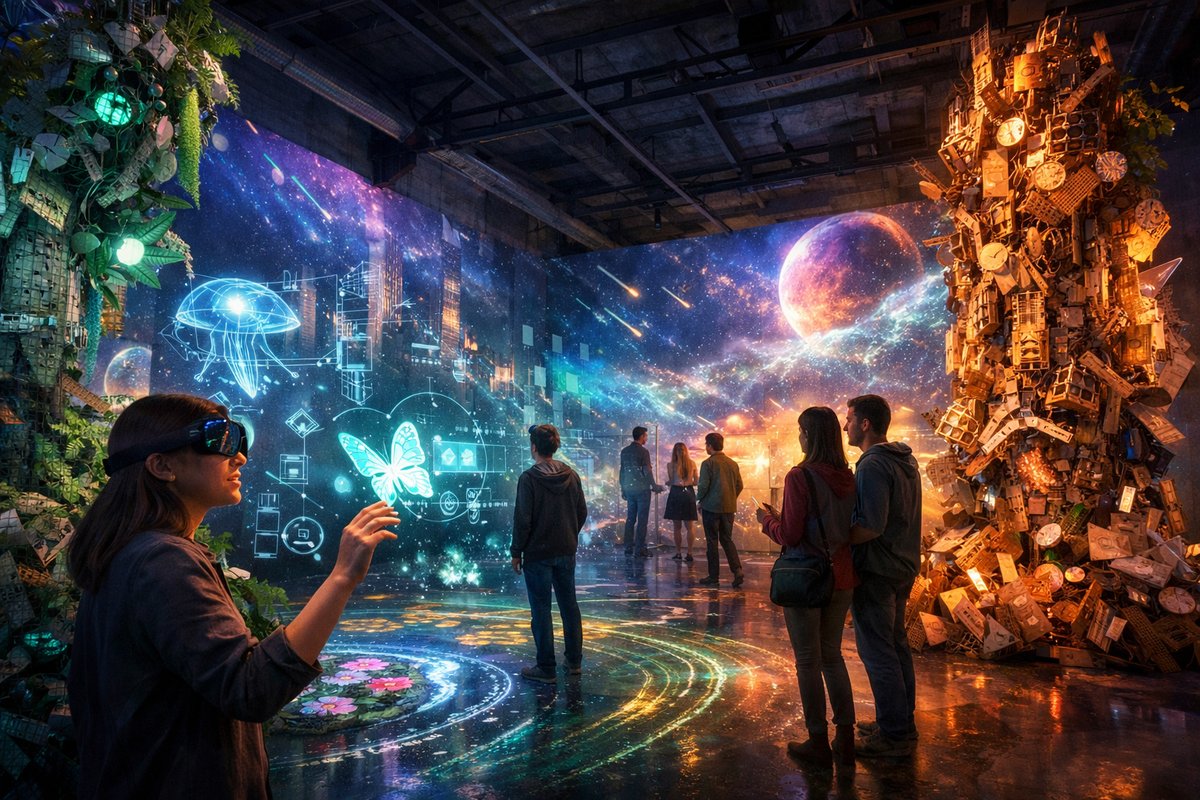

A former industrial loft in the city’s creative district has been transformed into a sprawling digital playground, where code meets canvas and visitors step into living installations. This news article explores the debut of “Living Frames,” an immersive exhibition that marries high-resolution projections, interactive sensors, and material sculptures crafted from reclaimed plastics and paper waste. Its goal: to spark fresh conversations about the evolving roles of form, function, and philosophy in contemporary art and design.
The heart of the exhibition is an array of wall-sized digital canvases, where abstract visuals ripple and flow in response to ambient sound and motion. Each surface is powered by a network of projection modules mounted overhead, seamlessly tiled to create uninterrupted imagery. As visitors approach, infrared sensors detect their movement and trigger subtle shifts in color palettes, pattern complexity, and visual rhythms. The effect is akin to standing inside a living painting, where one’s own presence becomes an integral brushstroke in a larger composition.
Augmented reality takes this interactivity a step further. Visitors can download a custom AR app on their smartphones or use gallery-installed AR headsets to summon virtual sculptures that hover mid-air. These digital forms range from crystalline shapes that refract the room’s light to organic, vine-like patterns that coil around physical pillars. Tapping on a tablet prompts the environment to respond, transforming the color of the floor projection or altering the soundtrack to blend ambient drones with melodic chimes. This convergence of physical and virtual realities invites a multilayered sensory dialogue: one that asks how art might evolve when the boundary between creator, object, and spectator grows porous.
Sustainability is woven throughout the show both conceptually and materially. The exhibition space features freestanding sculptures made from recycled plastic bottles, shredded paper pulp, and repurposed metal fixtures. In one installation, translucent panels crafted from compressed plastic waste glow from within, backlit by programmable LED strips that pulse in tune with an algorithmic soundscape. Artist statements displayed nearby emphasize the ecological narratives behind each piece, encouraging visitors to consider how design decisions and consumption patterns shape the world’s environmental future.
At the intersection of these digital and physical explorations lies an experimental 3D printing studio. A small corner of the gallery is reserved for live demonstrations, where visitors can choose simple geometric forms or organic motifs on a touchscreen interface. Immediately, a desktop 3D printer begins stacking recycled filament layer by layer, eventually yielding a small prototype that can be taken home. This activity not only demystifies the manufacturing process but also connects creative exploration with hands-on making. By the end of a visit, many attendees carry out their own micro-sculptures-tactile souvenirs that bridge the virtual designs they encountered on screen with tangible, three-dimensional artifacts.
Philosophically, “Living Frames” pushes audiences to reconsider the nature of artistic authorship. When interactive algorithms dictate how imagery shifts or when visitor movements influence sonic textures, the role of the solitary genius artist gives way to a collaborative ecosystem. Code becomes a co-creator, sensors serve as mediators, and every passerby contributes to the unfolding narrative. This shift challenges entrenched ideas about passive spectatorship. Instead, individuals become active participants in the ongoing composition, blurring the line between observer and performer.
A senior curator, reflecting on the project, explains that the goal was never simply to dazzle with technology, but to provoke curiosity about how digital tools can amplify human expression. “We wanted to spark a dialogue about responsibility-how algorithms curate our feeds, how they shape perception, and how interactive art redefines the museum experience,” she says. These remarks underline a critical tension that runs through the exhibition: the need to balance wonder and critical awareness in an age where screens and sensors mediate so much of daily life.
Feedback from early visitors has been enthusiastic. One design student noted that watching colors morph in sync with her heartbeat sensor felt like an intimate collaboration with unseen algorithms. Another attendee, a lifelong art devotee, admitted initial skepticism about technology-driven works but left with a newfound appreciation for digital craftsmanship. The exhibition also draws families curious to see how younger generations-often jaded by endless smartphone screens-react to art that demands both physical presence and digital engagement.
As the art world grapples with post-pandemic realities and the accelerating pace of technological innovation, exhibitions like “Living Frames” signal a turning point. Galleries and museums are experimenting with modular, pop-up formats that can travel between cities, embedding projection hardware and interactive kits into adaptable crates. Community-based workshops are sprouting alongside shows, teaching participants how to code simple visual scripts or solder LED panels into DIY light sculptures. This grassroots energy hints at a future where local makerspaces and established institutions collaborate to democratize access to high-tech art tools.
Yet challenges remain. Technical hurdles-software bugs, calibration drift, and network latency-can interrupt the immersive flow and remind audiences of the machine beneath the magic. Curators and technicians must work side by side to maintain stability without compromising creative spontaneity. Moreover, questions of long-term sustainability linger: how to power projection systems with minimal energy, how to repurpose or recycle aging electronic components, and how to ensure that interactive artworks survive beyond single exhibition runs.
Despite these obstacles, the momentum behind immersive digital art spaces shows no sign of slowing. Artists are already experimenting with machine-learning models that learn from audience behavior over months, evolving gallery environments in subtle, personalized ways. Others are weaving virtual-reality pods into shows, enabling fully immersive soundscapes and stereoscopic storytelling. Even as hardware costs continue to drop, the real currency remains curiosity-the willingness to step off a comfortable path and engage with art that unfolds in surprising, algorithmic ways.
In the end, “Living Frames” is more than a showcase of projection mapping or augmented overlays. It is a living laboratory where the future of visual expression is being prototyped in real time. For visitors who wander through its luminous galleries, the experience leaves an imprint: a renewed sense that art can be as dynamic and unpredictable as the world it seeks to reflect. Coming generations of creators will look back on these early forays into interactive design as the foundation for forms of expression we have not yet imagined. Here, in a repurposed industrial loft, the boundaries between code and canvas dissolve-and a new chapter in the story of art and design begins.
-
Graphics Drawing Tablet
Explore creative graphics drawing tablets for artists and designers. Find vintage Koala Pads and DigiPros, alongside modern Vtuber assets. -
Light Up Letter Board
This acrylic dry-erase drawing tablet features 8 vibrant color modes and 6 dynamic lighting effects, making it perfect for sketching, tracing, note-taking, and ...